
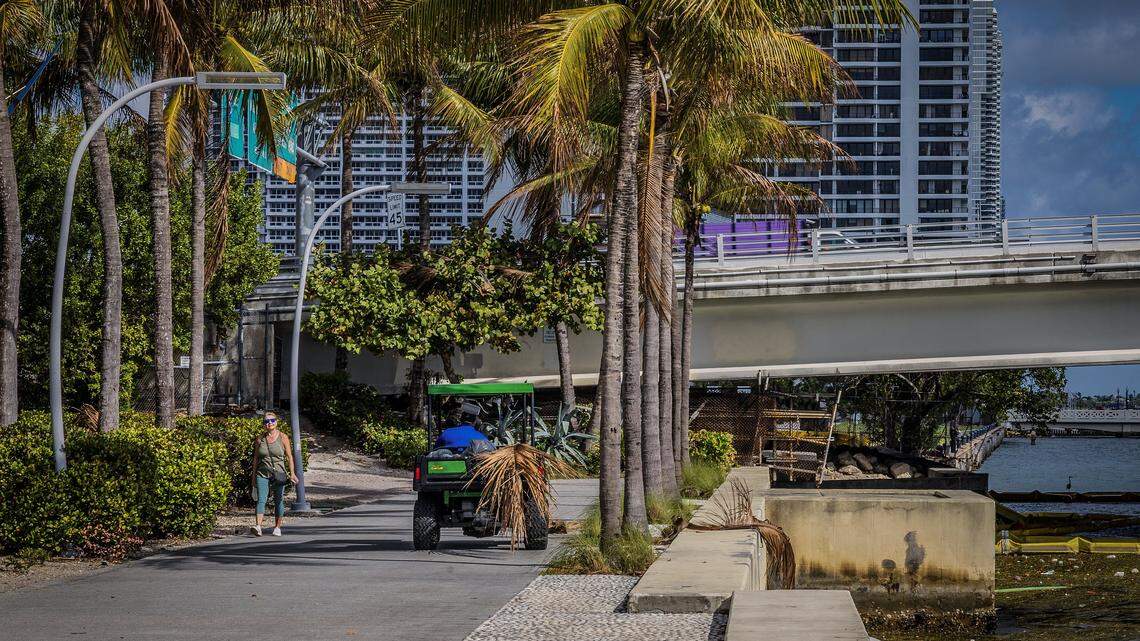
View of Miami’s longest continuous waterfront baywalk in the Maurice A. Ferré Park that ends at the South side of I-395 Bridge, the future location of the planned I-395 Baywalk Pedestrian and Bikeway extension under the Bridge that will connect the Baywalk with the old Herald site on the North side, on Thursday, March 12, 2026.
Pedro Portal
pportal@miamiherald.com
The vision for walkability and waterfront access in the city of Miami’s urban core has been almost 50 years in the making. Miamians shouldn’t have had to wait so long, but a major missing piece of Miami’s Baywalk is slowly coming to fruition in downtown.
For a project that’s been filled with setbacks, that’s a significant step.
The City Commission last Thursday approved the design and funding grant applications for the first phase of the pedestrian bridge linking the Baywalk at the Perez Art Museum of Miami (PAMM) and Maurice A. Ferre Park to the former Miami Herald building site. The over-the-water bridge is designed to go underneath the MacArthur Causeway.
The I-395 Baywalk Pedestrian and Bikeway Bridge is expected to solve a major choke point for users of the Baywalk, the pedestrian and bike path that connects Brickell, downtown and Edgewater along Biscayne Bay.
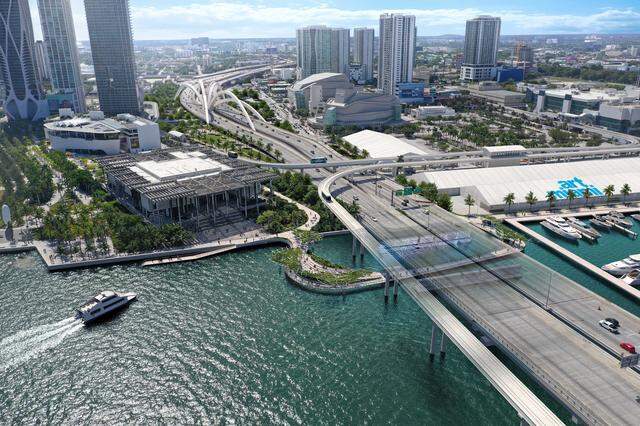 A rendering of the proposed I-395 Baywalk Pedestrian & Bikeway Bridge. The project will connect the downtown Baywalk, a pedestrian and bike promenade, from the Perez Art Museum of Miami, under the MacArthur Causeway, to the old Miami Herald building site. INFORM Studio
In 1979, Miami voters passed a charter amendment that requires new buildings to be set back from the water’s edge and provide public access to Biscayne Bay and the Miami River, where the Riverwalk is located.
But the implementation of this vision has been haphazard over the decades because there were minimal design standards for these pedestrian and bike promenades. In 2021, the Herald described the Baywalk as “a hodgepodge of disconnected pathways.” That same year, the Miami City Commission approved new design guidelines meant to make the path more uniform and hasten its completion.
Today, the Baywalk sections in downtown and Brickell are mostly completed, with some notable exceptions, but it becomes piecemeal once you reach Edgewater, where buildings that predate 1979 don’t have to abide by the charter amendment.
You can technically walk or bike from the southern end of Brickell, loop around Brickell Key, then cross the Brickell Avenue Bridge toward downtown and eventually reach the Perez Art Museum next to the MacArthur Causeway — and start again on the other side.
But there are major gaps.
To go from the PAMM to the north side of the causeway, you must take a dangerous, 20-minute detour. It requires going around the museum, then past the Interstate 395 off ramp and under the expressway’s overpass — where pedestrian sections have been disrupted by the Signature Bridge construction.
“People going north are taking their life into their own hands,” Neal Schafers, head of urban planning at the Miami Downtown Development Authority, told the Herald Editorial Board.
The planned 600-foot-long pedestrian bridge under the causeway is expected to address that problem, and it will have seating space for events, concerts and rotating art exhibits, Schafers said.
Once it is finished in an estimated three to four years, the bridge will make a huge difference. But that’s not the only unfinished portion of the Baywalk.
There’s the 300-foot-long section at the future 54-story headquarters of hedge fund Citadel on Brickell Bay Drive, where a waterfront pedestrian path will eventually be required. The gates at the Four Ambassadors building marina at the foot of the Brickell Key bridge are closed sometimes, blocking Baywalk access, Schafers said.
On the north side of the MacArthur Causeway, the 830-foot Baywalk section at the former Herald site is also missing. The land was once supposed to become a casino resort, but it currently sits vacant. Only when it is developed will the 1979 requirement kick in.
Going farther north, the Baywalk starts again at the Venetian Marina and Yacht Club, the Miami Women’s Club and Margaret Pace Park before dwindling down in Edgewater, Schafers said.
Now imagine what Miami could look like if the entire city were accessible by foot or bicycle — with waterfront views and activities that aren’t only available to people who work or live on Biscayne Bay or the Miami River.
That’s what voters chose in 1979, and we are getting closer to that goal. Miami-Dade County has also been building the Underline, the linear park under the elevated Metrorail tracks that will eventually connect Brickell to Dadeland.
We cannot forget the promised Underdeck, the Miami park planned below I-395, which is being elevated as part of the Signature Bridge project. Last year, with the passage of the Big Beautiful Bill, the city lost $60 million the Biden administration had earmarked for the project, putting it at risk.
Each of these projects should put us closer to a Miami that isn’t as car dependent, that fits its growing reputation as a forward-looking city. We just hope we don’t have to wait another 50 years.
BEHIND THE STORY MORE What’s an editorial?
Editorials are opinion pieces that reflect the views of the Miami Herald Editorial Board, a group of opinion journalists that operates separately from the Miami Herald newsroom. Miami Herald Editorial Board members are: opinion editor Amy Driscoll and editorial writers Isadora Rangel and Mary Anna Mancuso. Read more by clicking the arrow in the upper right.
What’s the difference between an op-ed and a column?
Op-Eds, short for “opposite the editorial page,” are opinion pieces written by contributors who are not affiliated with our Editorial Board.
Columns are recurring opinion pieces that represent the views of staff columnists that regularly appear on the op-ed page.
How does the Miami Herald Editorial Board decide what to write about?
The Editorial Board, made up of experienced opinion journalists, primarily addresses local and state issues that affect South Florida residents. Each board member has an area of focus, such as education, COVID or local government policy. Board members meet daily and bring up an array of topics for discussion. Once a topic is fully discussed, board members will further report the issue, interviewing stakeholders and others involved and affected, so that the board can present the most informed opinion possible. We strive to provide our community with thought leadership that advocates for policies and priorities that strengthen our communities. Our editorials promote social justice, fairness in economic, educational and social opportunities and an end to systemic racism and inequality. The Editorial Board is separate from the reporters and editors of the Miami Herald newsroom.
How can I contribute to the Miami Herald Opinion section?
The Editorial Board accepts op-ed submissions of 650-700 words from community members who want to argue a specific viewpoint or idea that is relevant to our area. You can email an op-ed submission to oped@miamiherald.com. We also accept 150-word letters to the editor from readers who want to offer their points of view on current issues. For more information on how to submit a letter, go here.