
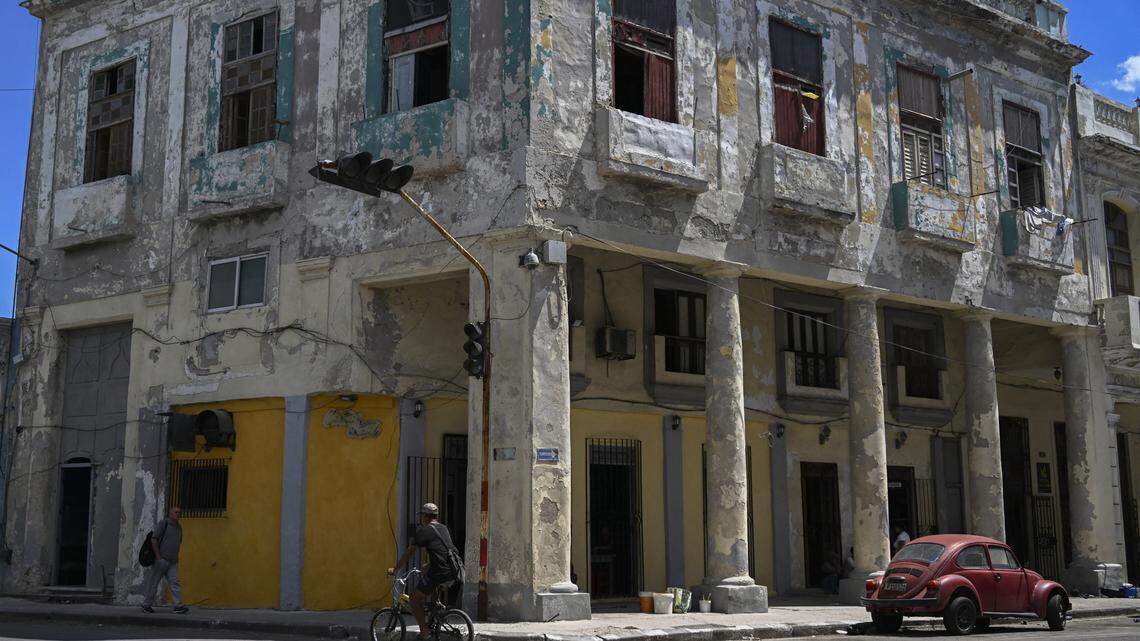

View of a corner of Havana during a blackout on March 16, 2026. Cuba suffered a widespread power cut against the backdrop of a severe crisis on the island.
YAMIL LAGE
AFP via Getty Images
The banging of pots and pans echoing through Cuba is the sound of a dictatorship cracking.
That sound marks a breaking point, and what comes next matters. America has a historic opportunity to finally usher Cuba back to freedom, but we must hold firm to the principle that there can be no peace without justice.
For the first time in decades, Havana is being forced to stand on its own, and it is failing. The regime has lost its lifeline. Fuel has not reached the island in months, the lights are going out and the system is collapsing in real time.
This moment did not happen by accident. It is the result of sustained pressure, led by President Trump, that exposed the regime’s fragility. No president in recent memory has confronted it with greater strength. If anyone can force real change, it is him.
As the representative of the heart of the Cuban exile community in the United States, I feel both the hope and the urgency of what lies ahead. But even now, we cannot lose our moral compass or repeat the mistakes of the past.
We must be guided by clear principles to deliver freedom and justice.
First, you cannot negotiate with the Castros. History has shown that the dictatorship never negotiates in good faith. It uses “dialogue” as a tactic, not as a path to change. They talk when they are weak, release a handful of prisoners for headlines and then tighten repression once the pressure eases. We cannot legitimize a dictatorship that has no intention of changing.
Second, we must not fall into the trap of the Chinese model of economic openings without political freedom. If power stays with the regime, that is not reform, it is control with a different face. We cannot allow the regime to use investment from Cubans abroad or cosmetic reforms as a lifeline, while continuing to surveil, silence and persecute its people.
Third, we must follow the conditions enshrined in U.S. law for normalization. Justice is not optional. We are not calling for revenge, but we will not accept erasure. The Cuban people deserve justice and the dismantling of the repressive apparatus that has crushed generations.
It’s not me saying it, it’s established clearly under U.S. law. The Helms-Burton Act lays out the conditions required for any normalization: the immediate release of all political prisoners, freedom of expression and a free press, and free, multiparty elections where the Cuban people, not the Communist Party, decide their future.
Today, those conditions remain wholly unmet. The regime claims it will release 51 political prisoners, yet only a fraction has been freed, while more than a thousand remain in jail. Meanwhile, repression continues, and many dissidents cannot even leave their homes.
For me, this is not abstract.
I know the story of Cuba because it is my story. It begins with my abuela, Elvira, and extends to my family, to the families I represent, and to millions of Cubans who lost a country but never lost their belief that it would one day be free.
I have seen it up close, years reporting in Miami, delivering the news to families like mine: political prisoners locked away for speaking out, men executed and opponents assassinated by the regime, balseros swallowed by the sea, the murder of Brothers to the Rescue, the men and women of July 11th who dared to demand freedom and were beaten, arrested and silenced. For decades, the Cuban regime embedded a lie in the minds of its people: that its invincibility was absolute, that resistance was useless, that change was impossible. That illusion became its most powerful weapon.
Today, that lie is collapsing, and with it, the fear that kept a nation silent.
We do not know exactly how this moment will unfold. But we know how it must end, with a real transition to democracy and a free Cuba.
U.S,. Rep. María Elvira Salazar, a Miami Republican, represents Florida’s 27th Congressional District. She is running for reelection.