
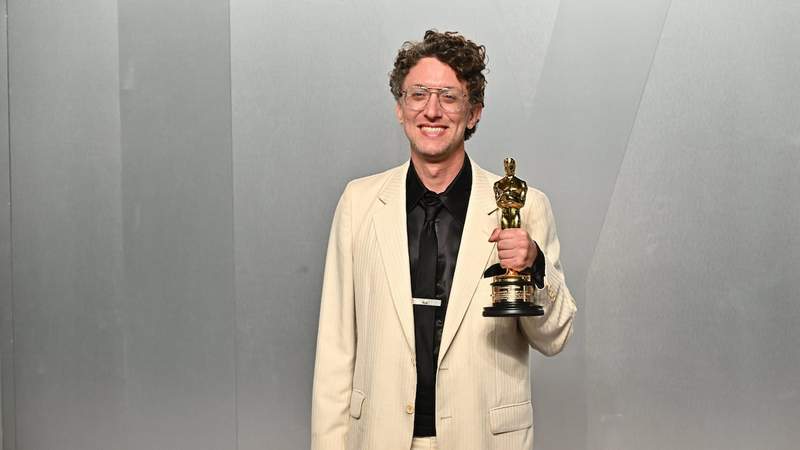
“I’m Florida through and through.”
The love that new Oscar winner David Borenstein, 38, has for his home state is palpable.
He delivered the most political speech of the night March 15 when accepting the Academy Award for best documentary feature for his film “Mr. Nobody Against Putin.”The movie, which is set in Russia, is in part about “how you lose your country,”Borenstein said Sunday, adding that “you lose it through small, little acts of complicity.” And he even referenced the deaths of Renee Good and Alex Pretti earlier this year. He believes “Mr. Nobody Against Putin” serves as a warning for the United States.
But over a Zoom interview conducted three days after the ceremony, it’s clear that when he’s thinking of America as a whole, he’s seeing the country through the lens of Florida.
“Florida is my home in America, and so it inspired the film,” he said.
The documentary might not immediately seem linked to the Sunshine State, but Borenstein insists the connections are there.
“Mr. Nobody Against Putin” is a documentary account of two years in the life of a teacher in a primary school in the rural Russian town of Karabash. That teacher, Pavel “Pasha” Talankin, shot much of the footage, which Borenstein then edited into a compelling narrative about the increasing intrusion of the Russian government into the students’ lives.
A government-mandated curriculum swept through the school following Russia’s invasion of Ukraine in February 2022: forced military drills, gun demonstrations, propaganda lessons about “denazifying” Ukraine, and a color-guard procession to start each day.
It’s orders of magnitude more extreme there, but, to the filmmaker, these accounts rhymed with what he’d heard about government-led curriculum changes in Florida.
“I have a lot of friends who work in education in Florida,” said Borenstein, who grew up in Parkland and graduated from Marjorie Stoneman Douglas High School. “I was definitely thinking about them with this film. I wanted to make sure that this wasn’t just a film about Russia, but spoke to democracies backsliding into illiberalism, and the kind of rising authoritarianism that people all over the world are feeling to various degrees.”
“And what I drew from in order to do that was definitely my experience in Florida and my experience talking with teachers and understanding what was happening under (Florida Gov. Ron)DeSantis.”
Borenstein, a class of 2009 University of Florida grad, left the state but moved back to Gainesville in 2019 to spend time with his elderly father. Over the next few years, he witnessed the changes to Florida schools enacted under the DeSantis administration.
In “Mr. Nobody Against Putin,” it seems like the Karabash school transforms overnight, with the teachers even being asked to video-record their new government-approved lessons and submit them to a mysterious website for oversight approval.
That, he said, particularly reminded him of the DeSantis administration’s conservative makeover of New College of Florida, which was happening concurrently with the events in the documentary.
“The radical transformation of New College in just a year or two, I mean it’s stunning,” Borenstein said. In 2023, the DeSantis administration, invoking liberal bias at the Sarasota college, transformed its board and leadership with the addition of conservative activists. The new board fired New College’s president and several librarians, and removed its gender studies curriculum. Within six months, a third of the faculty had left.
“Is it any less quick than what happened at Pasha’s school?”
Russia and “Mr. Nobody Against Putin” was not Borenstein’s first brush with authoritarianism. Having studied Chinese at UF, he earned a Fulbright scholarship in 2009 to study in China, then lived there for 10 years.
As a foreigner who could speak fluent Mandarin, Chinese media wanted to have him on TV frequently, usually to talk about entertainment topics.
Some of his China-related work ruffled feathers, such as a documentary he produced called “Race for the Vaccine,” which was less than flattering to the communist regime. He used a connection to get unprecedented access to China’s version of the Centers for Disease Control and Prevention as it was developing the nation’s COVID-19 vaccine.
“A lot of the stuff I did in China made it harder for me to work in China again,” he said.
But China was where he first learned about the mechanisms of propaganda, and he’s been spotting those mechanisms everywhere since. He also learned how to find storytelling partners to work with him from a long distance.
For “Mr. Nobody Against Putin,” Borenstein put out a call for teachers in Russia who wanted to report on conditions there for a film. Once he settled on Talankin, they spent two years talking over encrypted phone lines.
Borenstein would get spooked when he’d hear reports of other Russian teachers sentenced to decades in prison for “subversive acts” (likemildly criticizing the government) that he knew Talankin was alsodoing.
In one notable moment in the documentary, Talankin replaces a recording of the Russian national anthem that rings out at school each morning with “The Star Spangled Banner” as sung by Lady Gaga, which he thought was the most subversive recording of it he could blare from the school speakers.
Because Talankin ended up shooting so much of “Mr. Nobody Against Putin” himself, he’s credited as director alongside Borenstein, and they both collected Oscar statuettes at the Academy Awards.
Borenstein now lives in Copenhagen following his father’s death, but his mother still lives in Parkland, and he’s eager to bring his message to Florida. By March 27, his documentary will have played in four cinemas around the state, though no Tampa Bay dates are yet set. It’s available to stream now on Kino Film Collection.
When he and Talankin have participated in post-screening Q&As elsewhere in the country, Borenstein’s been moved by how American teachers respond to it, as book bannings and curriculum restrictions aren’t an exclusively Floridian issue.
“Pasha actually says this a lot whenever we’re at screenings, that Russian propaganda works by making you feel alone, by making you feel like your struggles are not shared by other people,” Borenstein said. “In fact, during the time that Pasha was filming this film, almost 200,000 Russian teachers quit rather than go along with what was happening. Then we went around and started showing it in America, and we had American teachers say that in watching ‘Mr. Nobody Against Putin’ they realized there are other people who share these struggles too.”