
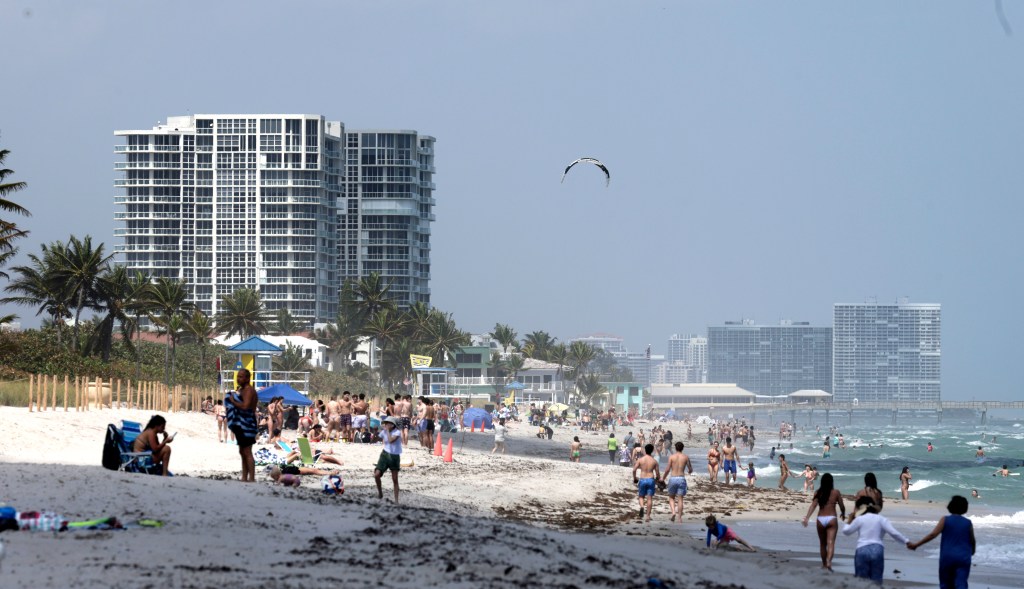
A move to allow boats slightly closer to shore is spurring debate in the city of Hollywood.
Aiming to boost safety, city commissioners are currently moving to amend Hollywood’s code of ordinances to allow a vessel exclusion zone starting at 218 yards from city beach shorelines, a move inward from the current 300-yard boat line.
New plans also would include installing buoys along the vessel exclusion zone and at the beach’s 1000 Mermaids Artificial Reefs, which attract visitors with their proximity to the shoreline and mermaid-shaped structures. The existing 300-yard line lacks buoy markers entirely.
Supporters and critics of the adjustment disagree about how it would affect the safety of snorkelers, swimmers and boaters. While supporters in city government say that marking the line at 218 yards will more clearly designate safety zones, opponents argue that the change could create a “boat traffic lane” that will overlap with people doing water activities.
“I don’t see how moving boats closer to swimmers will make them safer. I think if they really want to separate boaters from swimmers, you want to separate them from where the swimmers are most frequently going,” said Heather Schueler, a Hollywood resident who regularly snorkels at the beach. “What we’re talking about here is an extra layer of protection for the vulnerable snorkelers and shore divers.”
Hollywood beach’s nearshore Mermaid Reefs are located at about 160 and 185 yards from shore.
Hollywood communications director Joann Hussey said moving the vessel exclusion boundary closer to the artificial reefs — and marking it with buoys — will discourage swimmers and snorkelers from getting too close to boats visiting the reefs farther out from shore.
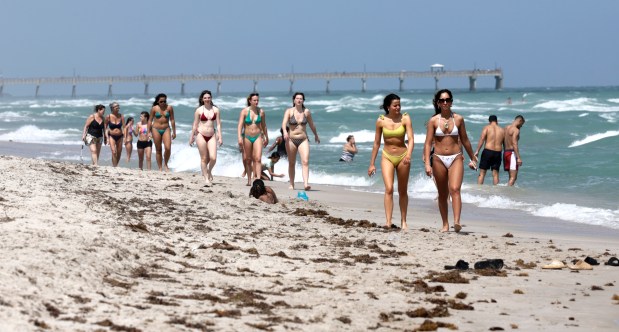 People enjoy the beach in Hollywood on Monday, March 16, 2026. (Carline Jean/South Florida Sun Sentinel)
“The idea was that if you snorkel out there, if the buoys are out further, people may look at that as a destination to go swim and snorkel to, and it’s pretty far,” Hussey said. “There is absolutely nothing there now. And so to have indicators, buoys that clearly define the space, is a safety improvement.”
Hussey also described the change as an issue of fairness: by encouraging swimmers and snorkelers to stay at reefs closer to shore inside the exclusion zone, boaters will get to “enjoy the nearshore reef without being so far out.”
Julie Greenfield, a Hollywood snorkeler and boater who opposes the move to 218 yards, said that she understands the appeal of shallower waters for boaters looking to snorkel or dive. But after recent close calls with divers while boating, Greenfield says she is skeptical that people will stay close to shore and away from boats — and that more inexperienced boaters will stay away from divers.
Although the artificial Mermaid Reefs are attractive to visiting snorkelers and divers, the proximity of natural reefs will still bring visitors farther out, Greenfield added.
“Once people realize that all they have to do is kick for about five more minutes to get to the real reef, and then it goes on and on and on and on and on, that’s what they’re gonna do,” Greenfield said.
Hussey said that the 218-yard boundary will help keep lifeguards safer in rescue situations.
“When they indicate 300 yards is too far, 218 will get us into alignment with our neighbors from the south, this seems like a happy medium where we can keep swimmers safe, we can keep boaters safe, and we can keep our lifeguards safe when we’re trying to rescue people,” Hussey said.
Earlier this month, city commissioners voted 6-1 to move forward with the ordinance change ahead of a second reading to be held at a later date.
The city will need approval from multiple state and federal agencies to construct buoys, including the U.S. Coast Guard. The process may take over a year, according to officials.