
Six years in the making, the educational center at the Holocaust Memorial Miami Beach is finally opening on Sunday.
“This building is meant to give a foundation for the history of the Holocaust but also to give messages of hope and resilience and give some stories of actual people who lived through this, some who didn’t, and the central function is really our theatre, showing the dimensions and testimonies and allowing visitors to interact directly with our survivors,” said Jessica Katz, one of the memorial’s board members.
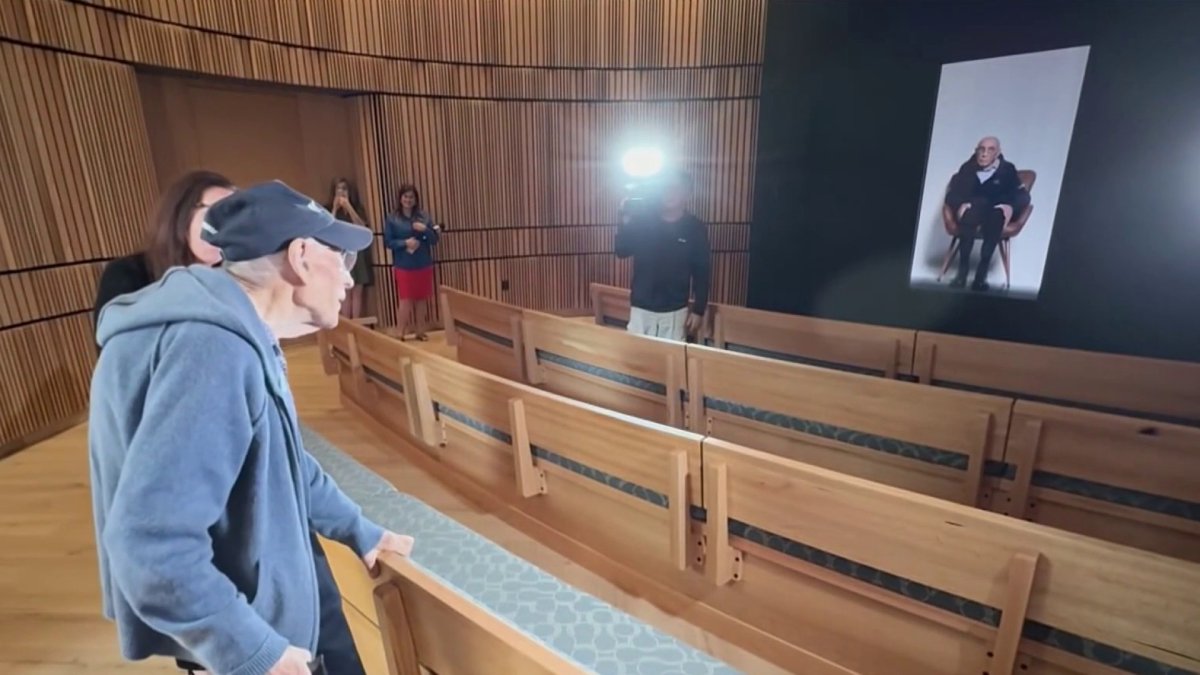
On this sneak preview day, we saw a 101-year-old Holocaust survivor interview himself.
“That’s me,” Jack Waksal said when he walked into the brand-new theatre and saw a 3D video version of himself on the screen. Through virtual reality technology, visitors can ask questions and the survivors on the screen provide answers.
“I escaped in 1944. I was six months fighting against Germany in Poland, in the resistance,” Waksal told us in an interview.
Like all survivors, he has an epic story.
Confined to the Warsaw Ghetto, then moved to a concentration camp, then forced into labor in a munitions factory, then a daring escape. The educational center has a picture of Waksal, his wife, and their baby just after the war.
“Every piece of the gallery has a quote from a local survivor,” said Sheri Zvi, the CEO of the Memorial.
From the beginnings in Germany to life after liberation, the gallery shows it all. The Memorial has been a landmark for decades, a place for peaceful reflection.
“Probably over 70% of our visitors in total are not Jewish, so it’s really important to us to tell not only the history of the Holocaust but life before, how normal it was and how abnormal it became,” Katz said.
It’s not just about history; the educational center also has an exhibit of current antisemitic incidents, connecting the past with the present.
“We live in an era when there’s a lot of disinformation and misinformation out there and it’s crucial for us to tell the story, use facts,” explained Matan Benaviv, the chairman of the Memorial’s board.
They’re connecting the dots to show the atrocities that hatred can inspire.
Waksal told us with this new facility, his life’s mission of keeping the memories alive has been accomplished.
“We should show the world, that’s what happened, not to say it never happened, that is my thing and that’s what I feel about it and I’m so proud,” Waksal said.