
TAMPA
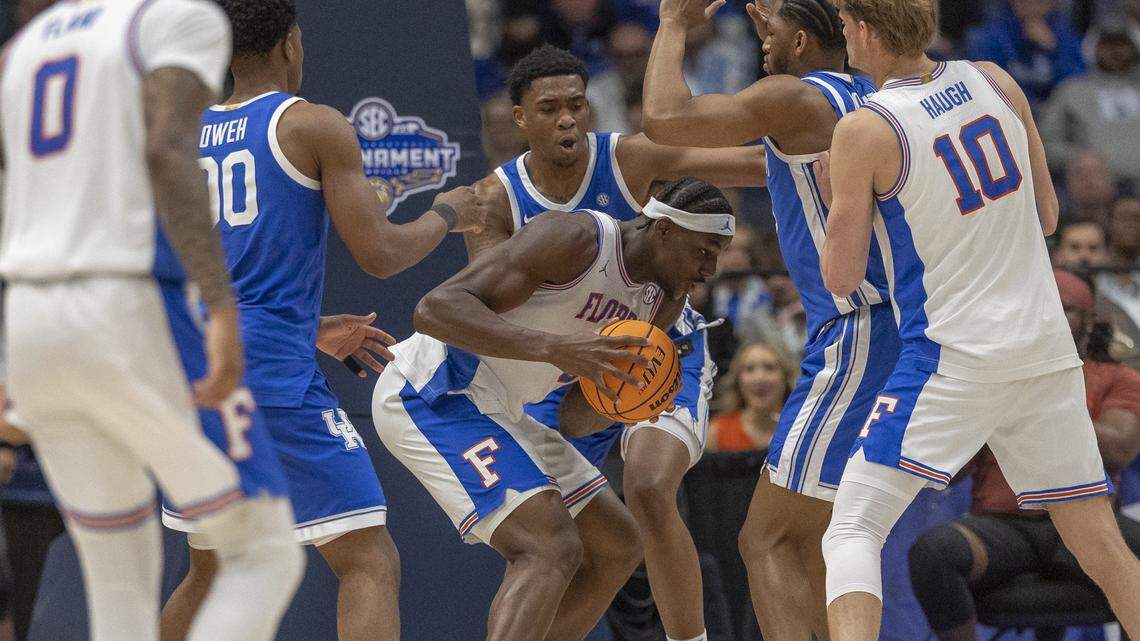
In early January, Florida led the country in offensive and defensive rebounding. It would have been the first time that a team accomplished that feat of utter board dominance. So had Florida not decided to tweak its offense to emphasize paint touches, dwindling the bricks its guards had regularly tossed through the first two disastrous months, this could have been a historic season.
Instead, it will have to settle for a fear-inducing one.
“They’re giant,” Iowa forward Cam Manyawu said. “They can out-physical people, and they’re super tall. I expect some elbows and bruises.
“It’ll be a war.”
Throughout the past months, scouts, coaches and opposing players have provided similar analysis of No. 1 seed Florida’s frontcourt. The Gators are only second and seventh in offensive and defensive rebounding percentage in the country nowadays, but their work on the boards — and their suffocation of foes via second-chance points — is the reason Florida’s rolled from 5-4 to 27-7, with only three losses since Dec. 9.
Well acquainted with that spiel, No. 9 Iowa, which is 69th in the country in defensive rebounding and even worse on the other end, may very well be stepping in front of a buzzsaw Sunday night in the Round of 32. The play?
“Just be as physical as possible with them,” Manyawu said. “You can’t let them push you around.”
That plan is probably as realistic as No. 16 Prairie View A&M coach Byron Smith’s cry for the Lord’s help against the Gators in the first round on Friday. The Gators can have that effect, simply sucking the will out of opponents with two, three, four shots in a possession, but the making of this machine is significantly more complex.
The unacquinated friend, just watching college basketball for the first time in March, can swiftly identify part of this formula. The Gators have a frontcourt with four 6-foot-9 or taller rebound gobblers. The Gators spend hours practicing how players should locate themselves relative to the basket and the opponent when the ball is in the air. At its core, that’s a science, and it produces a seemingly definite result these days. All four average at least six boards, including Micah Handlogten, who comes off the bench for only 15 minutes each game. Center Rueben Chinyelu is distinctly top of class, ranking just behind first in the country with 11.5 boards per game. “Every shot, I’m thinking about where the miss will be, getting the ball,” he said. Maybe faulty, given a top seed probably shouldn’t be missing so many attempts that it becomes a habit to wonder where the miss will land. But it’s the thought, literally, that counts: “You have to want it.”
When dancing among the trees, the tallest don’t always win, unless those trees also happen to be the most interested in the job that comes with height. In the Gators’ locker room Saturday afternoon, a debate broke out about the staple principles the men of that room live by: Is rebounding, in its most distilled form, more of a mental or physical skill? Height is the easiest attribute to quantify, yet the Gators think it matters more to want the rebound than to be physically more likely to grab it.
“Obviously, you need height,” said associate head coach Carlin Hartman, who coaches Florida’s bigs. “But we need guys who think that way. … It’s hard to make someone want to care, and if they don’t, it’s the guys that do that will grab more.”
Even if it’s hard to cultivate interest, Florida has designed a bootcamp of a program with that purpose. In conjunction with Hartman, assistant coach Jonathan Safir — Florida’s quintessential numbers guy in a building of numbers guys — leads the charge on teaching rebounding. The Gators have specific periods in practice when that’s the sole purpose, in which scoring doesn’t matter. You win if you get the second chance. The belief is that intense, focused segments help ingrain the principles the Gators live by on the court. They also spend time during every film session reviewing offensive and defensive rebounding techniques, breaking down the last game or practice’s film. “Those are intense. You never want them to call you out,” wing Isaiah Brown said. He’s a member of the group that gets caught the most: the smaller guys, relatively. But they’re trying.
Coach Todd Golden has an analogy he giggles at. For the football folks, he doesn’t want receivers who don’t block. His guards — they’re going to find themselves crashing the boards, especially defensively. The Gators also happen to be one of the most potent high-speed teams in the country, with an adjusted tempo in the top 40 nationally, per Bark Torvik. How do the Gators get moving so quickly? “Our guards are down in there,” Hartman said. And where does that come from? He smiled with this one: “They care.”
“We have a good process,” Golden said. “We’re constantly talking to our guys about their responsibilities whether it’s crashing the offensive glass or trying to protect the defensive glass. … The emphasis in which we put on it and the way we coach it is what allow us to be as good as we are.”
The Gators have only been outrebounded twice this season. Their average margin against ranked foes during their massive turnaround is plus-14.4. In the first round against Prairie View, the Gators grabbed 34 more boards than their No. 16-seeded opponent. They even outrebounded Vanderbilt by 15 in their loss to the Commodores in the SEC tournament. For Iowa, here lies hope. For Golden, it’s a point of consternation.
“When we get 20 offensive rebounds, in theory, we should be scoring 25 or even a bucket more on that. We only had 14 second-chance points,” he said. As standard in this iteration of Florida, the analytics are the reason it stresses the glass in the way it does. So when the numbers don’t align, it can feel like the world is crashing down. But the numbers almost always align.
The Gators have spurred rebounding margins of more than 20 in a whopping 13 games this season, the most of any team this century. On those nights, Florida’s unsurprisingly 13-0, and only two of those wins were by fewer than 15 points. Against foes as average on the glass as Iowa — like Florida State and Vanderbilt, which each grab within a percentage point of the same number of offensive rebounds as Iowa does (30.6%) — the Gators have controlled the glass to a combined +51.
“Every possession, we’re going to have to be ready to throw ourselves in there,” Iowa’s star guard, Bennett Stirtz, said. At the SEC tournament, an opposing coach scouting the Gators put things more simply. “They want to send you to the ER. And you might have to oblige them to win.”
A pair of Hawkeyes average 4.7 rebounds per game; the rest average the same or fewer than Florida guard Xaivian Lee. Of note: he’s 6-foot-4, per the media guide, which his teammates, amid that hearing about rebounding, began to debate as well. “We just want to get in there,” the Princeton transfer said. “It’s like a competition. You feel like you win something when you grab one.
“I’ve never been anywhere like that.”
Which is exactly what Golden wants to hear. When he arrived at Florida, it had been nearly a decade since its last Final Four appearance, and even more discouraging, the school didn’t seem to care. Times change — a packed Benchmark International Arena at midnight for a first-round game can be the litmus test for that one. But it came with Florida transforming into an SEC juggernaut overnight, which came with a culture shift toward caring about the controllables. On the technical end of the spectrum, that includes rebounding. “It’s kind of become our DNA,” Golden said.
And if Florida can make another run, it will be why.

John Devine has worked with the Miami Herald since 1996. He has worked as a Broward sports editor, Broward news editor, assistant sports editor and deputy sports editor before he became executive sports editor in 2021.