
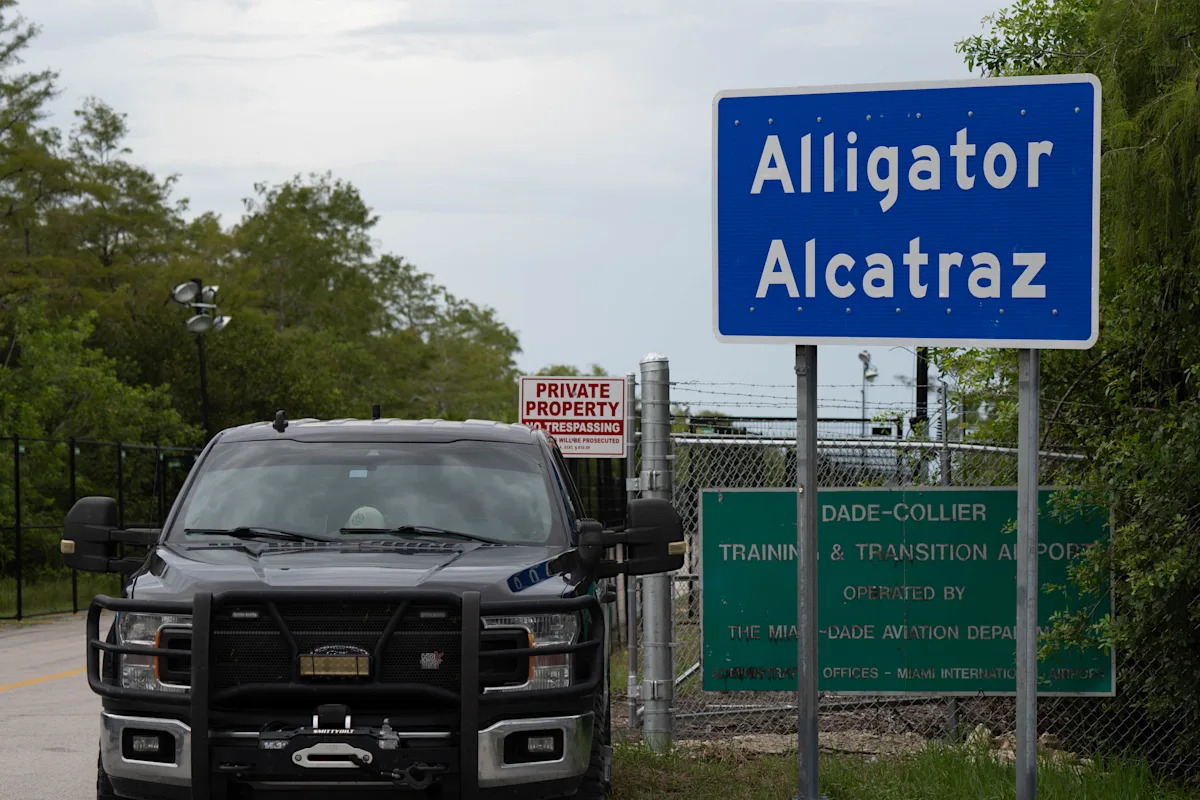
Recently released documents – given by court order to Friends of the Everglades – paint a picture of spending on Alligator Alcatraz to the tune of $1 million a day.
The immigrant detention center built in far east Collier County, Florida, on the edge of the Everglades in Big Cypress National Preserve, needs $1.02 million a day to house 4,000 to 4,100 detainees, according to documents obtained by Friends of the Everglades and shared with the Naples Daily News. Alligator Alcatraz was built in June 2025 and opened July 2.
Alligator Alcatraz is located on what was a Dade County-owned airport training field in Collier County. It was a first-of-its-kind facility, run by the Florida Division of Emergency Management (FDEM) instead of the U.S. Immigration & Customs Enforcement (ICE) agency. Gov. Ron DeSantis took over the training field via an emergency order.
In documents obtained by Friends of the Everglades through a court ruling, grant correspondence between FDEM and the Federal Emergency Management Agency (FEMA) about costs and reimbursement included details about number of detainees and costs to feed, clothe and offer medical care and transportation.
In its FEMA grant application dated Aug. 3, 2025, Florida originally requested $1.5 billion. FDEM later amended the request to $608.4 million.
Alligator Alcatraz was Florida’s first state-run immigrant detention center
In June 2025, the State of Florida began building an immigration detention center at an airport training center at the edge of the Everglades in Big Cypress National Preserve, off of Tamiami Trail/US 41 at the eastern edge of Collier County just before the Miami-Dade County line. FDEM, which plans for and responds to both natural and man-made disasters, is in charge of Alligator Alcatraz.
The facility was to hold between 3,000 to 5,000 people. FEMA grant documents indicate the facility has 16 units that hold 4,000 to 4,100 people.
FDEM describes Alligator Alcatraz as “temporary secure holding facilities.” It is meant to be a stopover to another facility or deportation. Requests by the Naples Daily News for records with details about detainees have not been fulfilled by FDEM.
Trump, DeSantis and Noem said Alligator Alcatraz would be mostly funded through FEMA’s Shelter and Services Program.
The U.S. Department of Homeland Security pegged the one-year cost of running the facility at $450 million. On July 31, 2025, DHS announced that $608.4 million was available in federal funds to the Florida Department of Emergency Management and that the application process would run July 31 to Aug. 30.
Environmental nonprofit group Friends of the Everglades, joined by the Center for Biological Diversity and the Miccosukee Tribe, sued in June to stop Alligator Alcatraz, citing a failure to follow federal environmental review requirements before construction. That lawsuit continues on appeal and is set for oral arguments April 6 in the Southern District of Florida.
On Sundays, a coalition of faith leaders and social justice organizations, primarily led by The Workers Circle, hold what they call peaceful gatherings against “inhumane” treatment and “violations of constitutional rights.”
Florida’s application for FEMA funds for Alligator Alcatraz included a request to forego environmental review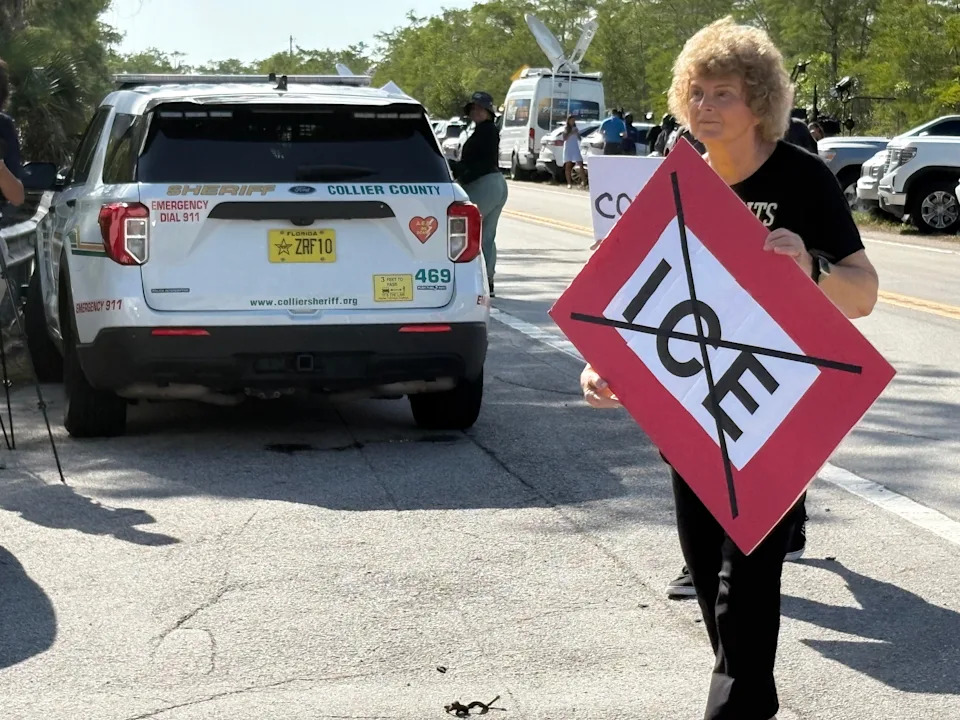
Protestors, media and law enforcement lined U.S. 41/Tamiami Trail July 1, 2025, as President Donald Trump visited Florida Gov. Ron Desantis’s immigration detention center known as Alligator Alcatraz.
In its grant application, Florida’s Division of Emergency Management said it spends $249 per night per detainee. At 4,100 people, that’s $1.02 million a day. That figure becomes $264.2 million spent between July 2, 2025, and March 17, 2026 – 259 days.
FDEM made it clear that it was not asking for money for any construction costs but did include “set up” costs.
Other costs included in the budget included in the grant application were for clothing and bedding; feeding services; medical care; transportation; safety and security; communications; record keeping; and management and/or administrative costs.
FDEM wrote: The budget information attached provides the detail justifying the federal award amount and does not include any items requiring an EHP (FEMA Environmental and Historic Preservation) review or additional information in order to release the hold of funds.
In an amendment to its application, FDEM asked to remove “the Environmental Planning and Historic Preservation (EHP) Compliance terms and conditions. FDEM is requesting the removal of the EHP terms and conditions as the detention center utilized is not a permanent structure, as such funding should not be restricted to the limitations of the EHP review and compliance.”
“The records confirm what Friends of the Everglades has maintained from the outset: This is a federal immigration detention facility, conceived and constructed on the promise of federal funding,” said Paul Schwiep, attorney for Friends of the Everglades in a statement sent by Executive Director Eve Samples.
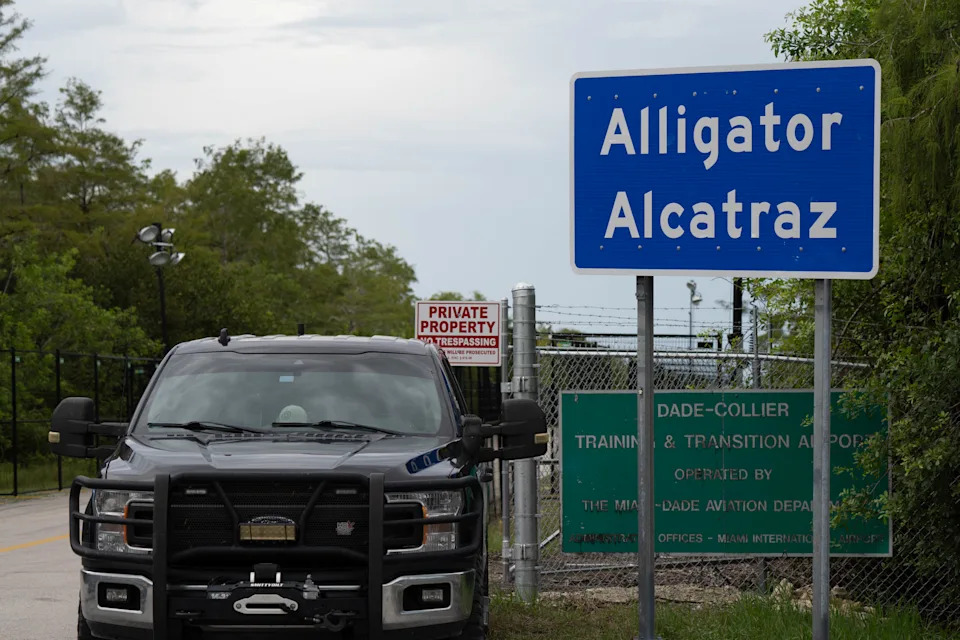
Police officers park outside Alligator Alcatraz in Ochopee, Florida, during the vigil Aug. 10, 2025.
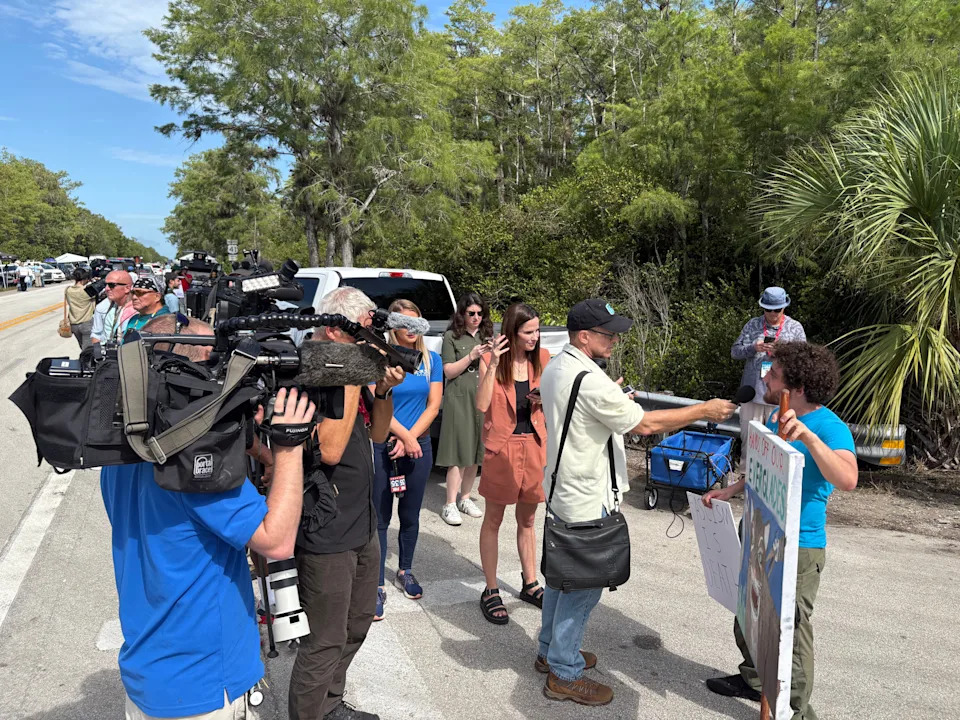
Protestors, media and law enforcement lined U.S. 41/Tamiami Trail July 1, 2025, as President Donald Trump visited Florida Gov. Ron Desantis’s immigration detention center known as Alligator Alcatraz.
“Attempting to delay federal reimbursement to sidestep compliance with federal environmental law is gamesmanship — and will not work. Director Guthrie himself concedes that the environmental review required by federal law must occur. That review was required before construction began. Until the mandated review is completed, operation of the facility should cease,” Schwiep said.
Florida taxpayers are footing the bill for Alligator Alcatraz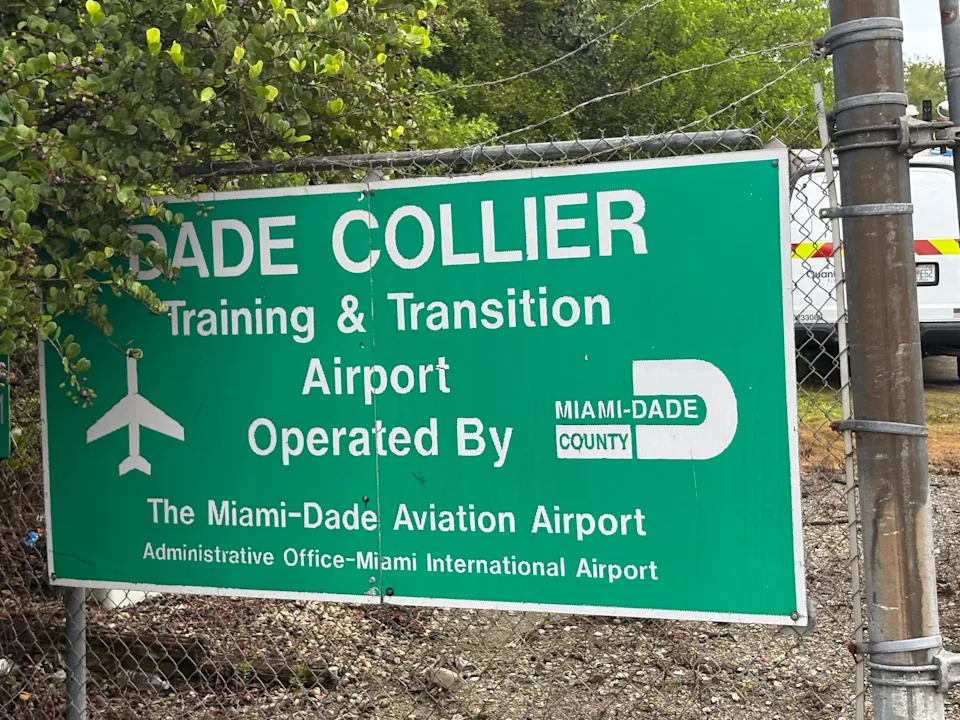
Protestors, media and law enforcement lined U.S. 41/Tamiami Trail July 1, 2025, as President Donald Trump visited Florida Gov. Ron Desantis’s immigration detention center known as Alligator Alcatraz.
DeSantis used a state emergency fund to build Alligator Alcatraz and later open Deportation Depot, west of Jacksonville in Sanderson. The fund, which expired Feb. 17, was originally created in 2022 to handle hurricane preparation and response and other natural disasters. But DeSantis has spent $573 million for expenses related to immigration enforcement within the last year alone.
On its last day of the legislative session, March 13, lawmakers agreed to extend the fund, but with some spending rules. The bill (SB 7040) includes reporting requirements, mandating the governor’s office and the Division of Emergency Management to provide quarterly spending reports to the Legislature.
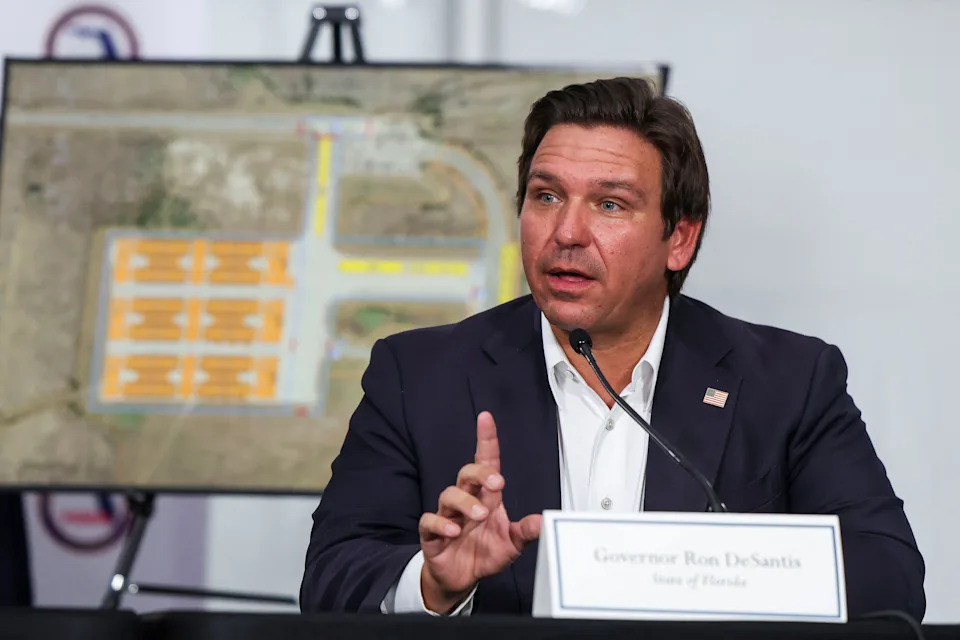
Florida Governor Ron DeSantis visits a temporary migrant detention center informally known as “Alligator Alcatraz” in Ochopee, Florida, U.S., July 1, 2025. REUTERS/Evelyn Hockstein
“These files illustrate a staggering waste of taxpayer dollars — funds meant to protect Floridians in times of natural disaster — diverted instead to construct an ICE detention center in the heart of the Big Cypress National Preserve that continues to inflict grave harm on the Everglades,” Samples said. “We are committed to stopping the harm at Alligator Alcatraz and will return to court next month to advance our case.”
What about the federal grant? Is Florida going to receive it?
U.S. President Donald Trump, Florida Governor Ron DeSantis and U.S. Homeland Security Secretary Kristi Noem visit a medical tent at a temporary migrant detention center informally known as “Alligator Alcatraz” in Ochopee, Florida, U.S., July 1, 2025. REUTERS/Evelyn Hockstein
Florida is still hoping for reimbursement from FEMA, a seemingly slow-moving process.
Stephanie Hartman, spokesperson for the Florida Department of Emergency Management, did not directly answer the question has Florida received the $608 million and when, but said, “As with the existing FEMA reimbursement process, once expenses are incurred, reimbursements will be requested from and reviewed by FEMA. Following approval, the appropriate funds will then be released to the state.”
FEMA Historic Preservation reviewer Portia M. Ross signed off Aug. 31, 2025, along with Donna DeFrancesco, “FEMA environmental officer reviewer or delegated approving official,” that environmental reviews for a myriad of topics including historic preservation, endangered species, migratory birds and fishery conservation were concluded and deemed unaffected.
In conclusion, the state would be reimbursed for providing shelter in detention; basic food and nutrition; necessary medical care; and “a trained and equipped staff to care for and secure detainees.”
Florida is still waiting on the money.
More: Finish line in site for $97M Collier County I-75 interchange project
And: CCSO investigating deadly shooting at Whistler’s Cove in East Naples
J. Kyle Foster is a senior growth & development reporter for The News-Press & Naples Daily News. Reach her by emailing jfoster1@usatodayco.com.
This article originally appeared on Marco Eagle: Alligator Alcatraz costs: Florida seeks $608M in reimbursements