
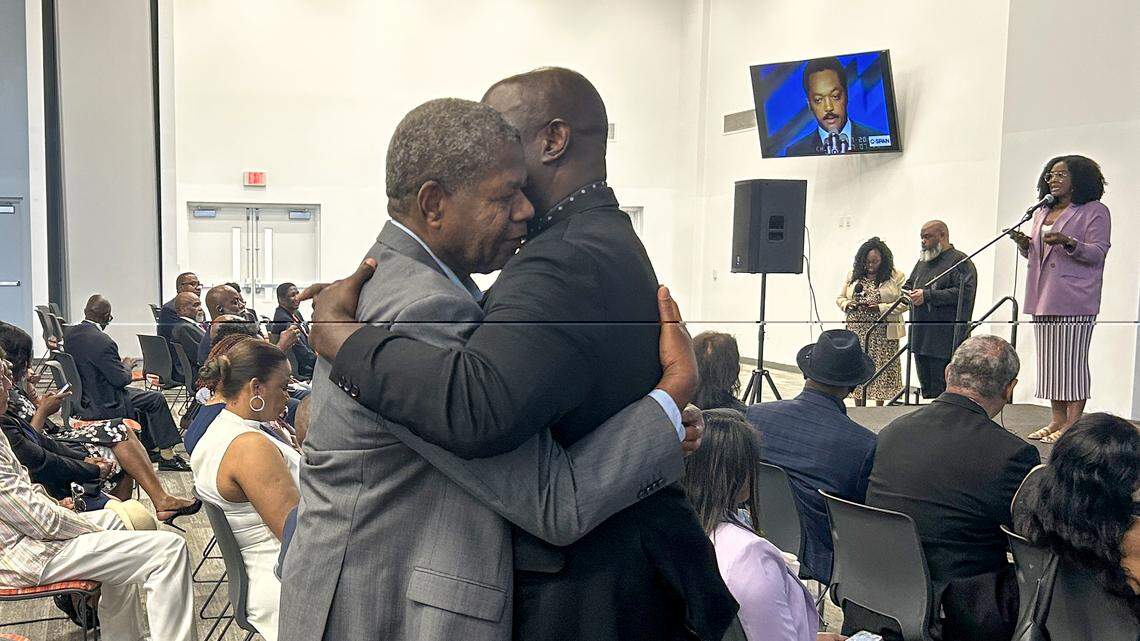
Abel Jean-Simon Zephir, left, one of the first Haitians to arrive in Miami by boat, is greeted by Rep. Wallace Aristide on Saturday, March 21, 2026, during a ceremony to honor the late Rev. Jesse Jackson, who died on Feb. 17, 2026. Jackson was a pivotal voice in the Haitian immigration struggle in Miami during the ‘80s and ‘90s.
Jacqueline Charles
JCharles@miamiherald.com
Pioneers of Miami’s Haitian rights movement paid homage Saturday to the late Rev. Jesse Jackson, recalling his support for their struggle while drawing parallels to renewed challenges their community faces amid the threat of detention and deportation.
The gathering, rich with personal anecdotes and reflections on the civil rights leader’s multiple visits to South Florida and Haiti, underscored his decades-long advocacy on behalf of Haitian refugees, particularly his push to have those fleeing the troubled Caribbean country recognized as political refugees rather than economic migrants.
Jackson died Feb. 17 at the age of 84 at his home in Chicago. Alongside his advocacy for voting rights and the poor, he championed the rights of Haitian migrants, leading prayer vigils and protest marches in the ‘80s and ‘90s as he called attention to their unequal treatment in comparison to arriving Cubans and other migrants.
Though the icon has been remembered in tributes across the country, Saturday’s gathering at the Father Gerard Jean-Juste Community Center in North Miami-Dade carried particular resonance. The event brought together African Americans and Haitians, elected leaders and Democratic Party organizers, longtime immigration advocates and residents whose lives were shaped by those efforts.
“This is a celebration, and I’m grateful for a life so powerfully lived,” Miami-Dade County Commissioner Marleine Bastien said, citing the local, national and global impact of Jackson’s fight for justice. “The Rev. Jesse Jackson was not only the towering figure of a civil rights movement. He was the force of good who stood boldly for the marginalized, the voiceless, the underserved, and he never, never withered in his pursuit of justice.”
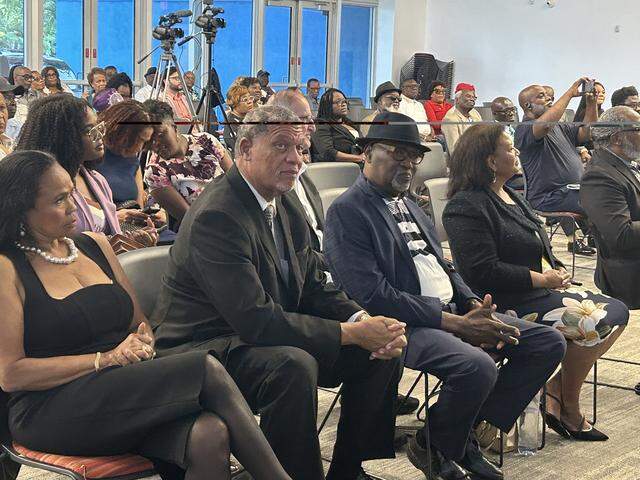 From left to right: Activist Farah Juste, Rev. Richard Dunn and former North Miami Councilman Jacques Despinosse join others in celebrating the legacy of the late Rev. Jesse Jackson on Saturday, March 21, 2026, at the Gerard Jean-Juste Community Center in Oak Grove. Jacqueline Charles jcharles@miamiherald.com
Bastien spoke of the honor of knowing Jackson personally and “working alongside him in moments that mattered deeply for our community.”
Those moments included the fight for Temporary Protected Status for Haiti before it was granted by the Obama administration after the country’s devastating 2010 earthquake. During a trip with Jackson to her homeland, Jackson didn’t want to just remain inside the presidential palace or visit Pétion-Ville, the affluent suburb where many of Haiti’s wealthy live, Bastien recalled. He insisted on meeting with ordinary Haitians, which he did when they visited Cité Soleil, the country’s largest slum.
“He made an indelible impact on all of our lives,” Bastien said. “And this impact will continue to live on.”
Still, the speakers reflected on the moment the community now faces: More than 50 years after Haitian refugees began arriving in South Florida in boatloads, prompting court challenges and street demonstrations for immigration protections, the community again finds itself in the throes of an immigration fight.
Protections from deportation that roughly 350,000 Haitians have relied on due to instability and gang violence in Haiti are now at risk.
President Donald Trump has asked the Supreme Court to allow his administration to terminate Haiti’s TPS designation after lower courts ruled against the move. The court is scheduled to hear oral arguments next month.
‘Where is the compassion’
“Where is the compassion?” Abel Jean-Simon Zephir, an early migrant, asked as he recalled Jackson’s pivotal encounter with another Republican in the White House.
That was George H.W. Bush, then vice president, whom Jackson called in August 1982 after being blocked from entering the Krome Detention Center in West Miami-Dade County to pray for 200 Haitian refugees on a hunger strike over their prolonged detention.
Zephir, who served as Jackson’s translator that day, recounted the incident for the crowd.
“Jesse prayed for me when my brothers and sisters were in jail,” he said. “My brothers and sister today, this is our moment to ask, ‘If you have TPS, get organized. … If you are a U.S. citizen, register to vote.’”
In an emotional moment, Zephir was recognized by state Rep. Wallace Aristide, D-Miami, who addressed the crowd in Creole and thanked him for his advocacy. But the focus remained on Jackson’s legacy and the ongoing TPS fight.
“We have lost Jesse Jackson, a pillar, a powerful icon,” said state Rep. Marie Paule Woodson, D-Hollywood. “But Jesse Johnson has worked with so many in this community, and we know we have won. … We will continue this fight. We will continue the struggle.”
A room of fighters
She then proceeded to highlight some of the stalwarts in the room who had been “in the trenches” with Jackson, including former North Miami Councilman Jacques Despinosse; activist and singer Farah Juste, who performed; former Haitian Refugee Center director Guy Victor, activist Tony Jeanthenor, one of the event’s lead organizers; and Bastien.
It never gets old hearing Farah Juste sings; yesterday she paid respects to the late Rev. #JesseJackson along with other fighters of Haitian rights including two prominent African American pastors in Oak Grove. pic.twitter.com/0BkW69ljCL
— Jacqueline Charles (@Jacquiecharles) March 22, 2026
They were joined not only by a crowd of Haitians who became permanent U.S. residents and citizens because of their efforts, but also by some of the African Americans who stood by them, including the Rev. Charles S. McKenzie Jr., Florida coordinator for Jackson’s Rainbow/PUSH Coalition; the Rev. Richard Dunn; and former state Sen. Dwight Bullard, who co-emceed the event. Also present were the families of Jack Lieberman and Bernard Fils-Aimé, longtime activists who died within a month of each other in 2020 from COVID-related illness.
McKenzie, who served as vice president of the Haitian Association Foundation of Tampa Bay, knew Jackson for 38 years. In 2012, he accompanied him on a visit to Haiti. There is still much work to be done, the pastor said as he spoke directly to the room.
“Our Haitian brothers and sisters, God loves you,” he said. “I would encourage you to pray around the Temporary Protected Status or whatever challenges we’re having in our communities.”
Then McKenzie invoked one of Jackson’s signature refrains: “Keep hope alive, keep hope alive by understanding that God loves you no matter who is in power.”
Miami Herald
Jacqueline Charles has reported on Haiti and the English-speaking Caribbean for the Miami Herald for over a decade. A Pulitzer Prize finalist for her coverage of the 2010 Haiti earthquake, she was awarded a 2018 Maria Moors Cabot Prize — the most prestigious award for coverage of the Americas.