
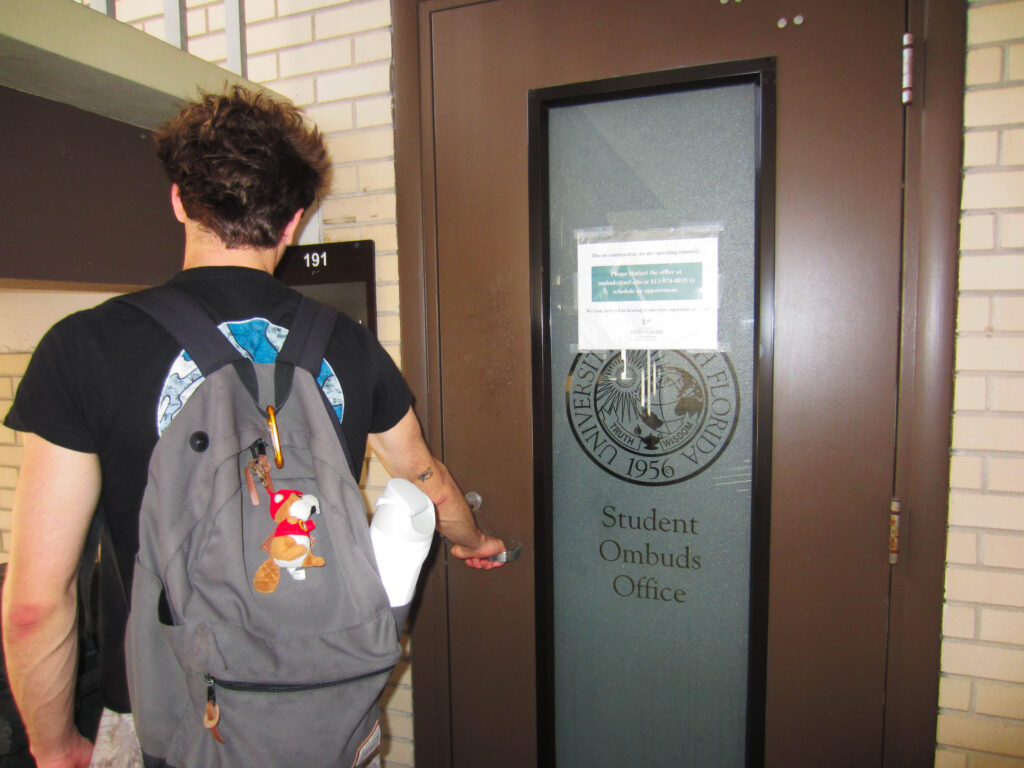
 USF’s Student Ombuds Office will move to a larger, renovated part of the John and Grace Allen Building this April. ORACLE PHOTO/CAROLINA MOLERO ROCA
USF’s Student Ombuds Office, which helps students navigate day-to-day issues and university concerns, has been led by Jennifer Smith Schneider for more than a decade.
The office, which reopened in January 2016 after a two-year closure, helps students resolve conflicts and find solutions for them and the university, according to the Student Ombuds Office.
Schneider said the office provides students with one-hour appointments to voice their concerns or issues surrounding the university. The office operates without formal authority, meaning it cannot enforce decisions or policies.
“We are an independent, impartial, confidential, informal resource for students who have university-related concerns,” Schneider said. “We’re really here to make sure people feel heard and that processes are fair.”
Schneider, who was the only Student Ombuds adviser for over a decade, said that the addition of a second adviser last March and the opening of a larger space in April will help the office serve more students.
During the 2024–25 academic year, the office saw 559 visitors and handled 719 individual meetings, according to the Student Ombuds Office Annual Report.
“[The new office] gives us an opportunity to have a confidential meeting space for groups, which is the biggest bonus, and it gives us extra room for the students and [the new adviser],” Schneider said.
Related: USF Counseling Center offers new online scheduling procedure
Schneider joined USF’s Student Ombuds in February 2015 and completed extensive training to become a certified organizational worker with the International Ombuds Association.
She said there were initially three staff members when she joined the Student Ombuds, but that they were part-time workers with other roles on campus.
This meant Schneider handled all student cases alone for over ten years, often meeting with up to five students a day while also conducting research and follow-ups on each case.
“It got to a point where students were having to wait several days for appointments, and many of the issues we handle are time-sensitive,” Schneider said.
As USF evolved into a larger, more nationally recognized institution, Schneider said the demand for Student Ombuds services grew — and the office expanded to meet it.
Laura Zuppo, the director of the Student Ombuds, joined the office in March 2025.
Zuppo worked part-time at USF St. Pete as a collateral ombuds until last year, when she joined the Student Ombuds on the Tampa campus as a full-time employee, according to the Student Ombuds Office Annual Report.
In addition to Zuppo’s full-time role, Schneider said an undergraduate student joined the office last March to help manage outreach and marketing.
The added personnel have helped reduce wait times for students and raise awareness of the offices’ services by allowing them to split responsibilities and visits, Schneider said.
Along with new staff, Schneider said the office’s physical space is also changing — moving from its suite in the John and Grace Allen Building to a larger, renovated space in the same building.
Schneider said that the upgrade will include private meeting rooms, additional workspace and improve confidentiality for students, which she hopes will be complete this April.
“In the past, students might have been sitting right outside my door waiting,” Schneider said. “Now we’ll have space to ensure privacy, especially for more sensitive conversations.”
Despite the office’s growth in staff and space, Schneider said awareness remains a challenge.
She said many students only learn about the office after they’ve already gone through formal processes, which limits the help the office can provide.
“‘I wish I had known about this earlier’ — we hear that all the time,” Schneider said.
Schneider said Student Ombuds only records information and notes about the general nature of the issue or concern and does not record student information.
“Some students don’t want to be part of a formal process,” Schneider said. “They just want to talk through something or figure out their options without it going any further.”
Related: ‘Stand with us’: Muslim students call on USF for a stronger response after prayer harassment
As the new space prepares to open in April, Schneider hopes more students will take advantage of the office and its services.
“It’s meaningful to help students and to help improve the university at the same time,” Schneider said.
Schneider said she hopes the new space will allow the office to accommodate more students and have more availability for those who need that safe space.
And though she said colleges and students will continue to evolve, Schneider believes the need for human-centered support will remain constant.
“Students are navigating a lot of change right now,” Schneider said. “Having a space where they can talk through challenges — that’s always going to be important.”