
Home » AIRLINE NEWS » Shutdown Travel Crisis: Will ICE Agents Be the Solution for Miami and Fort Lauderdale Airports?
Published on
March 23, 2026
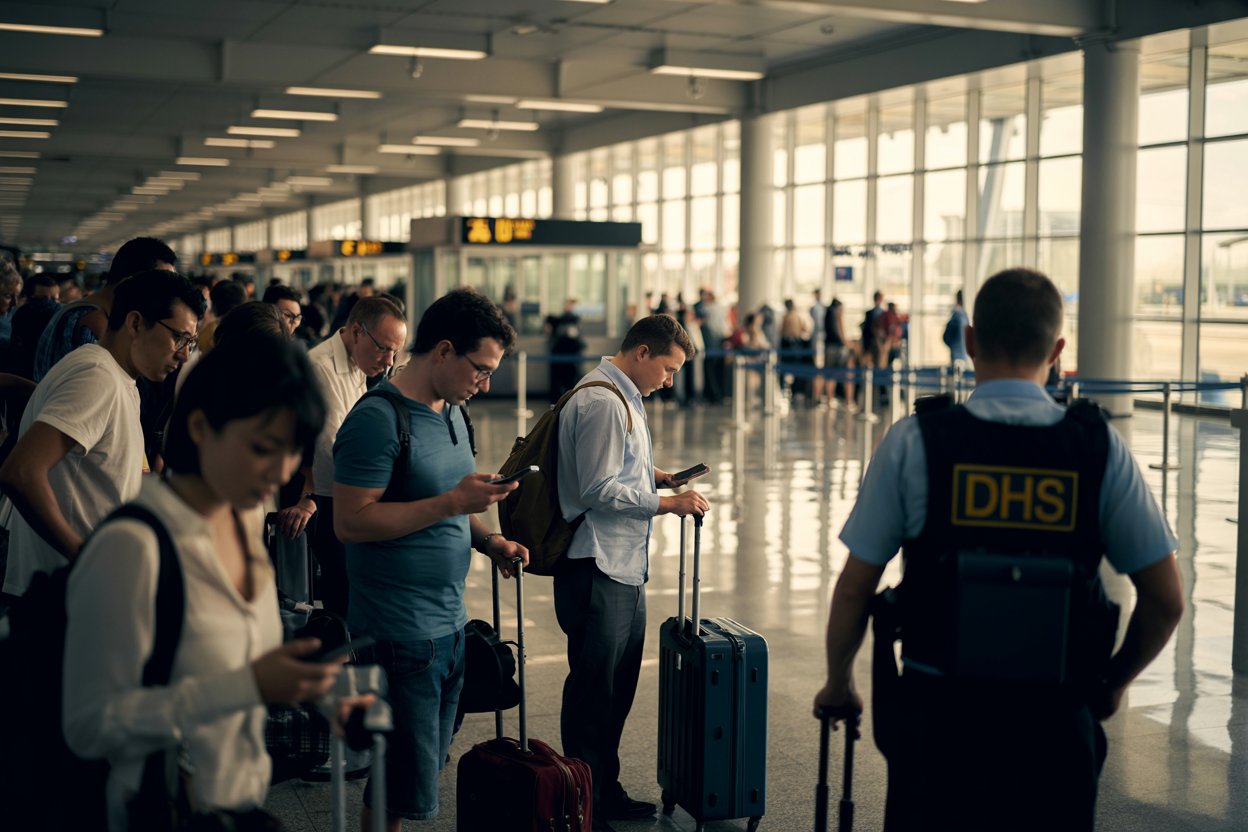
Image generated with Ai
As the calendar turns to late March 2026, the tropical breeze in South Florida carries more than just the scent of saltwater; it carries a palpable sense of anxiety for thousands of travelers. What began as a political stalemate in Washington, D.C. has now manifested as a logistical gauntlet at Miami International Airport (MIA) and Fort Lauderdale-Hollywood International Airport (FLL).
With the partial government shutdown entering a critical phase, a new and controversial proposal has taken center stage: the deployment of Immigration and Customs Enforcement (ICE) agents to major U.S. airports to bolster a thinning TSA workforce. For the travelers navigating the terminals of South Florida, the news is met with a complex mix of hope, skepticism, and weary resignation.
The Breaking Point for TSA
The math behind the crisis is sobering. According to the Department of Homeland Security, over 400 TSA workers have resigned since the shutdown began. For those who remain, the choice to come to work is a daily struggle of conscience and pocketbook. Working without a paycheck is no longer a temporary sacrifice; it has become a sustainable impossibility for many frontline officers.
“The stress points are being broken every single day,” says John Hubert, a TSA security officer. “You have to make your choice every day when you have to come into work.”
As these “essential” workers face missing yet another paycheck, the ripple effects are being felt in security lines across the country. While MIA saw relatively manageable wait times of nine to 13 minutes this past Saturday, other hubs like Atlanta’s Hartsfield-Jackson have seen lines exceed two hours. The fear among South Florida travelers is that it is only a matter of time before the “Atlanta Effect” hits the 305 and 954.
Enter the ICE Proposal
In a move that has sparked nationwide debate, President Trump took to social media to announce the potential deployment of ICE agents to U.S. airports as early as Monday. The directive was simple: “Get ready.”
Advertisement
Advertisement
The proposal aims to provide “relief” to the exhausted TSA workforce, using ICE personnel to fill the gaps left by high call-out rates and resignations. However, the reaction on the ground at MIA and FLL proves that there is no consensus on whether this is a stroke of genius or a sign of systemic failure.
The Traveler’s Perspective: Relief vs. Reality
For travelers like Barry Ivie, the specifics of the uniform matter less than the efficiency of the line. “Sooner the better, let’s get this done, let’s give the relief to the TSA workers,” Ivie remarked while preparing for his flight. For him, the deployment is a necessary intervention to keep the nation moving. His strategy for the shutdown era? “Everybody at the airport is telling me, be here four hours early… and I’m going to be.”
On the other side of the terminal, the sentiment is more guarded. Traveler Bob Aukema expressed skepticism about the feasibility of the plan. “He’s got a lot of crazy ideas. So I don’t, it probably won’t happen like a lot of things he says,” Aukema noted, adding that the situation only seems poised to worsen as long as the budget bill remains stalled in Congress.
A Spring Break Like No Other
The timing of this security shuffle couldn’t be more precarious. As Spring Break 2026 winds down, the volume of passengers at MIA and FLL is expected to surge. Sunday evening typically sees a massive influx of students and families heading back north, and a depleted security staff—even with ICE reinforcements—faces a daunting task.
For many locals, the sight of ICE agents in a civilian travel hub brings a different kind of tension. South Florida is a gateway to the Americas, and the presence of immigration enforcement at security checkpoints could change the atmospheric “vibe” of an airport that prides itself on being a welcoming international crossroads.
Humanizing the Hub: The Faces Behind the Badges
Beyond the political posturing and the long lines are the human stories of the shutdown. There is the TSA agent who can’t afford the gas to drive to MIA; the ICE agent being pulled from their primary mission to manage airport queues; and the traveler who saved for a year for a Florida vacation, only to spend the final hours of it in a four-hour security line.
The “MIA and FLL experience” has always been a blend of high-energy chaos and vacation bliss. Today, that blend is being tested by a federal vacuum. Travelers are being urged to pack extra patience alongside their sunscreen and to stay updated on the rapidly changing security landscape.
Navigating the New Normal
If you are flying out of South Florida this week, the “new normal” requires a proactive approach:
The 4-Hour Rule: Arriving early isn’t just a suggestion; it’s a safeguard against unpredictable staffing shifts.Monitor Live Updates: Use the MIA and FLL mobile apps to track real-time wait times, which can fluctuate wildly within a single hour.Pack Light: Reducing the number of bags to be screened can help speed up the process for everyone.Conclusion: A System in Flux
The potential arrival of ICE agents at MIA and FLL is a stark reminder of how deeply federal politics can disrupt the simple act of going home. Whether this deployment provides the promised relief or adds a layer of complexity to an already strained system remains to be seen.
One thing is certain: as the sun sets over the runways of South Florida, the eyes of the traveling public are turned toward Monday. Will the lines move faster? Will the planes stay on schedule? In the 2026 shutdown, the only thing we can truly count on is the resilience of the travelers and the workers trying to make sense of the chaos.
