
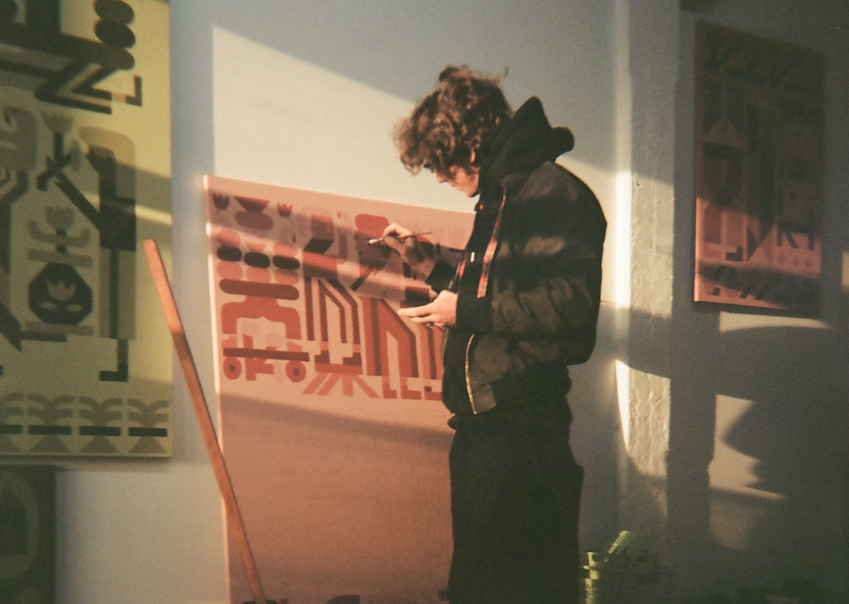
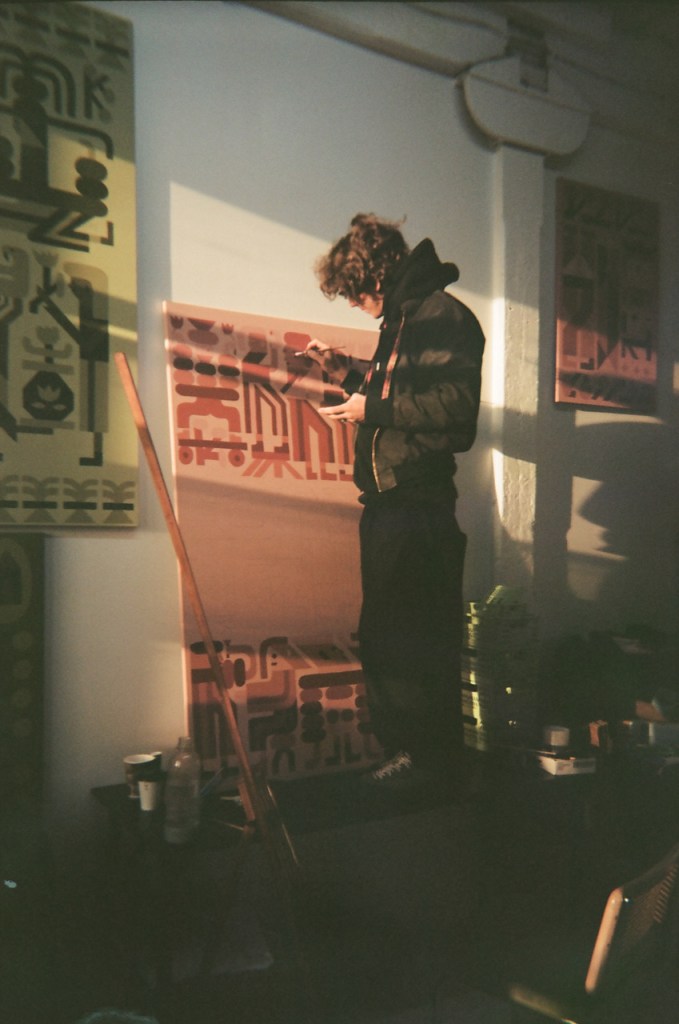
 Keya Tama Credit: c/o aadmixx
Some artists go to art school. Keya Tama had a different education. The now 28-year-old was born into paint jams and skate culture, raised in Cape Town, South Africa, by two teenage graffiti writers, Faith XLVII and Tyler B. Murphy. Tama grew up painting alongside his muralist mother and fine-artist-turned-tattooist father, making it almost inevitable that he’d eventually be prolific with a paint brush, too.
“Almost every school holiday, I would go somewhere new and paint murals with my mum,” Tama told Creative Loafing Tampa Bay, recalling his origin story at our asking. “And when I was 17, I started painting so much in South Africa that it led to jobs where I was starting to travel on my own more.”
Not long after that, Tama moved to Los Angeles where he assisted Shepard Fairey, and where his own personal style began to change and evolve from complex, black and white illustrative work to a more deconstructed geometric and impressionist style, playing with muted, desaturated colors.
“Working with Shepard’s team was very informative,” Tama said of his time painting alongside Fairey and friends. “The street art community in L.A. really informed my view on what’s possible, seeing street art as a constantly evolving media that doesn’t necessarily have one substance.”
And in fact, Tama’s work is not one dimensional either. Along with huge murals scaling the heights of tall buildings, Tama works with acrylic on canvas, glazed ceramics, apparel, ink on paper, digital illustration, and designs on wool tapestries.
One moment that inspired him most was visiting Rome’s catacombs with his mother when he was traveling while he was younger.
“In an older part of the catacombs,” Tama said, “there were some people buried that were illiterate, and so their loved ones, instead of writing their names, would come up with three symbols to represent them.”
Seeing those symbols, imagining the people buried there, and imagining the people in his own life, and what symbols might be associated with them, Tama was struck.
“The symbols and the people behind them start to contextualize themselves together and it really hit me,” he said. “And it made me so emotional, thinking about everyone I’d met or everyone I loved in that way, building a language of symbols. And how there’s no wrong answer.”
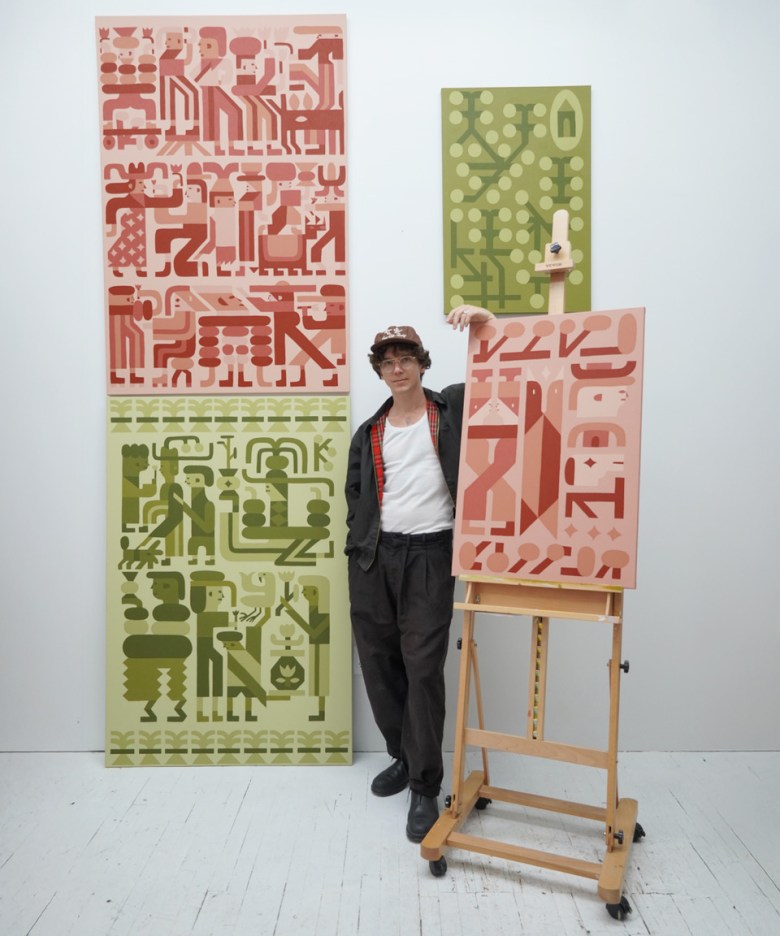 Keya Tama Credit: c/o aadmixx
It’s the way that symbols and geometry and natural, ancient colors work together to move beyond language barriers or boundaries that influence Tama’s work. And the youth culture, of course.
“The voice of the young kind of speaks through boundaries and breaks down what seems limited to us now,” Tama said.
And, it’s evident. His murals span continents, from the side of a 10-story apartment building in Salt Lake City, to an abandoned crayfish factory in St. Helena Bay. Covering walls in Ecuador, Puerto Rico, Haiti, and Madagascar, weaving geometric shapes and symbols to elicit human responses that are evolutionarily ingrained in all of us, no translation needed.
Tampeños and visitors alike have the chance to see Tama’s work in person later this month when Tied By Time (stylized all-caps) arrives on the rooftop of the The Tampa Edition (stylized “EDITION”). Set against the growing downtown skyline and the hotel’s fuchsia florals, the exhibition on March 27 will feature Tama’s canvas and tapestry works, beginning with a VIP collector’s preview from 7 p.m.–8 p.m. followed by a public viewing from 8 p.m.–11 p.m. and an after party at Arts Club.
For Tama, the exhibition offers another opportunity to continue building that symbolic language; one that invites viewers, wherever they are in the world, to find their own meaning inside it.
Follow @keyatama on Instagram for more.
This article appears in Mar. 19 – 25, 2026.
Related