
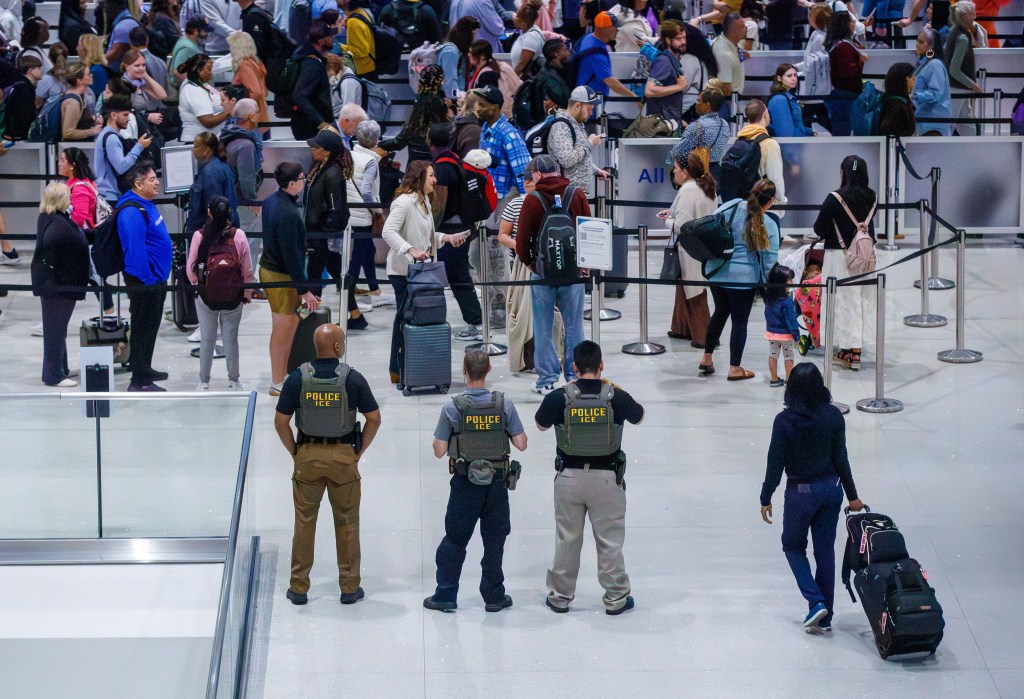
By the time the four passenger terminals at Fort Lauderdale-Hollywood International Airport opened about 4 a.m. Monday, the lines of air travelers had extended in some instances out the front door to curb-side.
It was largely the result of a convergence of Spring Break revelers heading home from a week relaxing along the shorelines of Greater Fort Lauderdale and cruise line passengers who had disembarked from their behemoth ships at Port Everglades, according to an employee of Clear, a private company that helps move passengers to their airport gates faster.
And there was an additional factor contributing to the lines: Travelers booked aboard flights to New York’s LaGuardia Airport could not get there in the wake of a fatal runway accident involving an Air Canada flight and an emergency vehicle. The incident forced LaGuardia’s closure until 2 p.m., leaving a number of Delta Air Lines passengers stranded in Fort Lauderdale.
Whether it was a line managed by Clear or the general and priority lines managed by the federal Transportation Security Administration, people hardly moved at all, according to the employee, who said he preferred to remain anonymous.
And there was no evidence of backup assistance by agents of Immigration and Customs Enforcement, which was promised by the Trump Administration on Sunday for airports nationwide.
More federal immigration officers are making their way to U.S. airports after President Donald Trump said he’d deploy them to supplement the Transportation Security Administration during a government shutdown that has caused long lines at security checkpoints across the country.
On Monday morning, Associated Press journalists saw Immigration and Customs Enforcement officers patrolling terminals and standing watch beside long lines of passengers at Hartsfield–Jackson Atlanta International Airport, John F. Kennedy International Airport in New York, Newark Liberty International Airport in New Jersey, George Bush Intercontinental Airport in Houston and Louis Armstrong International Airport outside New Orleans.
But it was TSA agents and Broward Sheriff’s Office deputies who appeared to be the main players providing the overwatch for thousands of travelers who coursed through the Fort Lauderdale airport.
As of mid-afternoon, 186 delays had been reported at Fort Lauderdale-Hollywood International, with 30 cancellations. By contrast, Miami International Airport had 85 delays and 30 cancellations, and Palm Beach International reported 82 delays with 12 cancellations, according to the flight tracker Flightaware.
Parents sought to keep children occupied, disabled passengers in wheelchairs patiently waited to be moved through lines, and a number of travelers worked the phones to book alternate flights or call home. One woman ordered some home furniture while two children fidgeted nearby.
But as the 9. a.m. hour rolled around, the lines at Terminal One, where Southwest Airlines is predominant, Terminal Two, where Delta Air Lines is the main tenant, and Terminal 3, which is shared by JetBlue Airways and American Airlines, among others, started to slowly diminish.
And customers of Spirit Airlines, with the exception of some individuals who appeared to have missed flights, were moving through the TSA checkpoint at Terminal 4 at a decent pace.
None of South Florida’s international airports appeared to be included among big U.S. airports who suddenly had ICE agents hosting their terminals.
By noon, much of the pressure on the TSA checkpoints at Fort Lauderdale-Hollywood had been alleviated, with much smaller lines than the crush of travelers before sunrise.
Some of those left waiting included travelers who arrived hours earlier for flights booked Monday afternoon. Two women outside the Southwest terminal headed for Detroit acknowledged their presumption of hours-long TSA delays was misplaced. And a woman and her family fresh off a cruise said they were waiting to fly American Airlines to Phoenix — at 5 p.m.
Outside one of the TSA checkpoints in Terminal 3, a television news reporter and camera operator appeared to be at a loss. The line that was once burgeoning about 9:30 in the morning had dwindled to a dozen or so people shortly before noon.
Fears that the deployments will heighten tension
Federal officers are a routine presence at international airports, where Customs and Border Protection officers screen arriving travelers and Homeland Security Investigations agents handle criminal cases. But what’s unusual in the current moment is their visibility at TSA security checkpoints.
Some fear the move to deploy federal immigration agents will only escalate tensions. Union leaders representing aviation workers stressed that ICE officers don’t have the same training and expertise as TSA workers — and the presence of federal immigration officers could also put some travelers on edge.
At Atlanta’s airport, ICE officers wearing tactical vests carried handguns holstered on their hips. At least one had what appeared to be a short-barreled, assault-style rifle slung across his chest.
Whether ICE will have a more sweeping role beyond watching long lines and patrolling terminals has yet to be seen. On Sunday, Trump said federal immigration officers could assist TSA by guarding exit lanes or checking passenger IDs. The administration signaled the deployments would be limited to large airports with the longest wait times.
Still, long wait times and some closed checkpoints persisted at some major hubs Monday. Atlanta’s Hartsfield–Jackson, for example, was still urging passengers to allow at least four hours for both domestic and international screenings. And in Houston, George Bush Intercontinental outlined screening times between two and a half and four hours at its two checkpoints that remained open.
Information from the Associated Press was included in this report.