
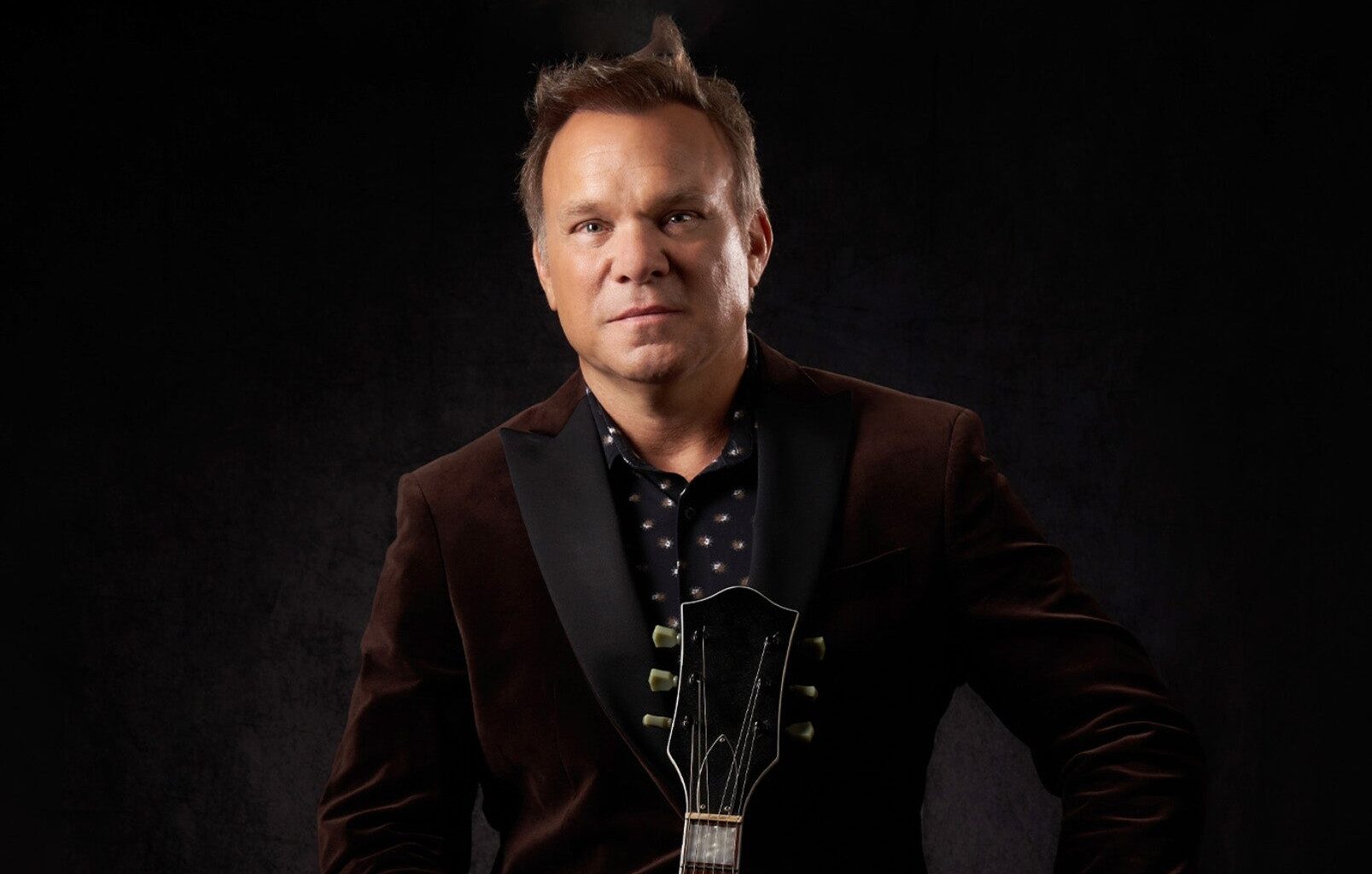
He has two Tony Awards, as Best Actor in a Musical, for his work on Broadway. Just nine people on the planet can claim that distinction.
He also originated the roles, on Broadway, of Fiyero in Wicked, and Edward Bloom in Big Fish.
Norbert Leo Butz is one of America’s biggest musical theater stars, and he’ll be onstage Saturday in Largo, with an intimate cabaret show.
(Those Tonys were for Catch Me If You Can and Dirty Rotten Scoundrels; Butz was also Tony-nominated for Thou Shalt Not and the 2017 revival of My Fair Lady.)
The Missouri native has also done dramatic roles in Netflix’s acclaimed Bloodline, Mercy Street on PBS, Hulu’s The Girl From Plainville and numerous others.
He has released four albums (not including his appearances on original-cast records), including two recorded live at the 54 Below club in New York City.
Tickets for Saturday’s 8 p.m. performance at Central Park Performing Arts Center can be found at this link.
St. Pete Catalyst: What’s a practical use for having two Tonys? Do you automatically get better restaurant seating?
Norbert Leo Butz: Yes, it can do that, a little bit. [Laughter] As for practical use, I suppose, they make good bookends. They look pretty cool.
And for a short while after you get a sort of honor like that, it ups your cache in the industry a little bit. But even that doesn’t last. It’s such a mercurial business. They’re mostly talking points.
Is this what happens? “Let’s bump this guy to the top of the audition list, because he’s Norbert Leo Butz and he has two Tonys”? Or do you still have to go out and “prove yourself” every time?
Less so, I would say, in theater. In theater I don’t really audition. Just because, like I said, I’ve been around a long time, people know my work, they know what I can bring. I tend to work with people who know my work, or we’ve wanted to work together on something.
But for sure in film and television work, everyone has to put themselves out there for those. These days, those roles are so few and far between that everyone’s trying to get a piece of the pie.
Why do both? Is that just the way your DNA is configured?
I guess there’s a couple reasons for that. A diverse portfolio is always the best way to go, just from an economic standpoint: The more things you can do, the more you get to work.
And for me … I think my parents had an ADHD kid before everyone was diagnosing it. And I like new challenges. I like to switch things up. I like to work in different mediums, to keep myself on the front foot, as it were. I’m always looking for the next new challenging thing to do.
Does that also include the singer/songwriter stuff you do? You don’t HAVE to do that; it sounds to me like you WANT to do that.
For sure! As a kid, music was my first real love. I grew up singing in church, and I just fell in love with the pop/rock music that was happening in the ‘80s and ‘90s. Post-punk rock ‘n’ roll, and a lot of influences.
You’re right, I don’t have to do that. I make music for myself. If I release it, I release it. I’ve been sitting on a record that I’m practically finished with now for a couple years. I’m just not ready to release it; it’s sort of “These are mine, these are mine!”
I do think it’s important, though, and it does kind of feed my other work. Performing artists or creative artists or whatever, should always have something they’re making that’s just for them. We’re constantly selling our wares, we’re constantly putting ourselves out there into this short attention span market, and you can grow cynical with it. You can forget the reasons that you did it in the first place. Making my own music always keeps me honest.
Let’s talk about the show you’re bringing here.
I travel with an incredible music director, brilliant piano player named Andy Roninson. I play some acoustic guitar. I also play a little piano; we switch instruments a little bit. We’re kind of a two-man band.
It’s an intimate evening; you know, I’ve done 11 Broadway shows now, and I’ve done a lot of new musicals, some of which are iconic shows now. I do songs that people might know me for, from those shows, but I also do very left-of-center covers. And throughout, I tell stories. I tell some of the backstage stories. I spill the tea, as it were, on the creation of some of these shows.
I joke in the show that only somebody with a name as awkward as mine, from South St. Louis, Missouri, could have gotten to work with the composers I’ve worked with, and have the career that I’ve had.
Well, you brought it up. Did you ever think of changing your name? It doesn’t exactly fall off the tongue.
It doesn’t! In college, I had a couple teachers who said “Hey, you might want to think about that …” I’ve always been a very stubborn person. I’m named after my dad and my two grandfathers, my grandfather was a German immigrant. I always thought it would hurt their feelings.
I’m very close to my family, and I always thought it would be like a betrayal of something integral to me, or to them.
But I have to say, I never thought I’d be in a position where anybody would say my name.
I remember I got my first Tony nomination, and they read my name out loud at Radio City Music Hall, and I thought ‘God damn, I should’ve changed that name!”
And by then, it was already too late.
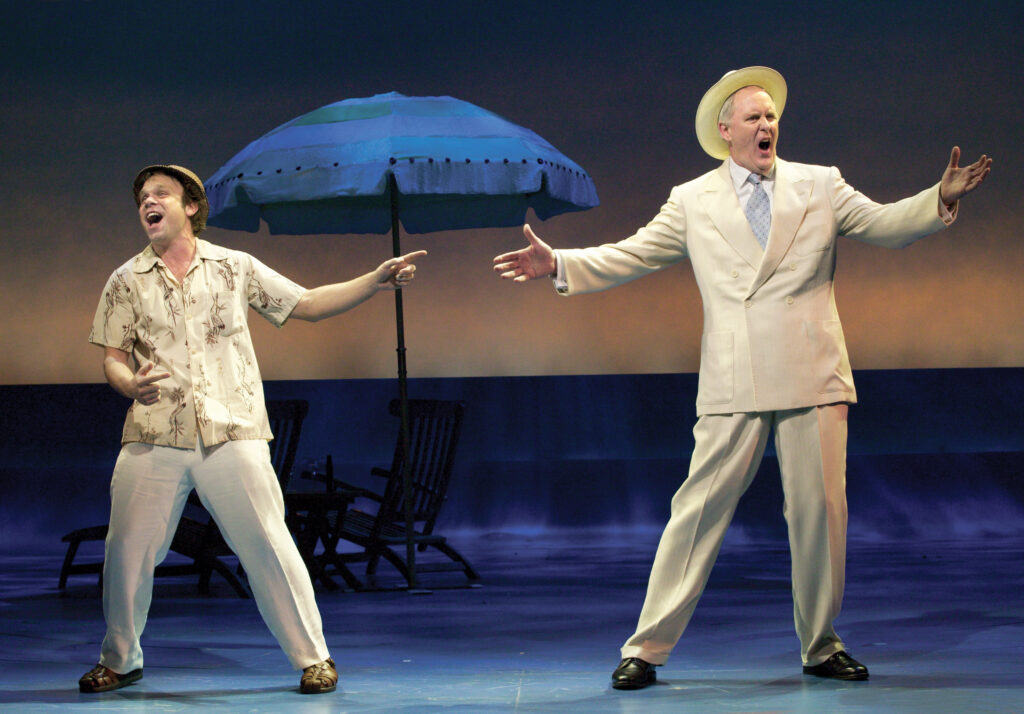
2004: Norbert Leo Butz, left, and John Lithgow in “Dirty Rotten Scoundrels” at the Old Globe Theatre. Publicity photo.
.