
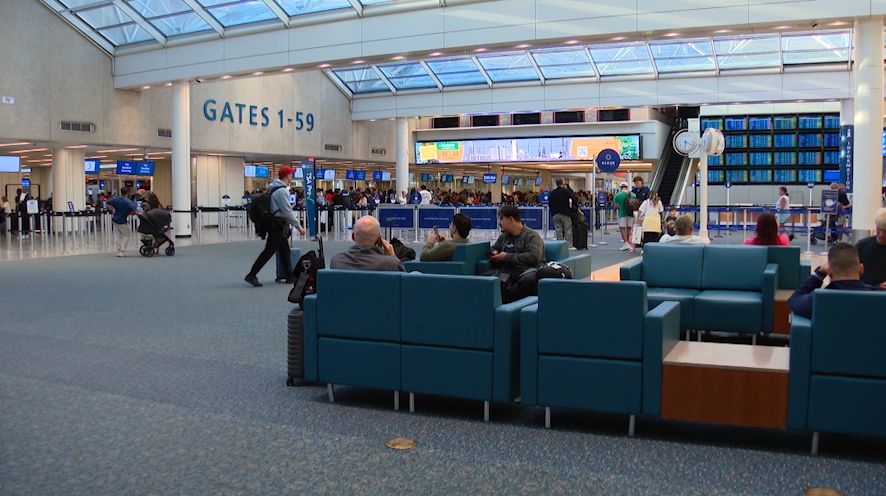
ORLANDO, Fla. — The delays experienced at LaGuardia Airport in New York were being felt by airports all over the country Monday, including at Orlando International Airport.
This has left thousands of travelers playing the waiting game at airports across the country, and caused concern in an air traffic control industry that was already concerned about the future.
What You Need To Know
A fatal crash at LaGuardia Airport in New York Sunday night had ripple effects that were felt across the nation, including at Orlando International Airport
The airport saw more than 250 delays and almost two dozen cancellations on Monday
One traveler said his spot on a flight to Rhode Island was given away, which left him waiting for close to 18 hours for the next flight
Monday proved to be a whirlwind of a travel day for some as red and yellow marked up the display board at MCO.
According to FlightAware, MCO saw more than 250 delays and almost two dozen cancellations in and out of the airport.
Ryan Porter was one of those people — he arrived at his gate in route to Providence, R.I., just moments before the gate was going to close. But when he got there, airline employees told him his seat had been given to someone else.
“It’s not until tomorrow at noon, 12:30,” he said of his new flight. “It’s 6:30 at night right now, so I got another 18 hours to go.”
Porter said the situation at LaGuardia was the cause of his travel issues.
“The whole reason that my flight got screwed up is because people that are trying to get back to New York and they’re just putting them on all on the Northeast flights,” he said. “So, they’re putting them to Rhode Island or what have you and that’s how I got bumped.”
This has become the reality for a lot of travelers, as the impacts of Sunday’s incident at LaGuardia go beyond just the people catching flights.
“This is significant, and this is concerning,” said Embry-Riddle Aeronautical University Associate Professor and Air Traffic Management Program Coordinator Dr. Michael McCormick.
McCormick has spent his career ensuring that future air traffic controllers have the proper training and said that Sunday’s incident was due to a combination of factors, including systematic errors and possibly not having enough trained staff on the clock.
He said one of the biggest goals at Embry-Riddle is to train students in a timely manner to help with the nationwide air traffic controller shortage.
“Our students can actually apply 12 months prior to graduation to become an air traffic controller,” McCormick said. “They then receive a written evaluation and a performance evaluation just like the FAA controllers at the academy in Oklahoma City.”
But while there are concerns, McCormick and other experts say the controllers who are working are well-trained and are conscious about people getting to their destinations safely.
“I would not hesitate to get on a flight right now,” said Jim Cardoso, the senior director for the University of South Florida’s Global and National Security Institute. “I wouldn’t think, ‘Oh my gosh, we’re at a high level risk now.’”
While McCormick said it will still be multiple months, if not years, before there are enough air traffic controllers nationwide, he said that Embry-Riddle and the FAA are working hand-in-hand to improve the situation.