
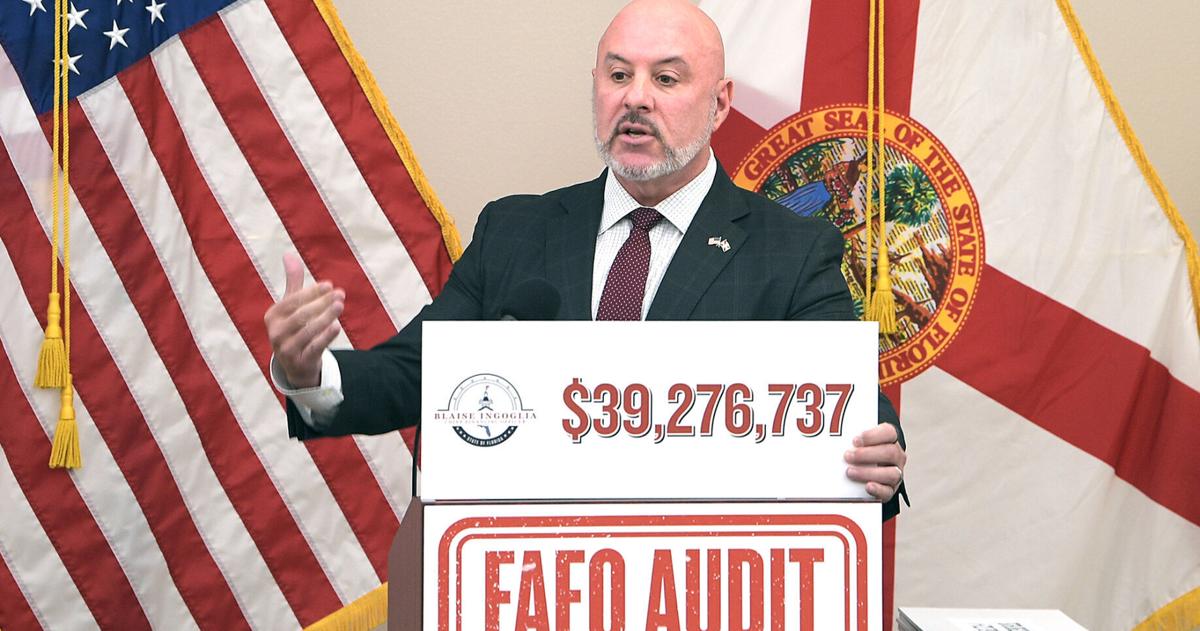

Florida Chief Financial Officer Blaise Ingoglia displays a sign Tuesday morning indicating the amount of dollars of what he calls “wasteful spending” he and his staff have identified within Citrus County government. Ingoglia held a press conference at the Realtors Association of Citrus County, putting a spotlight on his priority — taxpayer waste.
Matthew Beck/Chronicle photo editor
{p dir=”ltr”}Florida Chief Financial Officer Blaise Ingoglia came to Citrus County on Tuesday morning and delivered a jolt to attendees at a press conference: the county has wasted taxpayer money “to the tune of $39.2 million.”
He also highlighted another striking figure: Citrus County has added 278 full-time government employees over the past six years to serve a population increase of just 15,314.
“It doesn’t make sense,” Ingoglia told the crowd gathered at the Realtors Association of Citrus County in Lecanto.
Ingoglia has been traveling across Florida, holding press conferences in county after county to present his findings on what he calls wasteful local government spending based on his budget analysis formula.
The numbers, unveiled publicly for the first time, drew murmured gasps and prompted county commissioners to call for answers from County Administrator Stever Howard.
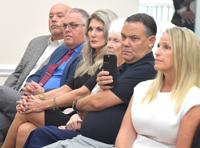
Elected officials, including County Commissioner Jeff Kinnard, Schools Superintendent Scott Hebert, County Commissioners Rebecca Bays, Janet Barek and Diana Finegan sit in the front row of the press conference Florida Chief Financial Officer Blaise Ingoglia held at the Realtors Association of Citrus County Tuesday morning. The CFO identified more than $39 million of what he calls “wasteful spending” within county government.
Matthew Beck/Chronicle photo editor
Commissioner Janet Barek said that one place to begin right-sizing government is Howard’s salary, which she called excessive at almost $225,000 annually. She plans to raise the issue at the next commission meeting.
She added that most of the 278 new employees have been hired during Howard’s tenure and, along with what she described as an overreliance on consultants. She said changes are needed.
Howard did not attend the workshop because he is on a cruise, Commission Chairwoman Diana Finegan said. When he gets back, she plans to meet with him about his hires.
“I want to know about these employees and what positions they serve,” she said.
Finegan said the $39 million figure did not surprise her, citing constituent concerns about rising taxes.
“Citrus County can do better – we absolutely can do better,” she said. “The five of us (commissioners) need to rally together and make this stop.”
Commissioner Jeff Kinnard said one of the largest recent expenditures was $12 million-$13 million for road resurfacing, which was driven by public demand.
Still, he acknowledged tough decisions ahead.
“When the CFO pulls out those numbers, you’ve absolutely got to look at it,” he said.
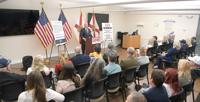
Florida Chief Financial Officer Blaise Ingoglia addresses a group Tuesday morning at the Realtors Association of Citrus County in Lecanto.
Matthew Beck/Chronicle photo editor
By the numbers
Ingoglia said his office calculated the $39 million figure using a formula he has applied across Florida: start with the pre-COVID (2019-20) budget, adjust it annually for population growth and inflation, and estimate a “reasonable” current budget.
That estimate is then compared to actual spending, with any excess deemed wasteful. In Citrus County, the budget grew from $106 million in 2019 to $182 million in 2025.
Statewide, he said, his office has identified $1.98 billion in “waste” using this method.
Other highlights
Ingoglia, citing fiscal-year budgets from 2019 to 2025, included these highlights:
Population increased by 15,314 (10 percent), while 278 full-time employees were added. Of those, 64 were first responders.
The general fund, supported by taxpayers, grew by $76.8 million, a 73 percent increase in six years.
That growth equates to about $5,000 in added budget per new resident, or $20,000 for a family of four.
Ingoglia criticized local spending practices, saying officials promote affordability while showing “zero fiscal restraint” and treating taxpayers like an “endless ATM.”
“Local government will not control itself,” he said.
He added that many local officials are surprised when confronted with such figures, but said the path forward is clear: budgets must be reduced because “the people have had enough.”
Property tax reform
Ingoglia repeatedly tied his findings to the push for property tax reform.
“Property tax reform is going to come and local government is going to have to come back and right-size their government,” he said.
He supports Gov. Ron DeSantis’ push for a constitutional amendment that would allow voters to limit or restructure property taxes.
The goal is to ease the burden on homeowners while shifting local governments toward more efficient spending and alternative revenue sources.
Ingoglia maintains that existing budgets contain enough excess to cut taxes without reducing core services, arguing that trimming unnecessary spending can preserve funding for police, fire, and schools.
What’s next
County commissioners are expected to take up Ingoglia’s findings at their next meeting.
Before the CFO’s remarks, Jeff Kottkamp, president and CEO of the Florida TaxWatch, addressed the audience and expressed support for identifying government inefficiencies.
“We have every right to question what the government is doing with your money,” Kottkamp said.