
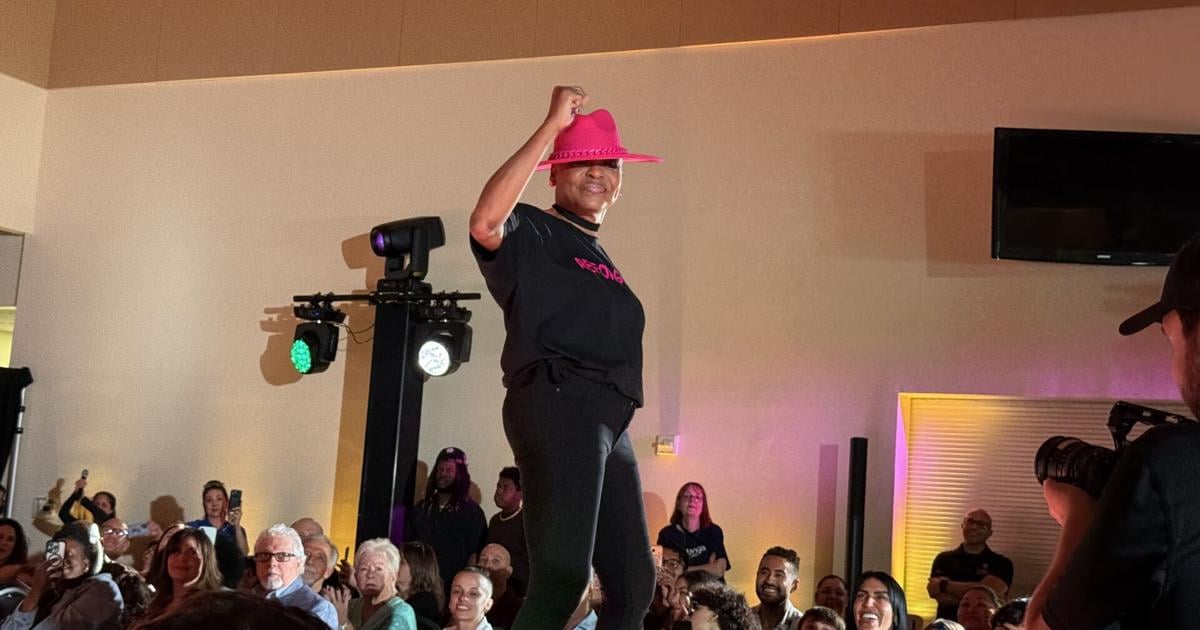
Last Saturday, six individuals with limb loss walked a runway in what organizers hope becomes a landmark moment for a community too often left out of the conversation on fashion.
“Runway Without Limits,” held in Long Key Natural Area & Nature Center in Davie, brought together patients from Hanger Clinic and Strive Recreational Therapy for an adaptive fashion show nine months in the making — one built not just around clothing, but the belief that life after limb loss is still a full one.
“That beauty — it’s a lot more than what society tells you that it is,” said Lizbeth Uzcategui, a patient care coordinator at Hanger Clinic with an amputation herself. “You have to feel beautiful inside so you can really project it and then just keep on going in your life.”

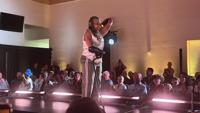
Zerlyn Jones, wearing adaptive clothing, waves to the audience.
(Rafael Hernandez for The Miami Times)
The event centered on adaptive clothing, garments designed specifically for people living without limbs, featuring magnets and zippers in place of buttons and clasps to make dressing easier. For many of the models on stage, it was their first encounter with clothing made with their disabilities in mind.
“The adaptive clothing is amazing,” said Eric Thompson, who lost his left arm and both legs last year after a medical emergency cut off blood flow to his limbs. “There’s no button, there’s nothing to stress yourself over. Just put it on and everything comes together by itself.”
Thompson said stepping onto the runway felt nothing short of cinematic.
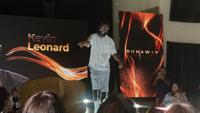
Kevin Leonard steps out wearing adaptive clothing.
(Rafael Hernandez for The Miami Times)
“When I step on the stage, it feels like one of those big Armani Exchange runways — Tommy Hilfiger,” he said. “It made me feel good, real good.”
The show was born from a chance encounter.
Uzcategui, having been born without her right arm, met Patricia Edwards, a fashion stylist who lost her left arm in a car accident, and immediately saw the possibility.
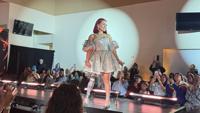
Alba Alonso steps out in an outfit that most represents her style.
(Rafael Hernandez for The Miami Times)
“I saw her and I was like, ‘You are absolutely gorgeous, and I wanted to put a fashion show and you evidently could be a model,’” Uzcategui recalled. “And she’s like, ‘I’m a fashion stylist.’ I’m like, ‘Oh my God, we need to talk.’”
From there, Uzcategui partnered with Irama Debourg of Strive Recreational Therapy, and the core team began taking shape.
Work started in June 2025, and the models selected were chosen not just for interest, but for consistency, Uzcategui said.
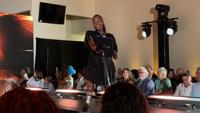
Sporting two new prosthetic legs, Shaniah Rolle, strikes a pose.
(Rafael Hernandez for The Miami Times)
“We had to disqualify, basically, the people that didn’t have the discipline of doing what we needed them to do — just being on top of how to walk, what to do, come to the meetings, work on their inner healing as well, their inner beauty.”
For Alba Alonso, who lost her right leg in 2020 after being struck by a drunk driver, crossing that runway felt like crossing a threshold.
“The adrenaline was definitely pumping, but it was a very freeing feeling,” she said. “I just felt very accomplished, and like I was entering a new chapter in my life.”
Alonso said the adaptive clothing’s ease was just as significant as its symbolism.
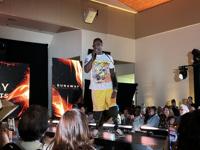
Eric Thompson, performing under his stage name “Limitless,” sings an original song to open the show.
(Rafael Hernandez for The Miami Times)
“It is hard to do something as simple as taking on and putting on clothes,” she said. “It’s made with us in mind, and it makes it easier.”
Kevin Leonard, who lost both feet — his right in a workplace accident at the Port of Miami 21 years ago and his left surgically afterward — said the experience reshaped how he thinks about living without limbs.
“The most important tool that you have is not your muscle, but your mind,” he said. “If you want to accomplish any goals, it will require critical thinking and deep patience and having grace for yourself.”
Leonard also said the show introduced him to a world he didn’t know existed.
“I did not know anything about adaptive wear until I got involved with this,” he said. “I would encourage people to go and do some research.”
Uzcategui said the show is just one piece of a broader effort to reconnect amputees with life beyond the clinic, including kayaking, golf and scuba diving events run alongside Strive Recreational Therapy.
“When you see all the people doing things that you never thought you could do, your options expand,” she said. “The limitations just, the barriers kind of calm down, and then you really get to blossom.”