
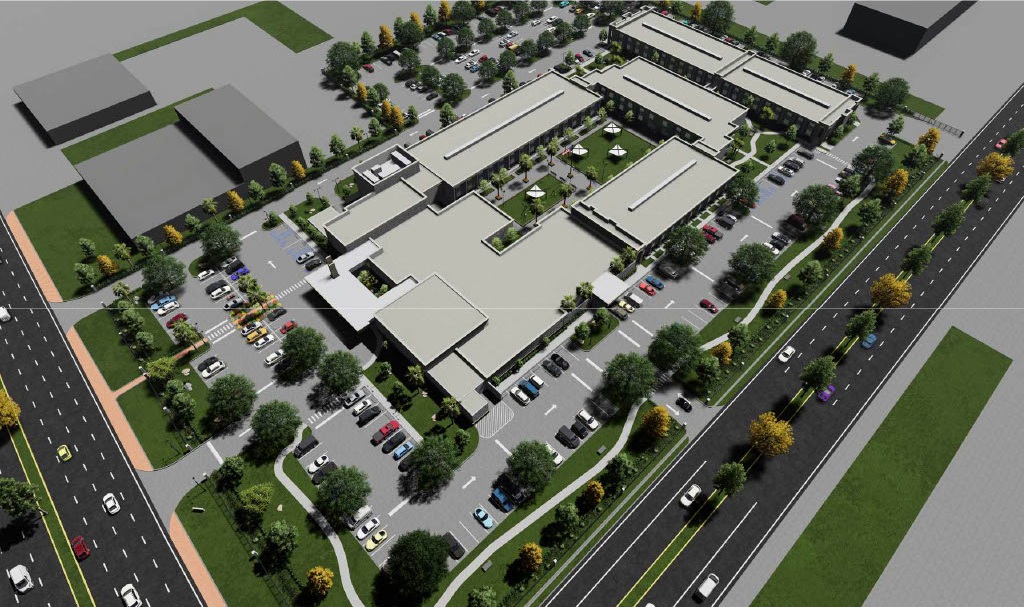
Plans filed recently with Orange County seek to transform a defunct Econo Lodge hotel on Orange Blossom Trail into workforce housing.
Gregory Crawford, with Thomas & Hutton’s Orlando office, filed a land use plan on March 20 on behalf of New Jersey-based InTown Orlando GSN. The proposal would convert the OYO Hotel Orlando Airport at 7100 S. Orange Blossom Trail, near the intersection with Holden Avenue, into an apartment complex. The site is about 8 miles from Orlando International Airport.
Ravi Sheth, who’s part of the ownership group, previously told GrowthSpotter the property was well-located for affordable housing.
“We’ve been there for a while, and we realized that having a multifamily location would be much more beneficial to the area,” Sheth said in the 2025 interview. “We’re not 100% going to be affordable. We’re looking at everything.”
The property sits on two parcels. On one parcel, the 212-room motel would be converted to 212 studio apartments, all set aside for affordable housing. The other parcel is a vacant
restaurant and banquet/warehouse building. which would be converted to 20 studio units and 26 two-bedroom apartments.
The hotel was last renovated in 2018 when the ownership group revamped the building’s facade.
The affordable units would be available as studio apartments for people making less than 80% of the area median income (AMI) — calculated annually by the federal government. The 2025 AMI for one person, the latest available, for Orange County is $59,040 for a one person, according to the U.S. Department of Housing and Urban Development.
Before the conversion can move forward, the county would have to agree to four separate waivers requested from Orange County codes regulating landscape buffers, parking, and minimum unit size.
The first two waivers seek to eliminate the required buffer along the eastern portion of the south property line and to reduce the rear yard buffer along western property line from 7 feet to 3 feet. The developer said the property was built in the late 1960s under existing codes, and meeting today’s buffer requirements would hamper vehicular circulation on the site and reduce the on-site parking.
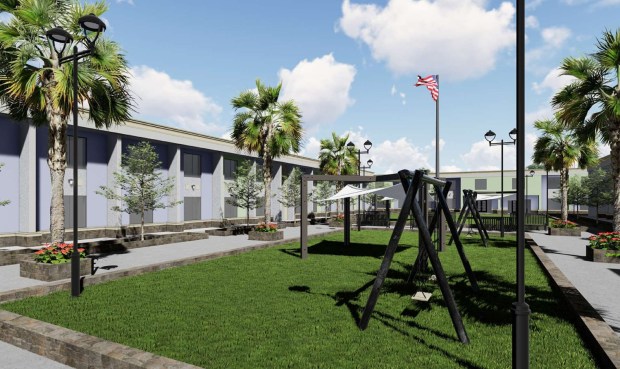 A rendering of what the courtyard surrounded by the former Econo Lodge hotel at 7100 S. Orange Blossom Trail would look like after it’s converted to an apartment complex of mostly affordable housing. (Image provided by Thomas & Hutton)
The third waiver seeks a parking reduction for the studio and one-bedroom apartments, for a total of 335 spaces, down from the 400 required by code.
To justify the waiver, the owners provided a parking study that says residents of the “workforce housing” typically don’t own vehicles and tend to rely on public transportation. They noted that Lynx recently expanded the bus stop in front of the property.
Lastly, the owners seek a waiver from the required 500 feet of minimum living area per unit to allow 350 square feet, again citing earlier codes which allowed smaller units. They say smaller units help utilize existing infrastructure, offer lower rental rates and increase availability of affordable housing. The owners also pointed to shared amenities, such as laundry facilities, outdoor spaces, community rooms and tenant storage.
Richard Rubin, a veteran adaptive reuse developer and principal/founder at Babylon AG/EGRE (Adaptive Reuse/Endeavor Group Real Estate), is not involved in the Econo Lodge project but said the waivers being sought are common with such developments.
“Generally, the whole advantage to purchasing a hotel and doing a conversion is that you can use, for the most part, one hotel room to one unit,” Rubin said. “As soon as you start combining two modules into a 700-square-foot apartment, which does happen, your costs are much higher.
“Talking about the financing of these things, what kills a lot of these deals is … land use and entitlements (including) density, parking, easements, landscaping, minimum unit size, impact fees, insurance premiums.”
He said the high cost of complying with current land-use regulations can be the death knell for such projects.
He said the ongoing housing crunch and the project’s location — near a major airport and theme parks — mean demand for these smaller-sized affordable housing units will continue because people always need a secure place to live.
Adaptive reuse projects have surged since the coronavirus pandemic changed how people live, work and relax, Rubin said. Florida’s tourism-based economy, combined with its inventory of old hotels and motels, provides fertile ground for conversions. But securing financing for such projects is no easier than construction starting from the ground up, he said, adding that supporters often pursue tax credits or incentives from local governments.
“It’s never easy to procure debt for projects, even if they are affordable, whatever that means,” Rubin said. “There’s no special pool of funding which exists for adaptive-reuse projects.”
Brian Bell can be reached at bbell@orlandosentinel.com. Have a tip about Central Florida development? Email Newsroom@GrowthSpotter.com. Follow GrowthSpotter on Facebook and LinkedIn.