
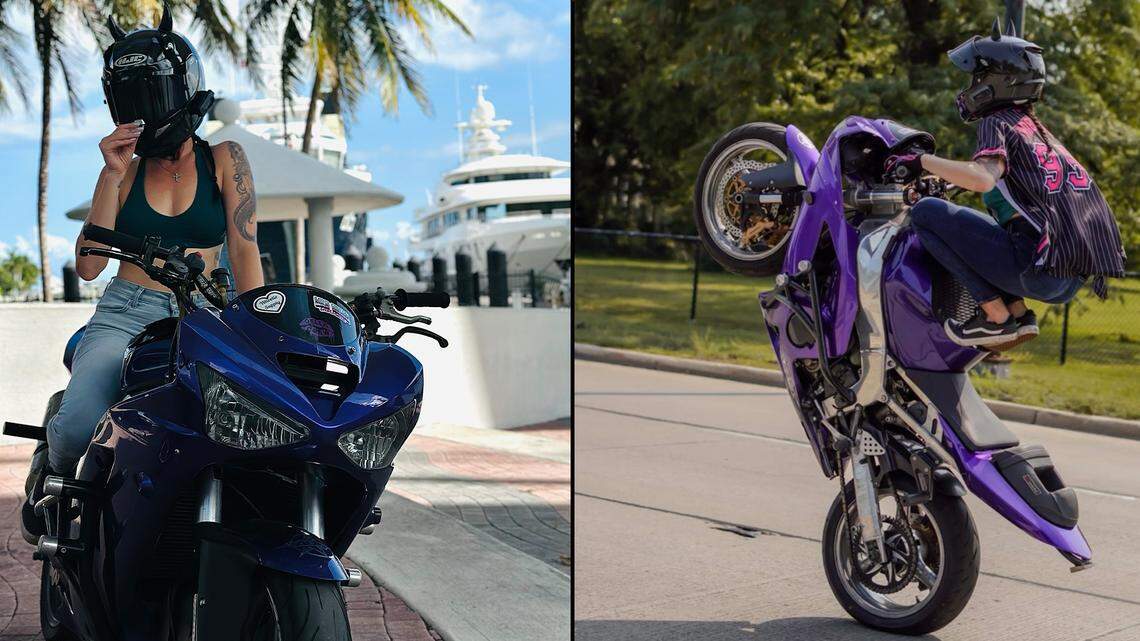
Robyn Stunts in Fort Lauderdale (left) and performing a “frogger” wheelie in Chicago (right).
Photos by Veneno Torres and Austin Moore
FIU Caplin News
Michelle Bartolotta was 29 years old when she lost her boyfriend, Nick, in a motorcycle crash. He had been teaching her how to ride throughout their 10-month relationship. He was a stunt rider, performing wheelies and tricks that drew her into a world she had never seen.
She didn’t have her own bike and could have walked away.
But instead, she bought a 300cc Yamaha.
“I felt like I needed to honor him,” said Bartolotta, now 32. “Because it’s what he wanted for me, and it’s what I wanted for myself.”
Bartolotta is one of a growing number of women bikers across South Florida. They are not recklessly riding for attention. They are some of the best on the road, and there are more of them every day.
“Bikers have a stigma that we don’t follow the law,” said Daniela Montoya, a Miami real estate agent who has been riding since 2021 and also lost a loved one in a motorcycle crash. “But a whole bunch of us are professionals. We do follow the rules.”
In 2023, 621 people were killed in motorcycle crashes across Florida — nearly two lives lost every day. Despite those risks, women riders in South Florida are becoming more visible on the motorcycle scene, planning their own meetups, safety briefings and events across Miami-Dade, Broward and Palm Beach counties.
One of the women organizing those meetups is Robyn Stunts, a motorcyclist who rides a 636cc Kawasaki Ninja. She works in the finance department at Ducati North America. Stunts helped launch Ladies Rides events in South Florida in 2024, drawing dozens of women at a time. Before every event, she gathers the group for a safety briefing, reviewing procedure and the planned route.
“The most important thing to me is to ride your own ride above anything else,” Stunts said. “Don’t go above your comfortable speed.”
The group assembles in a staggered formation and uses hand signals to communicate road hazards and turns. They also review the planned route before taking off.
The plan aims to keep the group together and reduce risks in busy traffic.
Yamilet Orta, who has been riding for about five years, said many women prefer riding together.
“It’s more responsible,” Orta said. “We use hand signals. We stay staggered. We stick with each other.”
Orta, who owns a 689cc Yamaha, said mixed motorcycle rides, which are predominantly men, can feel chaotic, with people traveling at different speeds or performing stunts.
“Other riders are just very unpredictable,” she said. “Sometimes they can run into you, or you can run into them.”
Chena Hernandez, 19, said she slid 60 feet across a wet road after applying too much rear brake during one of her early rides, stopping just short of a parked car.
She walked away shaken but physically unharmed. Her first instinct was to quit.
“I was like, I’m selling the bike,” she said. “And then after a couple of days I was like — I’m gonna fix this bike up.”
She spent two and a half weeks in a parking lot repairing the bike. That crash, she said, made her the rider she is today.
For many women, the community goes beyond the road. Bartolotta said many long-term friendships are formed through the meetups.
“As a girl, it’s almost not optional — you need to find your girls to ride with,” Bartolotta said. “We’ve formed real friendships. I’ve met a lot of girls that have really been there for me in hard times.”
Anna, a criminal defense attorney who started riding just before beginning law school and asked not to have her last name used, said the women-led community is more than a trend.
“We’re coming into a world where we are underestimated, where we have to work harder for things,” she said. “So when we all get together, we are just overly supportive of each other.”
But even with that support system, the reality behind what can happen never leaves their minds.
Angel Sanchez, a nurse who has worked in an intensive care unit, rides a 700cc Yamaha R7 and said she has seen the consequences of motorcycle crashes firsthand.
“I’ve seen trauma,” Sanchez said. “When people find out I’m a nurse and I ride a motorcycle, it’s not the most common mix.”
Sanchez said those experiences make her more aware of the risks she might encounter.
“You always have to respect the machine so you can get home every day,” she said.
Despite the dangers, many women say the experience offers something they cannot find anywhere else.
Bartolotta and Montoya’s decision to keep riding after losing a loved one reflects their resilience.
“The freedom you feel on those two wheels is something you can’t compare,” Montoya said. “You make so many friends and connections. Your life changes completely once you start riding.”
Bartolotta said the support she found within the riding community made the experience feel empowering.
“You’re never too old,” Bartolotta said. “There’s never going to be a good time. You just have to do it.”
This story is the result of a partnership between Florida International University’s Lee Caplin School of Journalism and Media and the Miami Herald.