
There’s been a major reduction in Miami Beach’s homeless population over the last few years — and the city has been using increasingly aggressive tactics to help make it happen.
Police ratcheted up enforcement of a ban on outdoor sleeping, making around 800 arrests in 2025.
City workers installed concrete bumps on walls to make them more difficult to sit or sleep on.
Officers even began flying drones to find homeless people hidden in the dunes along the beach, launching more than 40 drone flights last year that led to eight people being arrested.
Now, city officials are celebrating their success — despite criticism from advocates who say Miami Beach is simply pushing the homeless population into jails, shelters and the street in other parts of the county.
At his State of the City address last month, Mayor Steven Meiner revealed that an overnight census in January had identified just 93 homeless people in Miami Beach — the city’s lowest figure since the Miami-Dade County Homeless Trust began conducting counts in 1997.
The same census showed increases in the homeless population in the city of Miami and countywide.
.png "unnamed (1).png") A chart shows how the homeless population in Miami Beach has changed over the past three years, according to overnight counts by the Miami-Dade County Homeless Trust. Miami Beach Mayor’s Office
A chart shows how the homeless population in Miami Beach has changed over the past three years, according to overnight counts by the Miami-Dade County Homeless Trust. Miami Beach Mayor’s Office
The new push began in 2023, when Miami Beach commissioners revised the city’s camping ordinance so that police no longer had to issue a warning before making an arrest.
Enforcement was sporadic at first. It picked up in 2024. Then, last year, arrests more than tripled compared to the year before, according to data obtained by the Miami Herald through a public records request. Since the ordinance was changed, officers have made more than 1,100 camping arrests.
Last year, almost half of all arrests in the city — 45% — were of people who are homeless.
Beyond camping arrests, Miami Beach has gone to great lengths to make it harder for people to live outdoors.
Police drone flights over dune areas have discovered 80 homeless “encampments,” according to city officials. The police department “proactively surveils” the dunes “to aerially discover any encampments or illicit behavior,” a city memo says.
Miami Beach has also installed what’s known as “hostile architecture” to prevent people from comfortably sitting and lying down in certain areas, adding bumps along a low wall near volleyball courts in North Beach and to a wall on the boardwalk near Lincoln Road, a tourist hotspot.
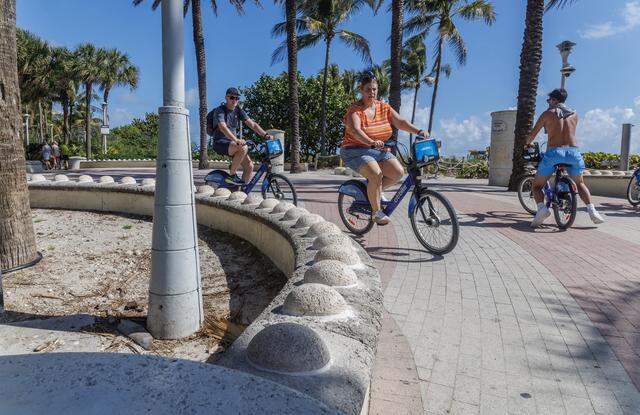 Bikers ride by round concrete bumps installed by the city of Miami Beach on low walls along the boardwalk near Lincoln Road on Tuesday, March 10, 2026. Pedro Portal pportal@miamiherald.com
In response to detailed questions from the Herald, city spokesperson Melissa Berthier said the decrease in Miami Beach’s homeless population is “encouraging” and attributed the trend to more than just arrests.
“While there may be a perceived correlation with increased enforcement following the updated camping ordinance, the City’s approach is far more comprehensive and service-driven than enforcement alone,” Berthier said. “Our primary focus continues to be on connecting individuals experiencing homelessness with meaningful services, support, and pathways to stability.”
The city brought more than 500 people to shelters and reunited 239 people with their families or helped them relocate in the last fiscal year, Berthier said.
[Click here to read the city’s full responses to questions from the Herald.]
The decline in homelessness has been noticeable, said Eugene “Gino” Gordon, who is homeless in the city and was arrested for camping in 2024.
“It’s very unfriendly right now,” he said.
Gordon, 47, said he has found ways to navigate the camping ban, including training himself to wake up to the sound of a police ATV approaching if he falls asleep on the beach. He has faced other low-level charges but hasn’t been arrested for camping again.
But he often goes days with only a few hours of sleep, he said. Sometimes, he asks people for permission to sleep near their businesses or homes, and they agree not to call the cops.
“I have some people that are rooting for me,” Gordon said. “I have a little bit of comfort to know that I may be able to sleep through the night.”
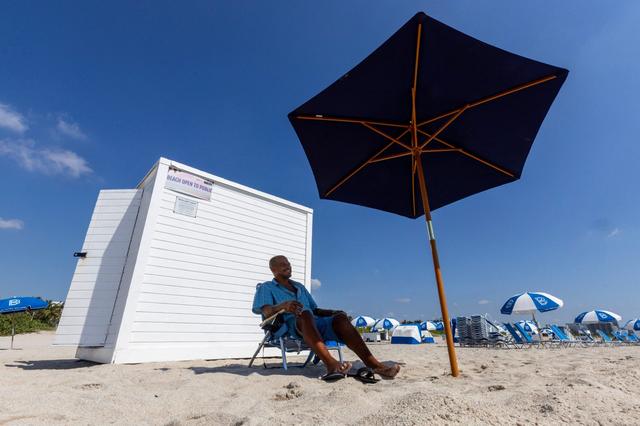 Eugene “Gino” Gordon is pictured on Wednesday, May 29, 2024, in Miami Beach. D.A. Varela dvarela@miamiherald.com
Mitch Novick, the longtime owner of the Sherbrooke Hotel in South Beach, said he sees fewer homeless people than he did in the past when he runs and rollerblades through the neighborhood each morning. That’s a positive step, he said, though “the problem still persists.”
Previously, Novick said he saw the same homeless people each day — and got to know many of them. That’s no longer the case.
“Now, if anything, it’s more transient than ever,” Novick said.
The city has been under pressure from some Miami Beach residents to take action.
In a June 2024 Facebook post, Commissioner David Suarez noted that residents had been “demanding action on the homeless problem” and said enforcement was picking up.
One resident commented that he moved to Miami Beach from California “precisely because we were sick and tired of the absurdity of the homeless policy there . . . What Miami Beach is doing is the only possible way to preserve the integrity of our city.”
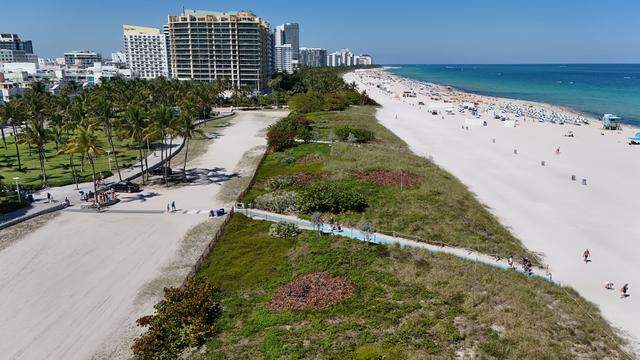 Since last year, Miami Beach police have conducted more than 40 drone flights over the dune area along the beach that located 80 homeless “encampments” and resulted in eight arrests, according to city officials. PHOTO BY AL DIAZ adiaz@miamiherald.com
Miami Beach officials stress that the camping ban requires that homeless people be offered a shelter bed before they can be arrested. And they point to millions of dollars that the city spends each year on services for the homeless population.
Miami Beach is “a compassionate city that leads with services first,” Meiner wrote in a March 5 email to residents.
“Our dedicated homeless outreach teams are active every day, and shelter placements and reunification efforts are also making a real difference,” the mayor said. “At the same time, we continue to enforce our anti-camping laws to protect neighborhoods, parks, and public spaces. It is truly a balanced approach. And our strategy is working in a big way!”
Camping arrests lead to jail time
People arrested for public camping are frequently spending time behind bars, according to data from the city’s municipal prosecution team, which handles city ordinance violations in state court.
City prosecutors have regularly asked judges to require bonds in camping cases. The defendants, facing bonds in the range of $150, can rarely pay their way out. Some have spent more than two months in jail on camping charges, records show. Often, they plead guilty and are released with “credit for time served.”
“When a client is homeless, there’s no way they’ll be able to afford a bond,” said Carlos Martinez, the Miami-Dade County public defender.
More recently, city prosecutors have agreed to let people go free if they don’t have any violent felony convictions in the past 10 years. Those people must also agree to report to the city’s homeless outreach office within 24 hours of their bond hearing.
For many, the camping ordinance has meant a revolving door between the street and a jail cell. The Herald reviewed police data and identified 187 people who have been arrested under the ordinance more than once. One man has been arrested for camping a dozen times.
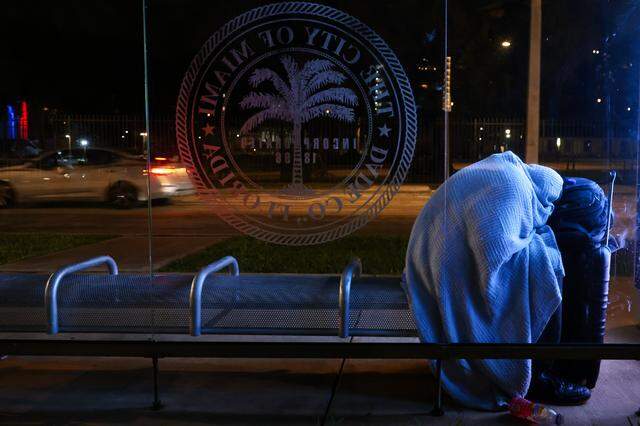 A homeless man sleeps at a bus stop in downtown Miami during the Homeless Trust’s biannual homeless census on Thursday, Jan. 22, 2026. SAM NAVARRO Special for the Miami Herald
Ron Book, who leads the county’s Homeless Trust and has sparred with Miami Beach leaders, said he wasn’t surprised to see the city’s homeless population going down, something that belies county trends.
Across Miami-Dade, the Homeless Trust identified 1,184 people living on the street in its January survey, the county’s highest number since 2008. The count found 605 such people in the city of Miami, an 11% increase from a year before.
Miami Beach officials are “exporting their homeless problem,” Book told the Herald.
“All the evidence suggests that after those people served their short-term jail stints, they were simply released back into homelessness elsewhere in the County,” he said in an email.
Using the criminal justice system to combat homelessness “is costly and does not result in improved outcomes,” Book added. The Miami-Dade Corrections and Rehabilitation Department estimates that it costs taxpayers $294 a day to keep someone behind bars.
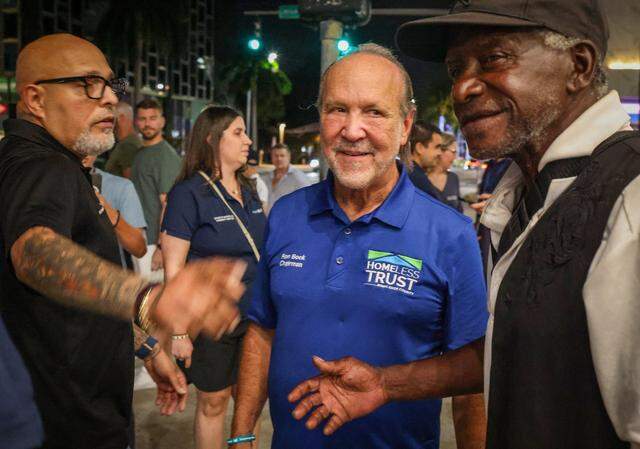 Miami-Dade County Homeless Trust Chairman Ron Book, center, participates in an overnight count of the homeless population on Lincoln Road in Miami Beach on Thursday, Aug. 22, 2024. Carl Juste cjuste@miamiherald.com
No other city in Miami-Dade is mimicking Miami Beach’s camping crackdown, despite a state law — which Gov. Ron DeSantis signed in Miami Beach alongside Meiner in 2024 — that subjects cities and counties to lawsuits for allowing people to sleep in public.
But Berthier said the city “strongly disagrees” with Book’s characterization that the city is “exporting” its homeless population.
“The data and day-to-day operations of our Homeless Outreach Services Team reflect a comprehensive, service-driven approach focused on engagement, stabilization, and long-term outcomes for individuals experiencing homelessness — both within our City and across the broader County system,” she said.
Offers of shelter beds often go rejected
There are no shelter beds in Miami Beach. But the city has contracts that allow it to use more than 90 beds in mainland Miami, officials said. The city also has a walk-in center for homeless people near City Hall and contracts with a nonprofit, New Hope CORPS, to provide overnight outreach services.
Miami Beach Commissioner Alex Fernandez, who supported the camping ordinance change in 2023, said part of the goal was to protect homeless people from becoming victims of crime. Whether they accept shelter or face arrest, Fernandez said, the hope is that they will end up “in a safer, cleaner place than sleeping on the streets.”
Still, when police offer shelter in lieu of arrest, people usually say no, city records show. From January 2024 through February 2026, police sent 189 people to shelters. During the same period, officers made six times as many camping arrests, the Herald’s analysis found.
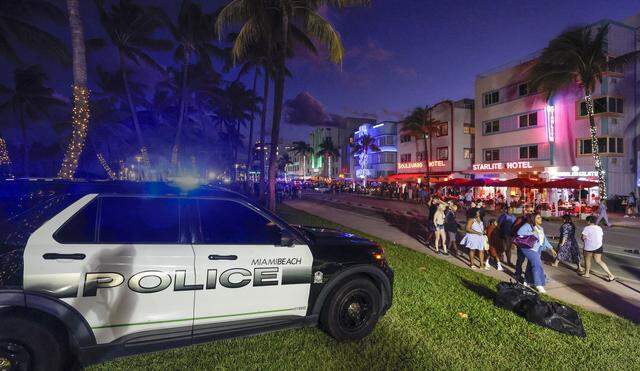 Miami Beach police monitor Ocean Drive on Friday, March 20, 2026. Officers have increased enforcement of a city ordinance banning public camping, heeding the requests of elected officials. PHOTO BY AL DIAZ adiaz@miamiherald.com
People decline emergency shelter for various reasons, including dangerous shelter conditions, strict rules, and limits on how much they can bring into the facility. Beds are typically only available for 24 hours at the Salvation Army in Miami, meaning people may return to the street the next day — without all of their stuff.
“There can be completely understandable reasons why somebody might turn down shelter,” said Stephen Schnably, a University of Miami law professor who studies homelessness. “That one night can be very costly.”
David Peery, who founded the nonprofit Miami Coalition to Advance Racial Equity and was a plaintiff in a landmark case on homelessness in the city of Miami, said a 24-hour shelter bed is “basically a glorified holding cell.”
“It simply recycles you back onto the streets again,” said Peery, who himself was homeless for years.
Berthier said that, after people are placed in a 24-hour bed, city workers meet with them at the shelter to conduct a “comprehensive needs assessment.” From there, they may be able to remain in a shelter if a bed is available, get placed into a specialized program, or be reunited with family or relocated “when a verified support system is available.”
“While the initial placement is typically short-term and immediate, it is designed as an entry point into a broader continuum of care — supported by both City outreach teams and specialized providers — that can lead to longer-term stabilization and housing solutions,” Berthier said.
‘Remove the homeless’
Bobby Hernandez, who leads the Miami Beach police union, said officers were initially hesitant to enforce the camping ordinance out of fear that they might be accused of violating people’s civil rights. But amid questions from elected officials in May 2024 about a lack of enforcement, Police Chief Wayne Jones encouraged officers to make use of the ordinance, Hernandez said.
In an email to police leadership that month, Maj. Ian Robinson framed camping arrests as a form of “broken windows theory” policing — addressing “smaller issues” to get “bad actors out of our city” and possibly “prevent a worse incident from occurring later on.”
“The camping ordinance is a bit unique in that it still gets homeless people shelter out of our city (if they accept) thereby accomplishing the same goal as an arrest if no other charges apply,” Robinson wrote.
The number of camping arrests began to tick up around that time, records show. Now, Hernandez said, “Everybody’s enforcing it.”
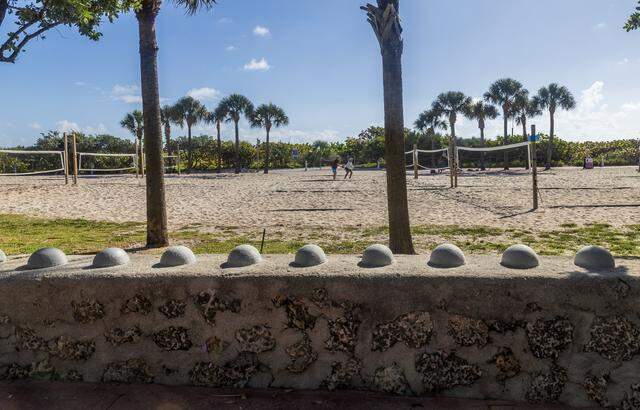 The city of Miami Beach installed concrete bumps on low walls near the Unidad of Miami Beach senior center at 7251 Collins Ave. Pedro Portal pportal@miamiherald.com
Fernandez, the city commissioner, said elected officials have sought “accountability” from police and city staff. He asked the city manager to provide weekly memos on initiatives related to homelessness, including data on camping arrests and shelter placements.
The memos track the percentage of people arrested for all offenses citywide who are homeless: 45% last year, up from about a quarter of arrests in 2021.
Residents are often on the front lines of enforcement, contacting elected officials to complain and share photos of those who appear to be homeless. The officials then pass the messages along to the city manager and police chief.
In August, someone emailed Meiner a series of photos showing people sleeping outside — on a wall near the boardwalk, on the beach sand, atop a lifeguard stand. “This is dangerous. It’s also horrible for business,” the person wrote.
“I agree that this is not acceptable,” Meiner responded, copying the city manager and police chief.
.png "image (3).png")
.png "image (4).png") Miami Beach Mayor Steven Meiner responded to an email from a resident who raised concerns about the homeless population last August.
Miami Beach Mayor Steven Meiner responded to an email from a resident who raised concerns about the homeless population last August.
In December, another resident emailed Meiner: “Could you please , send a police @ night and remove the homeless from 917 Alton road. Garbage side. I have someone camping there behind the garbage.”
Meiner forwarded the message to the police chief and city manager, who replied: “Mr. Mayor, We are on this.”
At a City Commission meeting last week, Meiner said he doesn’t receive as many complaints as he once did about the homeless population — an apparent result of the city’s ramped-up efforts.
“I used to get complaints all the time about homeless individuals,” Meiner said. Now, “it’s much more rare.”

Miami Herald
Aaron Leibowitz covers the city of Miami Beach for the Miami Herald, where he has worked as a local government reporter since 2019. He was part of a team that won a 2022 Pulitzer Prize for coverage of the collapse of the Champlain Towers South condo building in Surfside. He is a graduate of Columbia Journalism School’s Toni Stabile Center for Investigative Journalism.