
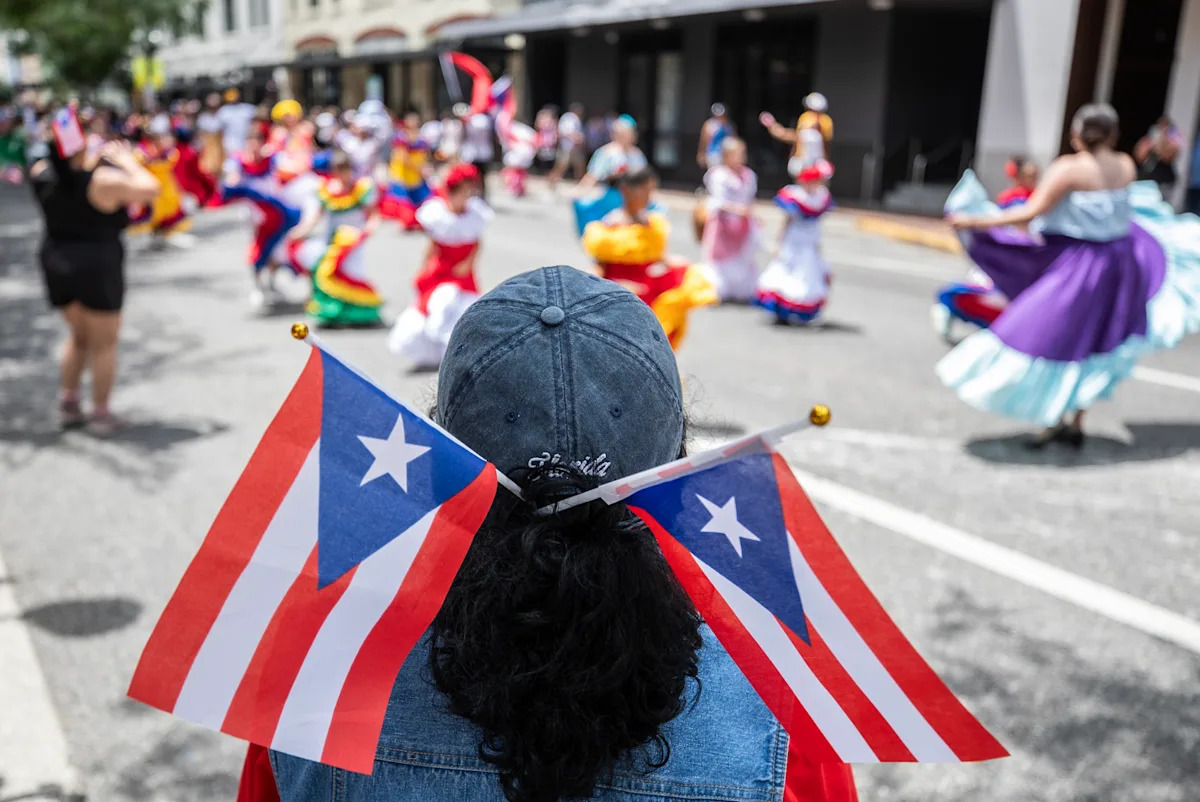
The Florida Puerto Rican Parade celebrates its 10th anniversary in April, but its leaders said the event may not happen in 2026 due to what they called an unfair hike in costs and fees by the city of Orlando.
An anti-DEI bill set to be signed by the governor may further hamper the parade.
At a press conference on Tuesday, parade leaders and organizers asked for donations in order to pay the city $53,000 to host this year’s parade along a roughly one-mile loop near Lake Eola.
That number includes $28,000 for police, $7,000 for EMTs, $3,000 for parking meters, $7,000 for clean up, $7,000 for a traffic plan and $1,000 for other permits, they said.
Organizers added that they paid the city $20,000 for police services last year and just $12,000 in 2024.
They also said the city has already cut its own monetary contribution to the event. For many years the parade received roughly $20,000 from the city, Cacares said, but last year it decreased to just $5,000.
“When you see this treatment, you can be led to think that they are going to raise prices until we leave,” Pablo Caceres, director and treasurer for the Florida Puerto Rican parade, said in Spanish. “And I’ll tell you right now we are not leaving.”
Orlando spokesperson Ashley Papagni said the city is still calculating the total for the parade this year.
However, it was unclear whether any particular changes — such as increases in hourly pay or increased numbers of police assigned along the route — played a role in a price hike for the Puerto Rican parade.
The conflict between the parade organizers and the city also comes as legislation to ban local government from any diversity, equity and inclusion initiatives heads to Gov. Ron DeSantis’ desk for his signature.
The bill prohibits cities and counties from spending money to promote or sponsor any actions related to “diversity, equity and inclusion,” which critics have said could impact events ranging from Pride festivals to St. Patrick’s Day parades. It also stipulates that local officials who don’t comply can be removed from office and local governments can face litigation.
State Democrats vehemently opposed the legislation, saying it went too far and lacked clarity, but it passed both chambers along mostly partisan lines.
If signed, the law would take effect Jan. 1. Papagni said anti-DEI legislation did not affect the size of the contribution from the city this year.
Although parade leaders did not mention the legislation, the parade — set for April 25 this year — transforms the streets of Downtown Orlando yearly to “highlight our Puerto Rican heritage with pride”.
“This event, the parade, is not just a parade where we go marching ‘Viva Puerto Rico,’” said parade president Ralph Morales. “The parade has a symbolic impact which is to bring attention to our community. We want people to know that we have the ability to contribute greatly to our community.”
But Morales said he and the rest of his board are very concerned they may not be able to raise enough money in time.
“Today, we are on very shaky grounds,” Morales said. “Unfortunately, we are in a state and in a city where community services don’t seem to be important factor for the leaderships that exist in our government structures. Maybe they’ll shut us down.”
Last year nearly 35,000 participated in the parade and this year’s turnout is expected to match that. Florida, home to over 1.3 million Puerto Ricans according to census data, has the largest concentration in the mainland U.S. outside the island territory. The Orlando metro area has nearly 400,000 Puerto Rican residents.
Officials said donors and sponsorships to date are not enough to cover the shortfall, but they are counting on fellow Puerto Ricans and other Latin American groups to donate.
“Why must we be subjected to this kind of treatment?” Morales said. “We are Puerto Ricans. We are American citizens. We belong here.”