
ORLANDO, Fla. — A high school student in Orlando used her love for science to create an eco-friendly tool to detect microplastics.
What You Need To Know
A ninth-grade student at Orlando Science Schools was named a finalist in the 3M Young Scientist Challenge
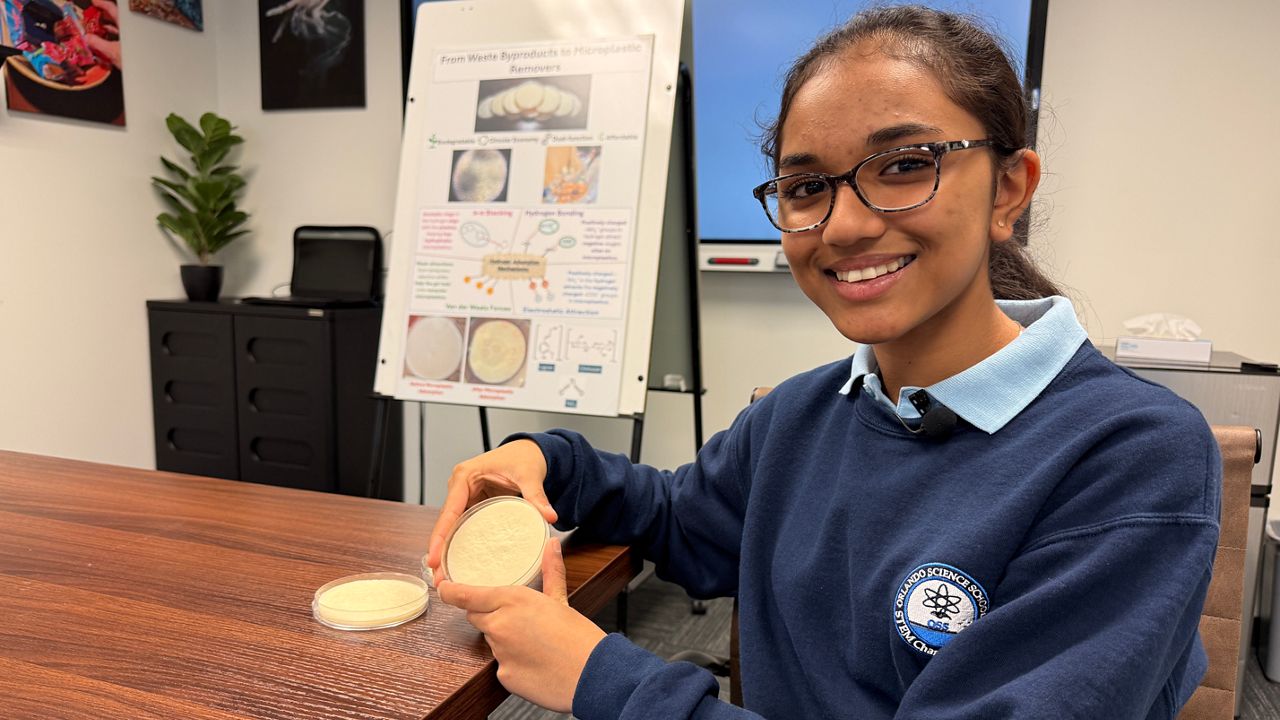
Sheyna Patel created a non-toxic hydrogel which attracts and breaks down microplastics in water
Patel used three different types of plastic in her project
A UCF Peagus Professor says microplastics are everywhere, and no one is immune
Sheyna Patel, a ninth grader at Orlando Science Schools, created a non-toxic hydrogel that attracts and degrades microplastics found in water.
“It’s able to interact with the sunlight, and it’s able to degrade and release these radicals onto these microplastics, essentially being able to degrade them over time,” said Patel.
To demonstrate, she placed the hydrogel inside a microplastic solution in the water and tested three types of plastic.
“When I squeeze this gel, water is able to come out since I developed these gels to essentially have these kind of sponge-like different properties inside the water,” explained Patel. “These microplastics are able to essentially just attract to the gel. You can imagine these gels almost like a magnet to attracting these plastics in water.”
Patel says the inspiration came to her two years ago after a trip to Kenya.
“We saw a lot of plastic pollution around the area, and I also witnessed a lot of locals drinking dirty, contaminated water. From that moment, it really just made me realize how easily many of us often overlook access to clean water and pollution in general,” she said.
Patel created the hydrogels to enter the 3M Young Scientist Challenge. She says she was mentored by a scientist to make her gel more eco-friendly and to overcome obstacles in science.
She flew to Minnesota and presented her project last week.
“It really felt truly amazing and super unreal, especially in June when they selected me as a finalist. Everything felt so surreal,” said Patel.
UCF Pegasus Professor of Biology Dr. Linda Walters says nothing is immune to microplastics. She says researchers are trying to figure out what it does to our bodies since humans breathe and consume microplastics everyday.
“What we eat, a lot of it will go away. But what we breathe is going through into our bloodstream, into our brain, and pretty much everywhere else. The field of microplastics has now turned into a really heavy-duty medical field,” said Walters.
Walters says microplastics are an interest to university students, and it takes young people like Patel to find a solution.
“We need everybody who is interested in the environment to be thinking about plastics,” said Walters.
Patel says her experience at the competition was great, and she hopes to work in the STEM field when she’s older.