
A new approach to modeling jet resonance
The research team tested a supersonic, Mach 1.5 jet — 1.5 times the speed of sound — and adjusted nozzle pressure and the jet’s distance from the ground to simulate take-off/landing and make a range of measurements.
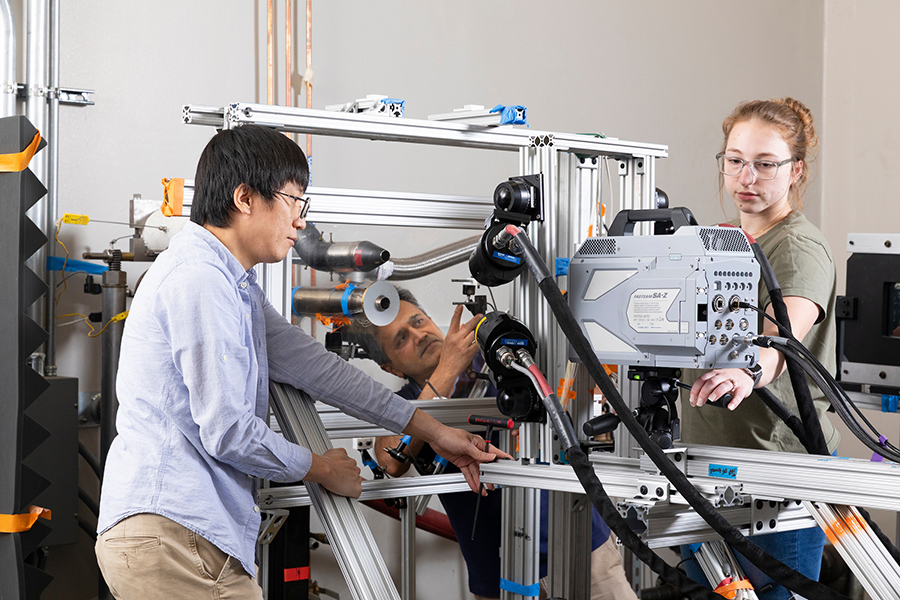
To see the airflow, they used a high‑speed camera and a specialized visualization technique called schlieren imaging that allowed them to ‘see’ the jet flow — including its large-scale disturbances and the sound waves generated in real time. At the same time, a highly sensitive microphone also recorded the sound produced by the jet.
When the jet is loud, the jet flow and the sound waves repeat at a regular rhythm, which is a characteristic of a resonant cycle. By matching images to a specific point in the cycle, the researchers developed a clear picture of the airflow and measured how fast large-scale disturbances in air moved and how sound waves traveled back toward the nozzle.
The researchers found that for many cases, the pitch — how the human brain perceives the frequency of sound waves — of the noise was primarily governed by acoustic standing waves, which appear stationary in space between the body of the plane and the ground. The findings reveal that the pitch is not primarily governed by disturbance velocity, thereby offering another perspective on the existing understanding of the resonance feedback. They also found that slower disturbances tend to be larger, consequently creating louder noise.
“That was surprising,” said postdoctoral researcher Myungjun Song, the study’s lead author. “We found that these acoustic standing waves are much more important in determining the pitch, while the size and speed of the disturbances decide the level or ‘loudness’ of the noise produced.”
The discovery offered the research team an insight. Because the disturbance speed has little effect on pitch, information about acoustic standing waves would be enough to predict the noise pitch.
The new model enables engineers to predict noise frequencies more easily during aircraft and landing pad design, a critical step toward protecting both aircraft structures and personnel from acoustic trauma.
World-class research facilities drive discovery
The experiments were conducted at FCAAP’s specialized research facilities, designed for advanced high-speed aerodynamic studies at the FAMU-FSU College of Engineering.
Researchers used the FCAAP’s STOVL facility, which offers cutting-edge flow diagnostic capabilities, and the hot jet facility, which can generate high-temperature, high-speed airflow in an anechoic chamber to allow for highly accurate acoustic measurements under realistic jet conditions.
“While jet propulsion is an important focus of our work, our research is not limited to it,” Alvi said. “The university and the college, through FCAAP, operates a polysonic wind tunnel that simulates supersonic flows up to Mach 6 — supersonic to hypersonic conditions. We also use our anechoic wind tunnel and subsonic wind tunnels for numerous other aerospace related research projects. Together, these facilities and the expertise of our researchers create a one-of-a-kind ecosystem for conducting leading-edge research in aerospace and aviation.”
An associated initiative, InSPIRE is an FSU-led effort to establish a new aerospace and advanced manufacturing hub in Bay County, Florida. The program builds on FCAAP’s foundation to develop complementary facilities for larger hypersonic wind tunnels that can handle a wider range of conditions for applied, industry-relevant research.
“In partnership with industry, InSPIRE is also integrating advanced manufacturing capabilities that will allow much more efficient test and evaluation and assist our industry partners to innovate manufacturing processes in a realistic factory-modeled setting,” said Alvi, the former director of InSPIRE. “Working with industry partners allows our researchers to use their expertise to solve the pressing and difficult problems that are directly relevant for industry.”
Research team and support
The project was a collaborative effort involving Song, the study’s lead author; Alvi; and graduate student Serdar Seçkin.
Funding was provided by the Office of Naval Research, with additional support from the National Science Foundation, the Air Force Office of Scientific Research, FCAAP, the FAMU-FSU College of Engineering and the Don Fuqua Eminent Scholar Fund.
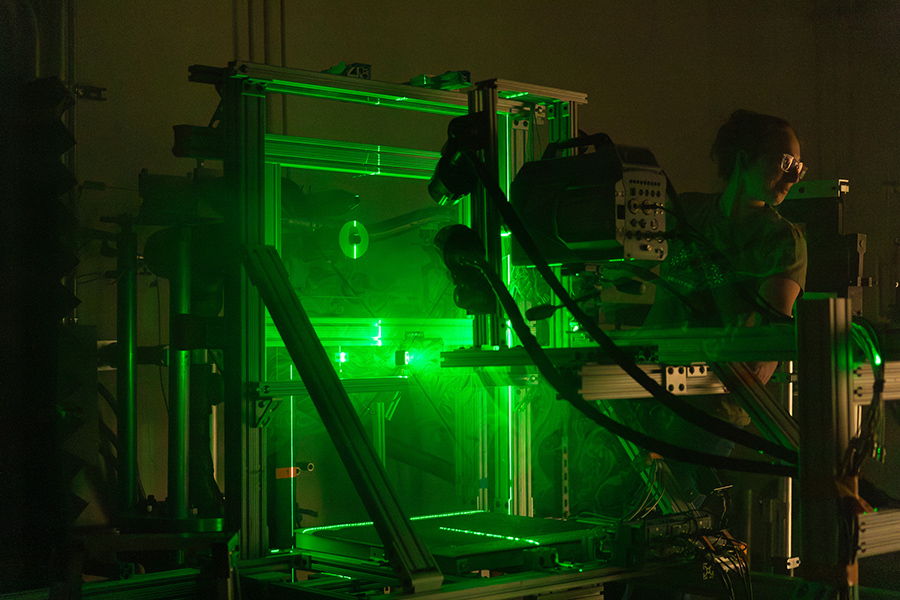 Doctoral student Allie Gagne sets up test equipment in the in the Short Takeoff and Vertical Landing lab at the Florida Center for Advanced Aero-Propulsion. (Scott Holstein/FAMU-FSU College of Engineering)