
Since 1982, the Orlando Sentinel has asked the community to help us recognize people who make a big difference in local lives with our Central Floridian of the Year award. Today, we will announce our second finalist. Our winner will be announced on April 11.
“What are your nightmares?”
For the team of researchers and therapists at the UCF Restores program, this question has become a key to unlocking the death grip of trauma on the human soul. Severe emotional trauma changes people, and many of those changes are forever. But their power can be broken, and UCF Restores is helping lead the way to hope.
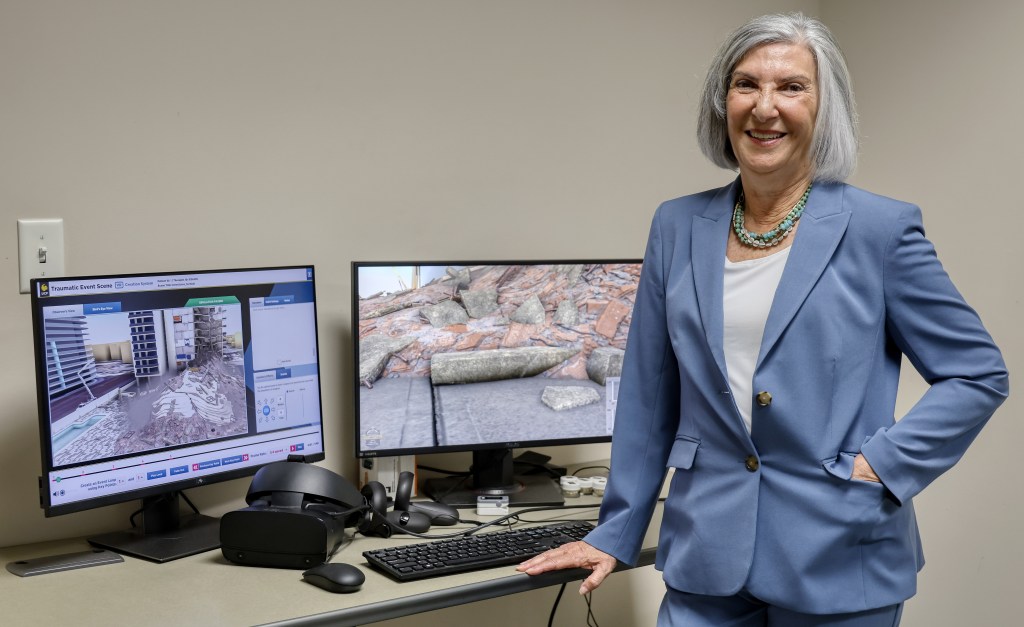
And from the start, Dr. Deborah Beidel has been at the forefront, seeing the potential for healing in a world that is becoming more mad by the minute. UCF Restores has become a national model for effective, surprisingly efficient treatment for post-traumatic stress disorder. The timeliness of her efforts make Beidel — representing the entire UCF Restores team — a finalist for the Orlando Sentinel’s Central Floridian of the Year award.
There can be no doubt: Trauma is proliferating across the American landscape. Over the past 50 years, the number of mass shootings has surged. Violence against law enforcement and other first responders is also on the rise — as is violence by police against civilians. In government offices across the nation, bulletproof glass often separates workers from their customers, and City Hall doors that once opened at a single tug are now locked, or flanked by armed security and metal detectors. School districts are creating “perimeters” around campuses.
But emergency personnel bear a special burden of this stress. It ranges from the routine — the cold weight of suppressed fear every time an officer walks up to a car they’ve just pulled over — to events of such magnitude that they cannot be imagined before they actually happen.
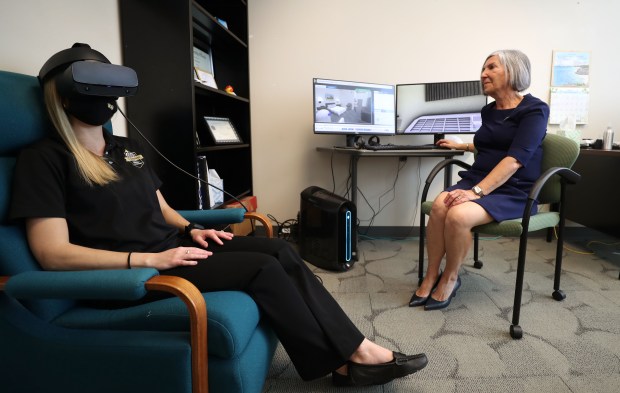 Left to Right, Senior Mental Health Clinician Chloe Findley, and UCF RESTORES Executive Director Dr. Deborah Beidel, demonstrate a virtual reality system to treat patients with PTSD, on Tuesday, March 22, 2022.
(Ricardo Ramirez Buxeda/ Orlando Sentinel)
And in 2016, Orlando saw one of these events unfold after a gunman opened fire at the Pulse nightclub on Orange Avenue right after last call. UCF Restores was still in its infancy, envisioned as a research-based exploration of post-traumatic stress disorder. The group had already been working with patients, but for Beidel and others, this was a call they could not ignore. Therapists were on site almost from the start and continued to work with Pulse survivors, families, law enforcement and community members for years afterward. Since then, they’ve responded to other large-scale traumas including the collapse of the Surfside Condominium in South Florida. But they’ve also ministered to hundreds of individual cases, largely focused on military, law enforcement and other first responders.
With surprising success. Many mental-health professionals have talked about how challenging PTSD can be to treat. But UCF Restores has forged a different reality: the vast majority of its clients go through a two-week residential program of intensive therapy that has shown success rate approaching 100%, measured as the number of participants who have been able to break the devastating mental associations that turn commonplace events into triggers for anxiety, rage, sleepless nights and anguished days.
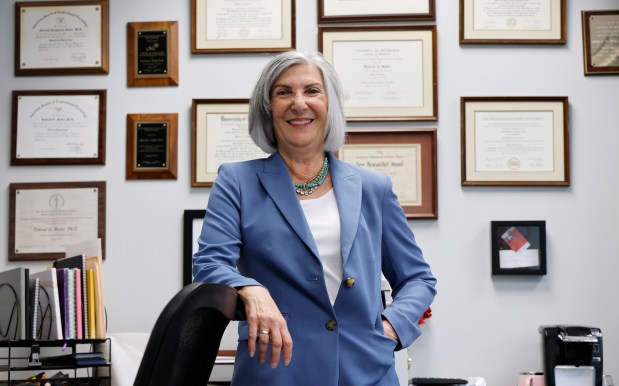 Dr. Deborah Beidel and UCF Restores played a vital role in helping treat first responders impacted by the Pulse nightclub shooting, where 49 people were killed in June 2016. (Ricardo Ramirez Buxeda/Orlando Sentinel)
Here’s how that can play out: In the hours after police regained control over Pulse and rescued those who were still alive — but before the bodies of the dead had been removed — police and emergency medical workers walked through the club accompanied by the incessant ringing and vibrating of cell phones of the deceased, calls that would never be answered. In the days and weeks afterward, many of those responders found that just hearing a phone ring would evoke the same shock and horror, producing surges of adrenaline and other brain chemicals that signal danger, fear and panic.
It’s the same kind of reaction that military personnel often describe: A reaction to something as joyful and innocent as a fireworks display can leave them gasping as if they are in a firefight. Breaking that cycle of association and response can often produce a rapid recovery, Beidel says — and UCF Restores collects data that proves how well their tactics work. Over the two-week period of initial treatment, many patients showed an increasing ability to control their breathing and diminish the negative emotions surging through them.
That two-week intensive session is one of the keys to the program’s success. People who are still employed as police officers or emergency workers can go through the program and get back to work, in far better control of their stress response and emotional health. “Nobody has to know that they’ve come to us,” Beidel says. “We’re committed to helping anyone who needs us.”
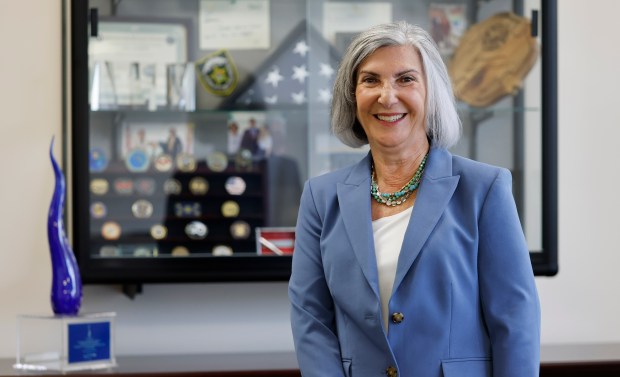 Deborah Beidel, who is the Executive Director of the UCF RESTORES program, on Tuesday, March 24, 2026. UCF RESTORES is an innovative program that helps first responders, military and others deal with the impact of on-the-job trauma through the use of virtual reality. (Ricardo Ramirez Buxeda/ Orlando Sentinel)
And without crippling medical debt. Thanks to state support, grant funding and private donations, all treatment is free, Beidel says. And because the term of initial treatment is so short, there is rarely a significant waiting list for services.
Kudos keep rolling in. Several other states are in the process of setting up similar programs, often sending therapists and academics to Orlando to study UCF Restores’ process. The organization has won multiple awards based on the effectiveness of its approach. But for Beidel and her team, the real accolades come from the numbers: To date, UCF Restores has helped more than 1,400 first responders among more than 2,000 people seen. Their relapse rate: Less than 1%.
“People will never forget what happened to them … and how they changed,” Beidel says. “But there is hope. They can heal.”
2026 Central Floridian of the Year
Last Sunday: Finalist No. 1 – Trina Gregory
Today: Finalist No. 2 – Dr. Deborah Beidel and UCF Restores
Sunday, March 29: Finalist No. 3 revealed
Thursday, April 2: Finalist No. 4 revealed
Sunday, April 5: Finalist No. 5 revealed
Sunday, April 12: Winner announced
More about our Central Floridian of the Year program and past winners and nominees at OrlandoSentinel.com/CFOTY