
OVIEDO, Fla. — Artemis II sets the stage for future Artemis missions, when astronauts will once again set foot on the moon.
Besides this launch, there are several more things that need to be done on Earth to get humans to the moon.
A lot of that work is being done by professors and students at the University of Central Florida.
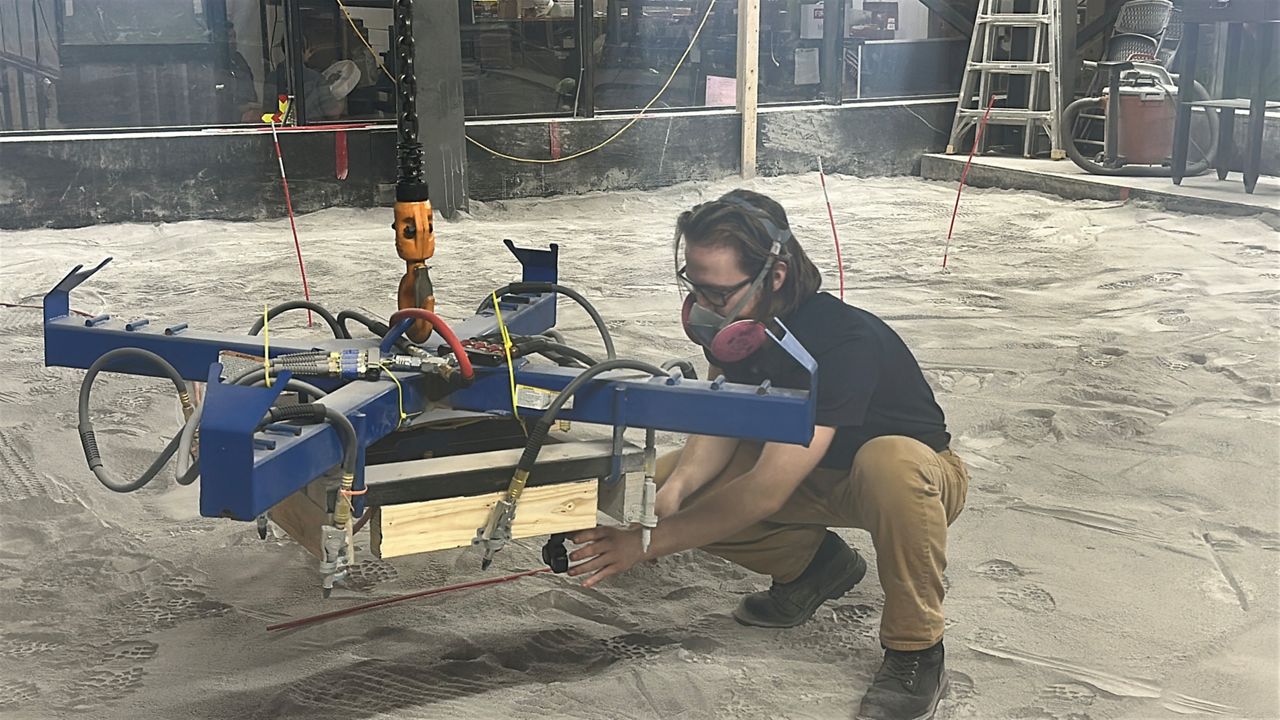
Noah Brockhoff, a mechanical engineering student at the University of Central Florida, spent 300 hours to build a simulated lunar lander.
“In many respects, this is my baby,” the Orlando native said. “There’s a lot of research that’s gone into this.”
The simulated lander is being used to understand the impacts from the moon’s dust and rocks, known as lunar regolith.
“The reason why we study this and the reason why this is important is because if this was an actual physical lunar lander, (there) would be a regolith ejecta that’s getting sent at terminal velocity upwards into the lunar lander, which could cause equipment failure, potential hazards to humans,” said Brockhoff.
To simulate how lunar dust impacts a landing spacecraft, Brockhoff experiments inside the Exolith Lab, a warehouse UCF’s Florida Space Institute outfitted in Seminole County with 120 tons of simulated lunar soil.
“This lunar soil is a mixture of all the minerals in the correct ratios and the correct particle sizes,” said UCF Planetary Science Research Professor Phil Metzger. “So it was a highly engineered replication of lunar soil. It’s the highest fidelity in the world and the largest amount of it anywhere in the world.”
Metzger spent 30 years at NASA before becoming a research professor at UCF.
He’s also the director of the Stephen W. Hawking Center for Microgravity Research and Education.
Filled with all kinds of student-led tests and experiments, the Exolith Lab, Metzger says, is key to understanding what it will be like when we return astronauts to the moon’s surface.
“I think we bring a lot of expertise to the lunar and space exploration community for developing technologies that interact with the soil,” said Metzger, who specializes in lunar soil. “That includes landing on the soil, driving in it, excavating it, extracting resources from it, constructing, building things with it, and studying it for science.”
Lunar dust is extremely abrasive, capable of damaging a spacecraft. Understanding how moon dust reacts to a lunar lander or rover is vital to keeping astronauts safe.
“We need to understand how far away do you need to be from your hardware when you launch or land on the moon,” said Metzger.
NASA is collaborating with UCF to figure this out, along with other critical issues before sending humans back to the moon.
Built entirely by UCF students, another experiment, which includes a wheel that goes back and forth over the simulated lunar sand, is making 500 laps a day and funded by NASA.
“This will help NASA decide what materials to use on lunar rover wheels so that we can have long-term reliability as we operate on the Moon,” said Metzger.
Metzger lists three reasons for going back to the moon.
First, the moon’s geology can help unlock the history of our solar system and how it formed.
“The moon is like Earth’s attic. It stores the record of our solar system because it doesn’t have the weathering and the plate tectonics like the Earth does to destroy all that evidence,” he said. “So by going up to the moon and digging in the lunar soil, we can unravel the history of lunar geology, which teaches about the history of the entire inner solar system.”
The second reason for returning to the moon is for resources.
“Lunar ice is a great resource for making rocket fuel,” Metzger said.
The third reason is that the moon is the best place to prepare for living and working on Mars, and because it’s closer than Mars, it’ll be easier to respond to challenges that arise.
“That allows us to develop technologies easily in a harsher environment,” he said.