
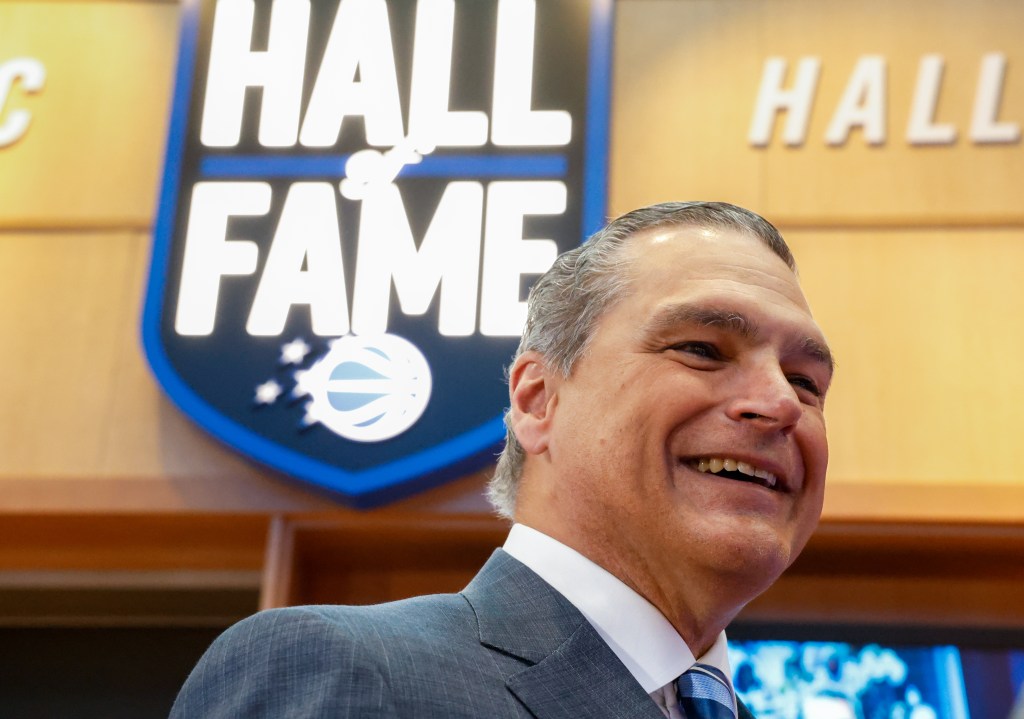
To the average fan, Alex Martins looks like the ultimate corporate suit. He dresses sharp. He’s got the slicked-back hair. And he wears that perpetual smile that sometimes makes you wonder, “Why is this man grinning in the middle of a six-year losing streak?”
So when Martins was inducted into the Orlando Magic Hall of Fame at the Kia Center earlier this week, the reaction from many fans was probably a shrug. A CEO? Really? Seriously? In the Hall of Fame?
But then you stop and think about it for a moment, and you realize something important:
There might not even be a Kia Center without Alex Martins.
And without the Kia Center, there might not be an Orlando Magic.
And without the Magic, Orlando might be just another city that used to have an NBA team.
That’s Martins’ legacy. And it’s why his Hall of Fame induction is not just justified; it’s necessary.
Building a new arena back then wasn’t very popular. In fact, it was political dynamite. Newspaper columnists blasted the deal. Taxpayers were skeptical. Politicians were stuck between the fear of public backlash and the possibility of losing the franchise if a new arena wasn’t built.
Then there was late Magic owner Rich DeVos, who had angered the powerful tourism industry with his famous line about local hoteliers needing to get their “grubby little fingers” off the tourist-development tax revenue. That money, in part, was what DeVos wanted to use to help fund a new arena.
It was a mess — political, financial and personal.
And that’s where Martins came in.
He wasn’t the owner. He wasn’t a politician. But he became something just as important: a bridge.
Martins used his political instincts, his relationships and his credibility to bring together the tourism community, city leaders and county officials. He helped broker the public-private partnership that eventually built the building we now know as the Kia Center, which was part of a three-tiered venue plan that also included the Dr. Phillips Performing Arts Center and a refurbished Camping World Stadium.
And as it turns out, Martins, Orlando Mayor Buddy Dyer and Orange County Mayor Rich Crotty were right: The arena wasn’t just for the Magic. It was for the entire city. Since opening, the Kia Center has attracted more than 20 million guests and hosted thousands of amazing events like March Madness, NBA All-Star Games, Taylor Swift, Elton John, Paul McCartney, Bruce Springsteen and Kenny Chesney.
We could go on and on about Martins’ résumé. He started as an $18,000-a-year public relations employee in 1989 and worked his way up to CEO; the rare executive whose fingerprints are on nearly every part of the organization: media, operations, partnerships, philanthropy and civic engagement.
He helped convince NBA Commissioner Adam Silver to bring the NBA Bubble to Orlando during the COVID-19 pandemic; a logistical long shot that turned into a global success story for the league and the city.
In the wake of the Pulse nightclub tragedy, Dyer asked Martins to lead the OneOrlando Fund, helping raise tens of millions of dollars for victims and their families during one of the darkest moments in the city’s history.
He also made a significant impact beyond the Magic and beyond downtown. As chairman of the University of Central Florida’s Board of Trustees, Martins was instrumental in helping guide UCF into the Big 12 — a move that elevated the university’s national profile and changed the trajectory of UCF athletics and the university as a whole. Much like the arena deal years earlier, it required behind-the-scenes relationship building, persistence and the ability to navigate complex political and financial landscapes.
His impact, in many ways, has had very little to do with basketball.
And yet, because this is sports, Martins’ legacy will still be judged by some through a simple lens of wins and losses.
That’s fair. That’s sports.
The Magic had only three winning seasons and no playoff series victories during his 14 years leading the organization. He hired Rob Hennigan, the youngest general manager in NBA history, and the failed rebuild that followed led to years of basketball irrelevance. There were coaching changes, lottery seasons and long rebuilds that tested the patience of the fan base.
Martins didn’t always make the right basketball decisions.
But if you define Alex Martins solely by the Magic’s record during his tenure, you fundamentally misunderstand his impact, not just on a franchise, but on a city.
Martins helped oversee the development of the AdventHealth Training Center, a $70 million investment placed in a struggling downtown neighborhood. He helped grow the Orlando Magic Youth Foundation, which has distributed more than $30 million to local nonprofits, impacting hundreds of thousands of children and families.
During his leadership, the Magic’s business side thrived even when the basketball side struggled. Ticket sales remained strong. Sponsorships grew. The franchise value soared. In 2024, the organization was named one of the Best Places to Work in Sports; the only team in the NBA, NFL, MLB or NHL to earn that honor.
That doesn’t happen by accident. That happens when leadership builds culture with intention.
Martins often repeated something Rich DeVos used to say: Don’t call us the owners of the franchise; call us the caretakers of the franchise. The real stakeholders are the fans and the community.
For nearly four decades, Martins has operated like a caretaker.
He was an ambassador for Orlando. A negotiator when the city needed one. A fundraiser when tragedy struck. A business leader when the franchise needed stability. And, often times, a shield who absorbed the criticism for the DeVos family.
His work doesn’t show up in a box score. You can’t calculate it in wins and losses.
But you can see it in a skyline.
You can see it in a downtown that comes alive on game nights and concert nights and all the nights in between.
You can see it in a university that now plays on a national stage.
You can see it in nonprofits that stayed open, in families that got help when they needed it most, and in a franchise that didn’t leave when it could have.
Alex Martin’s legacy isn’t a banner that hangs from the rafters of the Kia Center; it’s the reason there’s a Kia Center to hang banners in at all.
That’s a Hall of Fame résumé, whether you wear a jersey or a suit.
Email me at mbianchi@orlandosentinel.com. Hit me up on social media @BianchiWrites and listen to my new radio show “Game On” every weekday from 3 to 6 p.m. on FM 96.9, AM 740 and 969TheGame.com/listen