
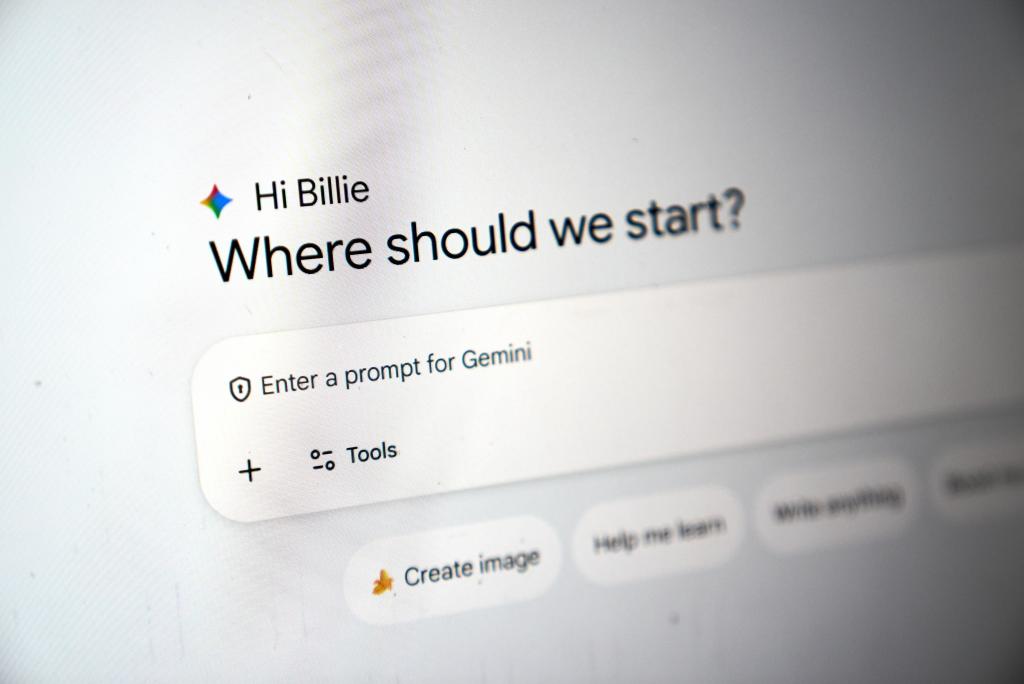
A junior at Hagerty High School pulls up her favorite AI website and types “Design me a prom dress. Blue and green. Floaty. Beads.” And right before she hits “generate,” her mother looks over her shoulder and says, firmly, “sleeves.”
The result isn’t quite what she wanted, so she adds more keywords and tries again. Fairy. Sparkle. Chiffon. “Ugh,” she says to her mother. “This is so slow.” Finally, she sees an image she loves, then asks the AI engine to build a pattern with estimates of how much fabric she’ll need. Over the course of about 15 minutes of typing and waiting (“So slow!!”) she’s got a good start on a custom dress that will turn her friends green with envy.
She’s also used enough energy to charge her cellphone several times over, power the food processor her mom is using to make dinner and maybe even get the dishwasher through a cycle or two.
Multiply that by the thousands of people living in Oviedo, most of whom spend at least part of every day on a computer, and then by all the cities in Florida and in the nation. Not all of them will be doing such energy-intensive tasks but — whether or not they realize it — almost all of them will have at least a brush with AI technology, whether it be in a simple web search or a suggestion for wording an email response.
Of course, a teenager doesn’t make those calculations or consider the cost behind her searches. She just wants a custom prom dress — and from her point of view, the technology she’s using is free.
But the power has to come from somewhere. The trillions — that’s with a “tr” — of calculations, comparisons and exclusions that it takes to produce one image of a fantasy prom dress have to be performed somewhere. Those giant banks of processing power need spaces to physically exist, giant pipelines of power and often, water to help keep them cool.
Increasingly, those critical computing functions are taking place in vast data centers scattered across the state. They are housed in nondescript warehouses whose exteriors rarely betray their greedy secret: They are gulping down electricity so voraciously that power companies are having to hastily add capacity to generate power. According to the website datacentermap.com, there are 12 such data centers operating around Orlando, among more than 100 across the state. On average, the energy demand from a medium-sized data center could power 15,000 households.
It’s no wonder, then, that Gov. Ron DeSantis told lawmakers before the current legislative session that he wants a comprehensive set of regulations governing where new data centers can be placed, who should foot the bill for the power-generating infrastructure they will need and how much water they can take from the single-source aquifer that provides Floridians with most of their drinking water.
We agree with the governor that it’s not fair for Florida ratepayers to cover this expense. Before the session, DeSantis demanded lawmakers pass a bill that would require public notice before new data centers are built and make it illegal for electric utilities to pass on costs of adding infrastructure to the current electric grid or consume large amounts of otherwise potable water. He also wants consumer protections for children that might be enticed into forming relationships with AI-powered “chat bots,” citing cases where AI companions have been suspected of introducing children to inappropriate sexual content or exacerbating a child’s depression to the point of suicide.
AI is giving bad advice to flatter its users, says new study on dangers of overly agreeable chatbots
They were all good ideas. But as the bill worked its way through the Legislature, it was gradually weakened. And one key point — public transparency about where new data centers would be located and how big they would be — was reversed, with the final version of the legislation actually reinforcing trade-secret protections for owners of new data farms.
This puts DeSantis in a quandary. The legislation (SB 484) hasn’t yet been delivered to him for his signature or veto. But there’s nothing keeping him from negotiating with House and Senate leaders on a more comprehensive bill with the protections Floridians need, then adding that issue to the special session that’s expected to kick off in April. Lawmakers can pass a better, stronger bill, leaving DeSantis free to veto the first attempt.
This is a complicated issue. Certainly, Floridians also benefit from the availability of AI, even when they don’t know they are. But they should also be able to understand the implications and costs of this technology — and remember that these data centers can serve customers around the word, not just here in Florida. There’s no reason for Floridians to be forced to pick up the check for giant data farms without even a clue as to how much the total bill might be.
The Orlando Sentinel Editorial Board consists of Opinion Editor Krys Fluker, Executive Editor Roger Simmons and Viewpoints Editor Jay Reddick. Use insight@orlandosentinel.com to contact us.