
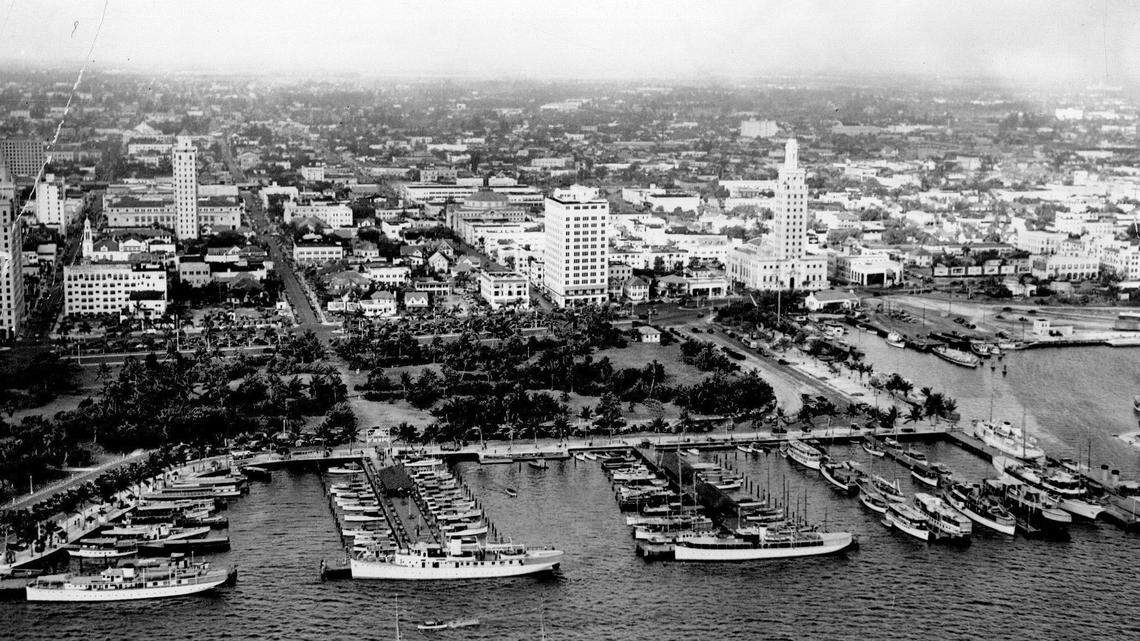
Before the Ultra Music Festival … Before Bayside Marketplace … Before protests and rallies … Bayfront Park in downtown Miami had a different beat.
It was a place for fishing. For strolling. For listening to an orchestra For visiting the library.
Not to say it was quiet all the time.
President-elect Franklin Delano Roosevelt survived an assassination attempt there.
But as downtown Miami grew, Bayfront Park evolved.
The library, which blocked a view of the water for 30 years, was demolished, moved several blocks west as part of a new cultural center.
The fishing fleet was diminished, and soon joined by sightseeing boats.
The amphitheater, where bandleader Cesar LaMonaca led an orchestra under the moonlight for nearly 50 years, was gone, eventually replaced and moved a bit north and booked with acts of the day.
In the late 1980s, Bayside Marketplace, a collection of shops and restaurants built around the water, opened. It quickly became a social spot for tourists and locals before the faltering economy slowed it down. A new basketball arena opened nearby in 2000 and remains the home of the Miami Heat.
Several years ago, the annual Ultra Music Festival moved into Bayside, introducing the waterfront green to electronica-loving fans in day-glow outfits.
But before all that, Bayside was still the center of activity. It was just different.
MORE: What is that torch along the bay in downtown Miami?
Here is an exclusive look at the Bayfront Park of yesterday from the archives of the Miami Herald:
History of Bayfront Park through the 1980s 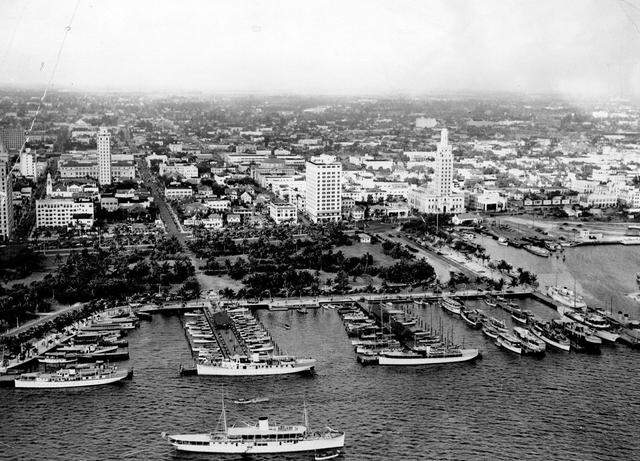 View of Bayfront Park and downtown in October 1937. Miami Herald File
1921: City of Miami buys 62 acres of bay bottom from the Florida East Coast Railway for $1 million. When filled in 1924, that becomes Bayfront Park.
1929: Caesar LaMonaca begins nighttime concerts at bandshell, which continue until 1977.
1933: March 6. Giuseppe Zangara, in an attempt to assassinate President-elect Franklin Delano Roosevelt, kills Chicago Mayor Anton Cermak.
1950: Library built, but public says it blocks bay view.
1953: Italian government gives Christopher Columbus statue to city.
1960: Torch of Friendship is built.
1980: After several unsuccessful plans to renovate the park, the Downtown Development Authority and the city hire sculptor Isamu Noguchi to redesign the park.
1983: City Commission approves redevelopment plans.
1984: Congress allocates $5.2 million to build a baywalk. That path along the bay was dedicated Friday.
1985: Construction begins on what is now a $30 million project.
1986: As part of the renovation, the library is torn down.
1988: Bayside opens
Redesign of Miami’s Bayfront Park 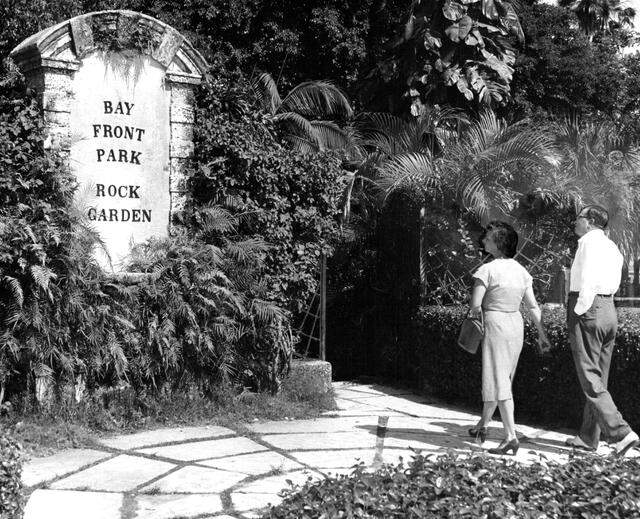 Bayfront Park Rock Garden in 1963.
Published July 18, 1982
Bayfront Park should celebrate the union of city and sea. The the palette of the park — the green of the grass and the blue of the bay — should capture us, captivate us, as we walk down Flagler Street, and it doesn’t. There should be a strong formal axial relationship betwen Miami’s main street and its front yard.
The newest plan by sculptor Isamu Noguchi does this, adamantly. It is a design intended to rivet our attention on the park and the bay.
Finally. This plan, made public last month and still being fine-tuned, is Noguchi’s third offering, but it is the first really good one. It is looser, easier, more playful, more parklike than its predecessors. It makes sense for Miami, for the times and for the place.
This is a design for a park that is always more than it seems, as if a magician planned it. There is a piazza that is also a fountain, and a playground that is also a theater. There’s an amphitheater that can seat 10,000, or accommodate a small group. Its signature — and its signal to sea and city — will be a light tower 102 feet high.
Gone are most of the elements of the earlier plans, among them the berms that would have run along Biscayne Boulevard creating a walled park, a closed and forbidding space in a fearful city. Gone is the central amphitheater of stone, which was placed right in the middle of the park for the sake of symmetry, an arbitrary choice that ensured that the park would be cold and unspontaneous. Gone is the entry pylon at the south end of the park, a sculpture that played a much-too-obscure ceremonial role and not much else. The old designs were too formal, too detached, too cold.
Noguchi and his architect-partner Shoji Sadao have spent two years on these revisions, with good result. The park plan now shows great promise, and it is the first to be done in the context of a comprehensive plan for the whole 100 acres of the downtown park system.
There’s still an amphitheater in the plan, but this one is a grand-sized grass amphitheater (the-bring-a-blanket-and-a-picnic kind) at the northeast corner of the park near Miamarina and the water and near the proposed Bayside — a waterfront marketplace development that would be built adjacent to Miamarina. Both Bayside and Bayfront Park will be considered by the Miami Commission Thursday.
The amphitheater will seat 10,000, and it is designed with a fairly gentle slope (of just 16 feet) so that when not in use it blends back into the park.
At one side of the amphitheater is a water-taxi dock, which also provides covered storage space for acoustical and electrical equipment, and next to the rock garden (the rock garden will be restored) will be a cafe and a children’s play area.
To the south of this, on a direct east-west line with Flagler Street, will be the piazza, which Noguchi likes to call the rambla to make it sound Latin, but it’s really an Italian space. The piazza will be a shallow concrete or stone bowl, 300 feet in diameter, a bit more than an acre and a half. The piazza will jut out over the great stone boulders that will form the rip-rap bay wall.
For the center of the piazza, Noguchi has designed a fountain that would spurt up into the air and then spill over onto the piazza. With the fountain off, the base of the fountain can be turned into a stage, a second performance space.
There’s a strength here that didn’t exist when the park’s centerpiece was the amphitheater. This is the only part of the park where formal relationships are meaningful, and in fact all- important. There should be something to see from Flagler Street, and the park should shout out that this is a tropical city that sits on the water’s edge. The amphitheater wouldn’t have done that, but the fountain will.
At the southern end of the park, next to Ball Point, will be a park-within-a-park, a space with elevated geometric forms that can be converted into small platforms for experimental dance or theater or impromptu musical performances or even poetry readings. The intention is to create a more intimate space.
The light tower, the park’s beacon, will be placed near NE First Street, and it will be a complex organism indeed. A 102- foot sculptural metal grid, encasing laser lights and spotlights, will emerge from a 60-plus-foot high concrete sheath with holes punched into it, and all of that will rise out of a one-story structure that will house rest rooms, the park office and another cafe.
As a whole, the design poses some very intriguing possibilities. There are soft edges and hard edges, formal spaces that don’t thwart spontaneity, casual spaces that can be used for more serious business. Parts of this park would be bold and dramatic; other parts would be relaxed and easy. It seems to fit the temper of the city, and it is more than mere artistry.
There are some residual problems, though, and some new ones.
In the plan are walkways that meet at angles rather than meander naturally. The amphitheater rises to an elevation of 23 feet above sea level, and it will block the view to the bay from a portion of Biscayne Boulevard.
The park won’t work, no matter what the design, unless it becomes easier to cross Biscayne Boulevard. Plans call for turning the median strips into cul-de-sacs, and that’s a start at easing the crossing. The people mover poses its own separate problem; it’s a bulky system with fat columns, and could make the boulevard crossing seem more forboding. These are difficult problems, but it is essential to solve them.
But then, there must be reasons to go there, as well. The park won’t work without music, entertainers, vendors, tables, chairs, umbrellas. All of these give this park or any park its vibrancy, its sense of life, and its sense of security.
And, there is the issue of the library. The Noguchi plans are predicated on the removal of the old Main Library building, after the library moves into the Cultural Center. But now emerges a move to save the library, to convert it into, among other possibilities, a YMCA executive fitness facility and day care center.
The old library building is a background building stuck in the foreground. Given its location, its bulk and its oh-so- stolid air, it does more damage than good to the city’s psyche.
The presence of the building has the same effect as the walls at the entrance to Bicentennial Park. People don’t go in because they can’t see in. What’s behind those walls? Who’s lurking in back of the building? Rational fears or no, the fact remains that the 24 acres of Bayfront Park belong right now to a few misfits and derelicts.
From some vantage points, the library building makes the park disappear. It makes it seem an underdeveloped street, not a park. In 1949, a bad decision was made to put the library at the point where Flagler flowed into the park. It was an ill- considered decision then, and it is ill-considered now to think about keeping it there.
Of course it’s troubling to think of tearing down a relatively new public building. Moving it is a possibility. But this building really does not meet the critical tests of preservation: It’s not architecturally important, and its major contribution to our history has been to give us a sobering lesson in bad planning.
The crux of the issue is this: There are plenty of other sites for a YMCA, for a day care center, for an arts center, but there’s no other place to put Bayfront Park.
Either the park is linked to the city, physically and visually, and allowed to be both beautiful and festive, or there’s not much point in having it. We have before us now, at long last, a plan that could accomplish this, and we need to give it a chance.
A shot at the president in the park 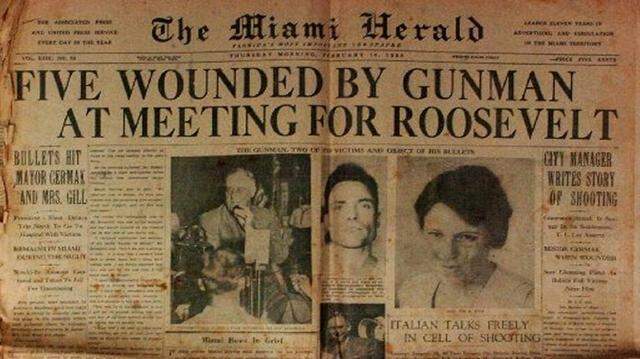
Published Sept. 20, 2007
Long before Lee Harvey Oswald, James Earl Ray and Sirhan Sirhan, there was Miami’s Guiseppe Zangara, a troubled man who nearly altered the course of U.S. history on a February night in 1933 when he arrived at a packed political rally at Bayfront Park with a .32-caliber pistol hidden in his pocket.
His target: President-elect Franklin Delano Roosevelt.
On the night of Feb. 15, FDR’s life or death rested on the aim of Zangara, an Italian immigrant, an unemployed bricklayer and self-described anarchist itching to assassinate what he saw as a symbol of capitalism.
Zangara, who had purchased the pistol for $8 at a local pawnshop, mingled among a record crowd of 25,000 people who had come to catch a glimpse of the famed FDR.
The drama that unfolded on that night has been largely erased from the collective memory of much of Miami. Today, few recall that Chicago Mayor Anton “Tony” Cermak died from a bullet meant for FDR; four others were wounded by Zangara’s errant shots.
But tonight , the story of FDR’s visit to Miami will be retold at a symposium at the Historical Museum of Southern Florida in downtown Miami, a stone’s throw from the courthouse where Zangara was sentenced to die.
“This is an important moment in history that has all but been forgotten,” said Miami-Dade Circuit Judge Scott J. Silverman, fascinated by the case for years. “It’s one of the biggest ‘what ifs’ of the 20th century. What would have happened if FDR had died that day?”
Featured for the first time in decades: rare film footage of the assassination attempt.
“This is footage we had never seen before and had no idea even existed,” said Silverman, who located the black-and-white gem at the University of South Carolina’s film archives. The newsreel was donated by Twentieth Century Fox.
Silverman is founder and trustee of the 11th Judicial Circuit Historical Society, a new group created to preserve South Florida’s legal history. It is sponsoring the event.
Symposium goers will also hear a 1975 taped interview of Russell Caldwell, who survived the shooting after getting struck between the eyes by a bullet from Zangara’s gun that ricocheted back to the crowd. In 1975, Caldwell, who had kept the slug, donated it to the museum and sat down with museum officials and told his story.
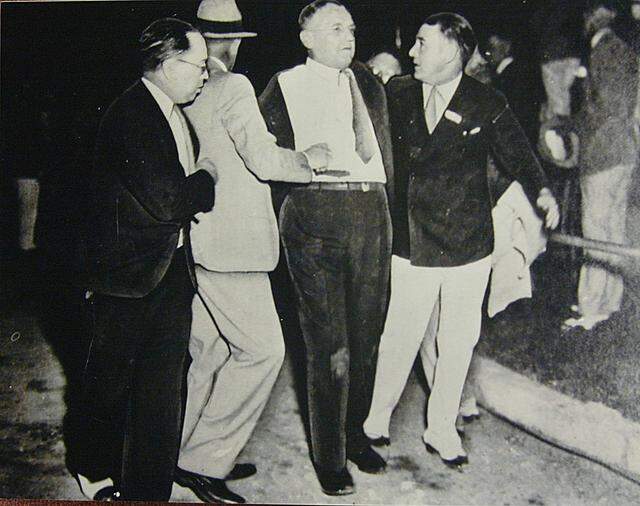 Chicago Mayor Anton Cermak, center, after he was shot in Miami in 1933. Miami Herald File
laise Picchi, a Broward County attorney who in 1998 published the definitive book on the assassination attempt — The Five Weeks of Guiseppe Zangara: The Man Who Tried to Kill FDR — will be the keynote speaker.
“It’s one of the most fascinating cases in South Florida — and few know about it,” Picchi said.
FDR’s visit to Miami had been a last-minute thing, Picchi said. In early February 1933, as FDR planned his Cabinet, he decided to vacation in sunny Florida.
The popular president, he said, was to stop in Jacksonville for a rally and then board a yacht owned by his millionaire friend, Vincent Astor, for a two-week Caribbean vacation before his inauguration on March 4.
On the day of the shooting, Astor’s yacht docked at the city marina, where FDR greeted reporters and the mayor of Miami, Redmond Gautier, who escorted him to Bayfront in a green Buick convertible.
The polio-stricken FDR was driven to an elevated area of the band shell at the park at about 9 p.m.
Miami was abuzz about FDR’s visit, Picchi said. “This was a very big event; thousands were expected — and they showed up,” Picchi said.
Party bigwigs were coming to shake his hand. Among them: Joseph Gill, president of Florida Power & Light, and his wife, Mabel, and Cermak, in from Chicago to meet with his powerful friend.
Also on hand: several spectators who would become a footnote in history.
Caldwell, then 22, a private chauffeur for a local woman, arrived at the park about 5 p.m.
“My employer heard Roosevelt was going to be at Bayfront Park, and she wanted to see him,” Caldwell said in the 1975 interview. The two sat on the second row of benches. Zangara, all five-foot-one, was there, too, with a gun and a handful of bullets in his pocket.
FDR’s motorcade slowly moved through the crowd before coming to a stop. FDR hoisted himself atop the back seat.
FDR said a few words about enjoying his fishing vacation and promised to return. His breezy chat by the bay was over in less than five minutes.
Suddenly shots rang out in the night, followed by the screams and pandemonium.
Lillian Cross, a doctor’s wife, ended up standing near the would-be assassin. Photos show Zangara peering over her hat.
“The first shot he fired was so close to my face I got powder burns from it,” Cross told reporters. She tried to grab Zangara’s arm; other horrified spectators did the same, tackling him to the ground.
His errant bullets had missed FDR but fatally wounded Cermak, Mabel Gill and William Sinnott, a former New York police officer working security. Two others in the crowd who took bullets were Margaret Kruis, 21, a dancer from Newark, and Caldwell.
“The bullet hit me in the head, and it knocked me back in the seat,” Caldwell said. “I expected any minute to take my last breath.”
In the melee, FDR asked that Cermak be brought to his car for the ride to the hospital. “I said, ‘Tony, don’t move; keep quiet. It won’t hurt,’ “ FDR later told reporters. Cermak would die of peritonitis in 19 days.
FDR visited all the wounded. Caldwell said he wheeled himself into his room. “He didn’t have any high airs or anything. He was just real nice.”
At the jail in the Dade County Courthouse, Zangara confessed and expounded on his dislike for heads of state.
“I have the gun in my hand. I kill kings and presidents first and next all capitalists,” he said.
His first appearance in Courtroom 6-1 on the West Flagler Street courthouse was a worldwide sensation. But there would be no trial. Zangara pleaded guilty to the attempted murders of four people and was sentenced to 80 years by Judge E.C. Collins.
As he was led out, Zangara gave the judge lip in broken English: “Four times 20 is 80. Oh, judge, don’t be stingy. Give me a hundred years.”
Collins, fully aware Zangara would most likely be executed if Chicago Mayor Cermak didn’t make it, wryly responded:”Maybe there will be more later.”
Cermak died on March 6. He received a hero’s funeral and his words that night to Roosevelt — “I’m glad it was me instead of you” — are inscribed in a plaque at Bayfront Park.
The grand jury quickly indicted Zangara for first-degree murder in Cermak’s death. He pleaded guilty and was sentenced to die.
Zangara smiled on his way out of the courtroom. Within days, he was at Raiford State Prison. On March 20 — after spending 10 days on Death Row — he was executed.
When it came time to die, Picchi said Zangara exploded when he learned no newsreel cameras would be allowed to capture his final moments, cutting short his 15 minutes of fame.
It put him in a foul mood.
So when asked if he had any final words: He spit back:
“Pusha da button!”
And someone did.
The old library in the park 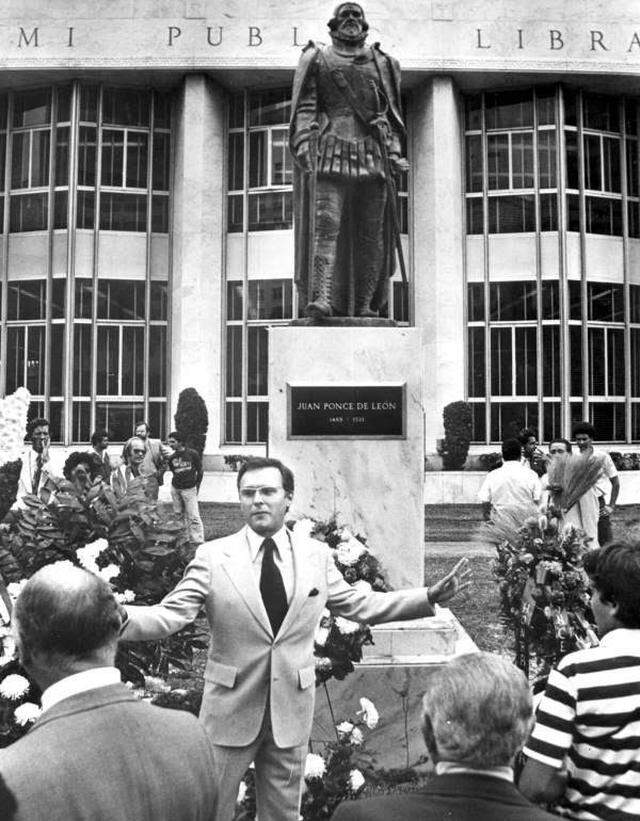 The unveiling of the Ponce de Leon statue in front of the Miami Public Library in 1977. Miami Mayor Maurice Ferre is in the center foreground. State Archives of Florida
Published July 10, 1982
The building stands amid all the flash, the gleam, the wow of new Miami, something of an architectural anachronism.
One face is of marble and tall glass with a few neo- classical dips and angles, dignified, but probably more suitable for a post office out in the stern Midwest than an urban bayscape in South Florida. The opposite side is unadorned white stucco.
But the soon-to-be vacated Miami-Dade Public Library is a big, solid thing. It’s functional. And in these times of austerity, civic leaders are torn over whether they ought to demolish 60,000 square feet of good, usable building.
Or should it be left a wart on the changing face of Bayfront Park, an impediment to the plans of Isamu Noguchi, who was hired for $100,000 to turn the park into Miami’s “social and spiritual center.”
Noguchi, a New York sculptor and landscape architect of considerable reputation, took on the $10-million project in 1980 only when the Miami City Commission agreed that the 31-year-old library building would go.
He wanted to change the area now occupied by the library into a green visual corridor between Biscayne Bay and the foot of Flagler Street, set off by a fountain near the edge of the water. The park was to become a strip of relief between the new brown office towers to the south and the bayside shops and restaurant complex planned for the north end.
Architects were hired to turn his ideas into workable plans. The City Commission approved. The first work was to begin this fall. But the grumblings about demolishing the library building have lately become a roaring debate.
Civic leaders all over town are taking sides, readying for one more public hearing July 22. A faction has arisen to “Save the Library.” Another to “Open Up the Park.” Dade residents have been finding petitions in their mailboxes that support either side of the argument.
“Well, basically, I’ve never cared for the building,” said influential Miami lawyer William Frates, who can see the library from the window of his downtown high-rise office. “It’s ugly. It interferes with the view.
“But it’s there.”
Frates says save it.
“I don’t like the choice but I want a program that brings people into the park,” he said. “We have to get people into the park.”
Miami architect Lester Pancoast, who is adapting Noguchi’s plans to the park, agrees that the park needs people, but the library is more the problem than the solution. The building, he said, stands in the way of a plan to build a pedestrian mall from Flagler and a people mover station to the bay.
Frates and some other Miamians want the YMCA of Greater Miami to take over the building and put in athletic facilities after the library abandons the building. The library will move to the new Metro-Dade Cultural Center, nearing completion a few blocks down Flagler Street.
The YMCA is at the core of the move to salvage the building. President Ed Ellis said he could put in seven handball courts, an undersized basketball gymnasium and other athletic facilities in the building.
Ellis has some powerful help. County manager and racquet ball enthusiast Merrett Stierheim has pledged his support, “as a private citizen. This isn’t a city-county issue,” he said. So has one Metro commissioner, Beverly Phillips. She is also executive director of the YWCA, which will operate a day-care center in the building under the Ellis plan.
The heavy hitter on the other side is Miami Mayor Maurice Ferre, along with his own stable of downtown movers and shakers.
The real soldiers, however, are former state legislator Marshall Harris and Downtown Development Authority Executive Director Roy Kenzie, who are showing up all over town to speak on the issue.
They battled head to head Friday in front of the Miami Kiwanis Club.
“Do we want this building on the most valuable piece of real estate the city owns?” asked Kenzie. He supports the Noguchi plan, which he says the city loses altogether if it backs down in the library issue. He has managed to convince the local chapter of the American Institute of Architects, the Miami Woman’s Club, the Dade County Chapter of Arts and Sciences and downtown businessmen that the library must go.
“It’s a $6 million building,” said Harris, who is gathering names on his petition. “I’ve got the signatures of 9,000 people who want that building there.”
Kenzie is worried. He thinks the votes are there on the City Commission to carry on with the Noguchi plan, but he spoke of the emotional reaction taxpayers have to a campaign dubbed “Save the Library.” “This is pretty serious,” he said.
But there may be an answer, or at least a compromise that will satisfy those unhappy with the idea of destroying a usable building. “The city has engineers looking into this,” Kenzie said. “We think we can move the building to the other end of the park.”
Arrival of Bayside Marketplace 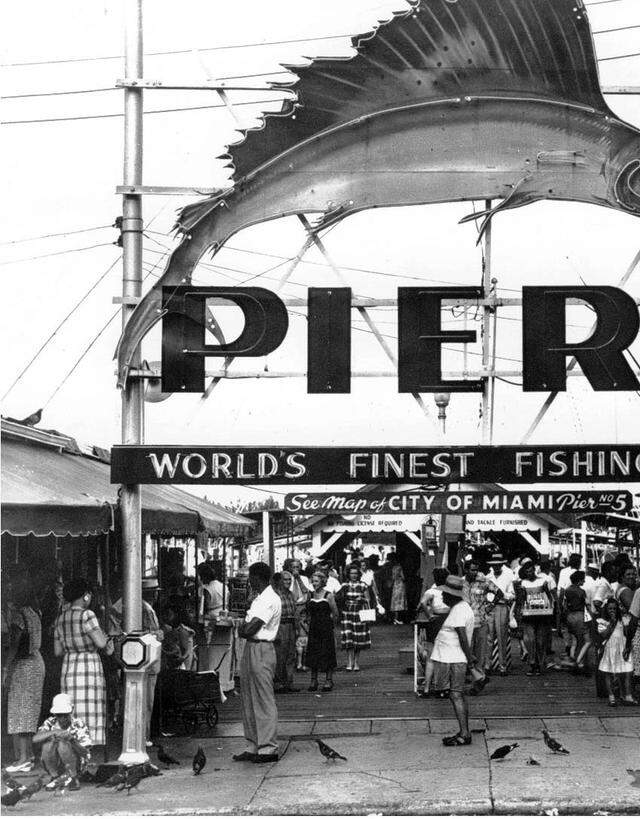 Pier 5, decades before Bayside Marketplace. Miami Herald File
Miami’s Bayfront Park is a dream struggling to come true.
For three days this week, the dream becomes real as the city celebrates the park’s grand opening with songs, festivals and shows.
But then the bliss is over: The park is only half done, the city needs to find another half-million dollars to finish it, and no one knows how the city can afford to run it.
“The ‘And then what’ scares the daylights out of me,” said Alan Greer, a Miami attorney who volunteered to take charge of the $30 million park temporarily.
When it is finished, maybe a year from now, Bayfront Park will be the city’s front yard, a gathering place to celebrate culture and be dazzled by technology — laser beams that shoot into the evening sky and a fountain that sprays 60 feet high.
It is the next-door neighbor to the Bayside Marketplace, and the two are supposed to feed off each other to create a daily downtown festival.
It opens Friday, ready or not.
For all its civic good, Bayfront Park is a guaranteed money-loser. Under the best of circumstances, it might nearly break even. Under the worst, it will cost taxpayers $500,000 annually. In its eagerness to bring other downtown projects to life, Miami has sprung a three-prong trap on itself that has ensnared the financial vitality of Bayfront Park.
The city agreed that the park’s food and drink sales can be conducted by a private company without competitive bidding. It agreed not to sell out seats in the amphitheater. It placed itself in jeopardy with the state, which may order the theater closed in five months.
The cost of maintaining Bayfront Park alone could deplete 8 percent of the city’s Parks and Recreation budget.
“There is no way the city can do it. No way,” said City Commissioner J.L. Plummer. “You can only get so much blood from a turnip.”
Bayfront Park’s success is an integral part of the city’s plans for downtown. Besides the value of its open spaces and sloping landscapes amid the city center, Bayfront Park is a sign of faith that if the city is willing to invest $30 million downtown, its citizens will be encouraged to build, shop and live there.
“I believe the park will be the most widely used park in America,” said Rosario Kennedy, Miami’s vice mayor. “It is going to change the way we entertain ourselves downtown.”
Kennedy has made completion of the park her primary goal in office. She has pushed it, despite worries from some of her colleagues that it is too grandiose, built at the expense of improving neighborhood parks throughout Miami.
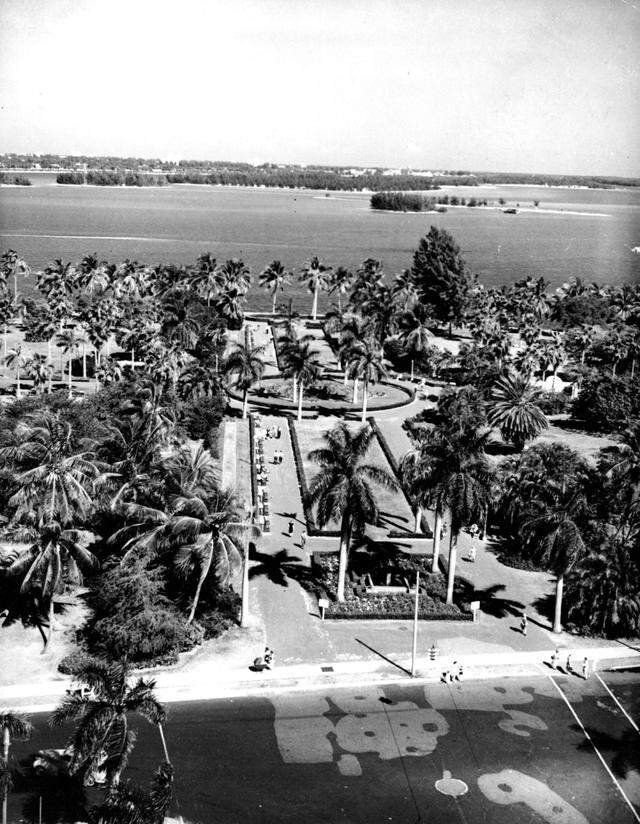 Bayfront Park Miami Herald File
Ever since 1921, when the city paid $1 million for the bay bottom and filled it in to make Bayfront Park, politicians have feuded over what to do with it.
They tossed aside developers’ plans to build on it in 1924. They acquiesced in 1950 and allowed a library there, and then fought 35 years later over whether to tear it down. They finally did.
And while the feuding continues over how to pay for the park and who will eventually run it, there is a consensus among city commissioners that — regardless — Bayfront Park is a major part of downtown’s rebirth.
“I look at it as a wheel,” Plummer said. “And Bayfront Park is the hub.”
Miami’s three downtowns meet at Bayfront Park like spokes on the wheel: Brickell Avenue to the south, Flagler Street to the west, the Omni to the north.
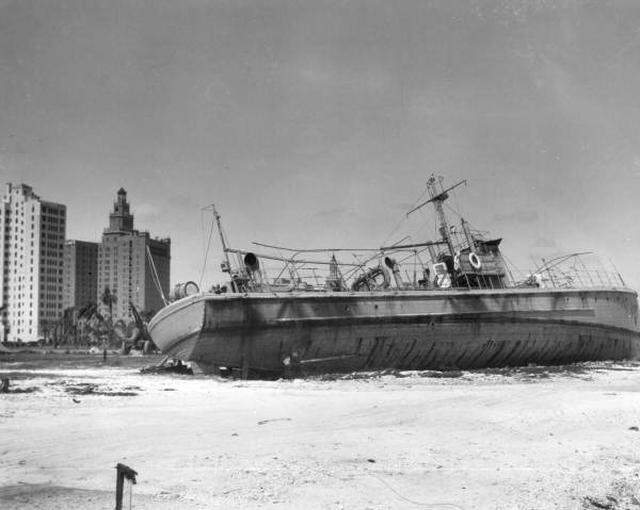 A boat washed ashore along Bayfront Park after the 1926 hurricane. State Archives of Florida
But the 48-acre hub is rotating slowly. Despite a determined fund-raising group and an unrelenting vice mayor, the project has lagged. The park has been designed again and again: To make way for Bayside; for a bigger amphitheater;and now, the latest, for the possibility that a parking garage will be built underneath its south end.
The garage, serving the Miami Center officer tower, would raise the park two feet. The proposal is under study, and park sculptor Isamu Noguchi hasn’t been consulted yet.
Bayfront Park bandshell 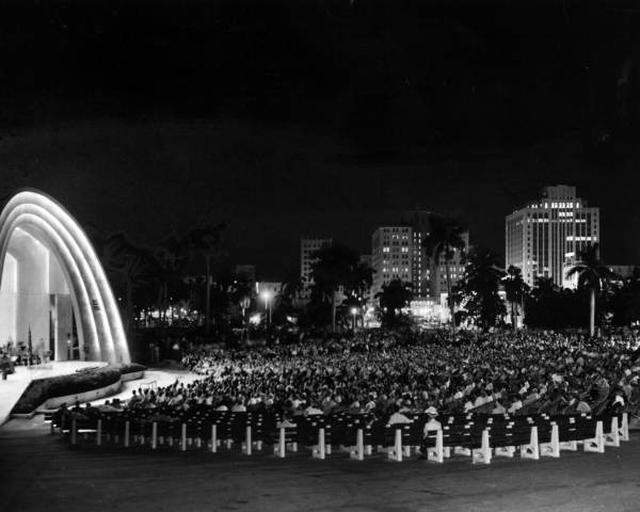 The Bayfront Park bandshell State Archives of Florida
When Miami’s city manager filed his annual report in July 1926, one of the items on his wish list was a bandshell for the almost completed Bayfront Park. A small bandstand was erected sometime during the creation of the park, but there was no seating of any significance nor was there a structure that satisfactorily could be termed a bandshell.
References to a bandstand that hosted small musical programs in the park appeared in newspapers of 1927. In February 1928, however, a larger bandshell that stood in nearby Royal Palm Park (now Dupont Plaza) was moved to the Bayfront site. It was there less than a month when, on March 21, 1928, it mysteriously burned to the ground.The following morning, the Miami City Commission ordered a new bandshell to be erected immediately, and in time to facilitate the Shrine convention coming to Miami in May. Work began right away on the estimated $15,000 project and was completed in time for the convention.The bandshell, seating 4,000, was adorned with minarets and the park and Biscayne Boulevard dressed with statues and Sphinx representations.
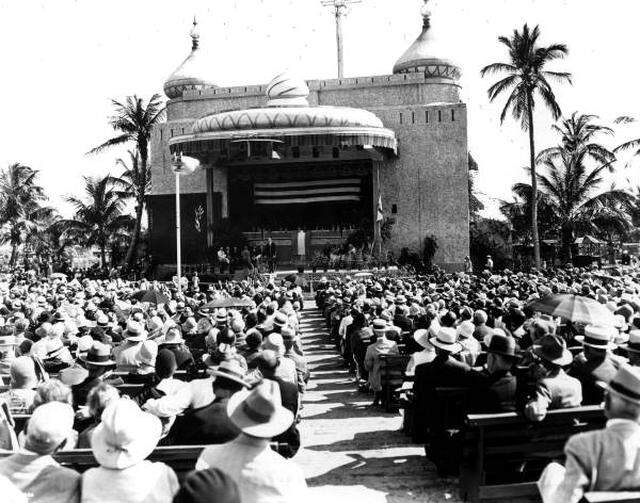 The original bandshell. State Archives of Florida
Shortly after World War II, Miami decided its bandshell needed replacing. Prominent architect Walter DeGarmo, who designed the McAllister Hotel, presented a bold plan on Oct. 17, 1945 for a significant structure in the park. The amphitheater would seat 6,000 and cost in excess of $250,000 to build.
It never came to pass in that form.In 1947 the bandshell was ordered torn down after the city commission heard a report that it was unsafe. The city engineer, on Feb. 12, 1947, condemned the 19-year-old bandshell as being beyond repair, unsafe and hazardous. Despite all that, the bandshell was not removed until October 1949 when plans were accepted for a replacement bandshell capable of holding up to 200 performers and as many as 150 musicians in its orchestral pit. It was called greatly improved acoustically than its predecessor. The new $71,000 dome-shaped structure premiered on July 28, 1950, as the highlight of Miami’s 54th birthday celebration.
It was named the R.C. Gardner Bandshell in honor of a former city commissioner who did much to further the project.
Conducting musicians in the new bandshell that night, just as he had done in the old bandshell since 1929, was Italian-born Caesar LaMonaca, a Miami institution. LaMonaca, who passed away in 1980 at the age of 94, conducted for 47 seasons at bandshells in the park.
He finally retired in 1977 at the age of 91.
In July 1981, the bandshell was razed when construction began on the Ball Point property immediately to the south.
Follow More of Our Reporting on Uniquely Miami