
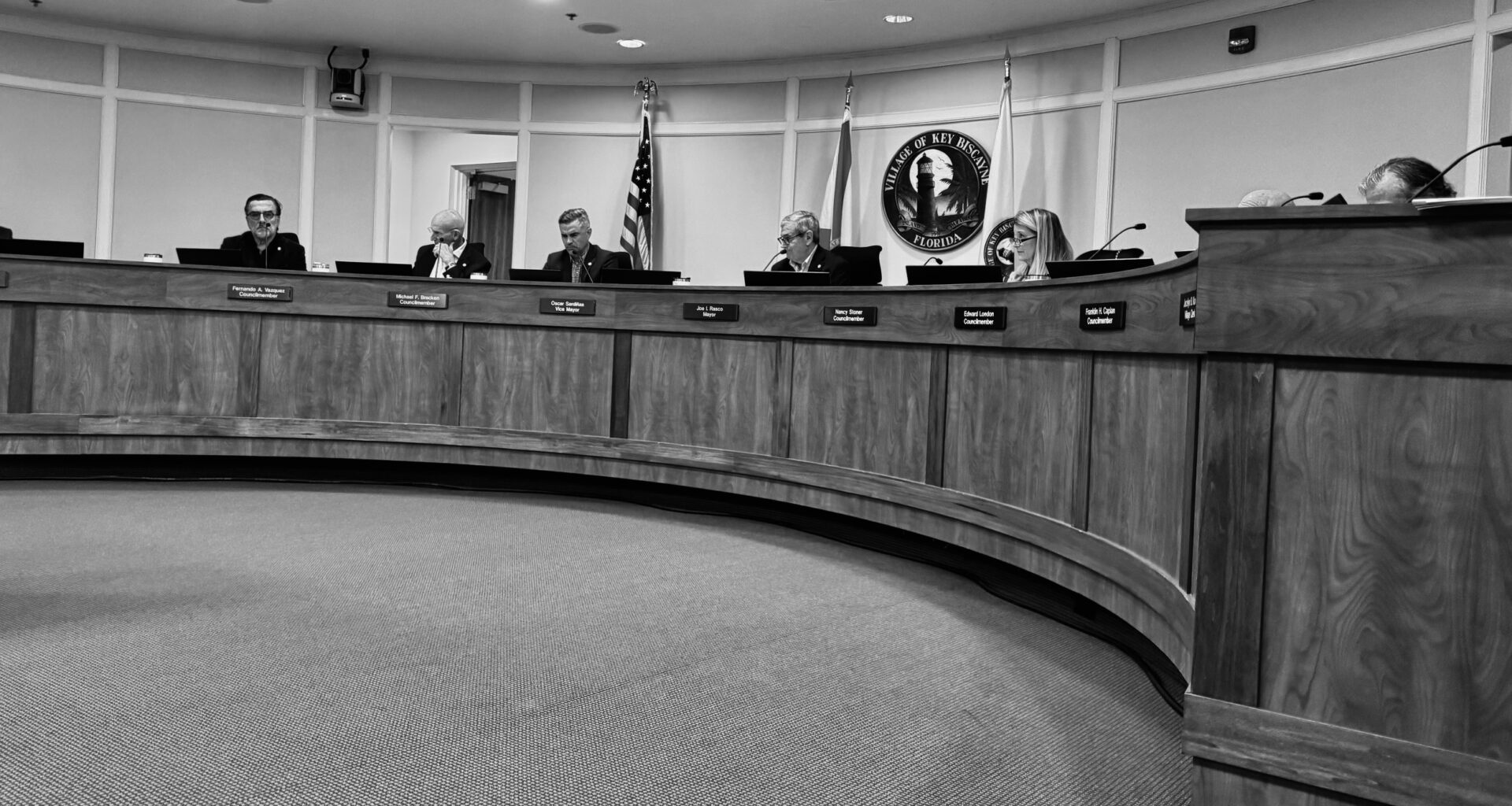
Defending his now-defunct media gag order, Village Manager Steve Williamson told Council members the policy wasn’t meant to threaten staff or choke information, but instead was for their benefit, aimed at giving staff “space and time” before they answered questions from reporters.
The manager left out that Village employees would face disciplinary action if they spoke to reporters without first getting approval. And it only applied to the media – those very same employees could interact with residents, no problem.
Transcripts of two closed-door legal sessions obtained by the Independent are a remarkable insight into the thoughts of Village officials in the days after the civil rights lawsuit challenging the policy was filed last June — all the more so because elected leaders have been largely silent about a policy they never reviewed as a group.
What the transcripts do show is Williamson’s continuing effort to frame his gag policy as wrapped in good intentions — and a Council that was largely on board with officially-crafted “talking points.”
Some council members did not participate in the first critical session last September. Ed London and Fernando Vazquez were not present.
“I’m a true believer in the First Amendment,” Williamson said at a Sept. 29th secret session. “[What] I really want to do is give them [Village employees] space and time to really think about how they would actually answer the questions versus being put on the spot,” he said.
He said he wanted his staff to answer reporters “in the proper manner.”
What was his ‘proper manner’? Questions would only go to him or Village spokesperson Jessica Drouet, so that there would be time to coach the employee on how to respond.
Council Member Frank Caplan said he was on board with Williamson’s goal, saying it was “a function of responsible management to try to control the messages, so that people wouldn’t be misled.”
But the Village’s lawyers advised the Council to scrap the policy and come up with alternatives that would pass legal muster.
Never miss a story! Sign up for our FREE newsletter
“The issue that does arise is, what we would say would be the chilling effect or the prior restraint component of such a policy,” Village Attorney Chad Friedman said, responding to Caplan. “So when you start to route those requests to a public information officer, then you start running into potential issues.”
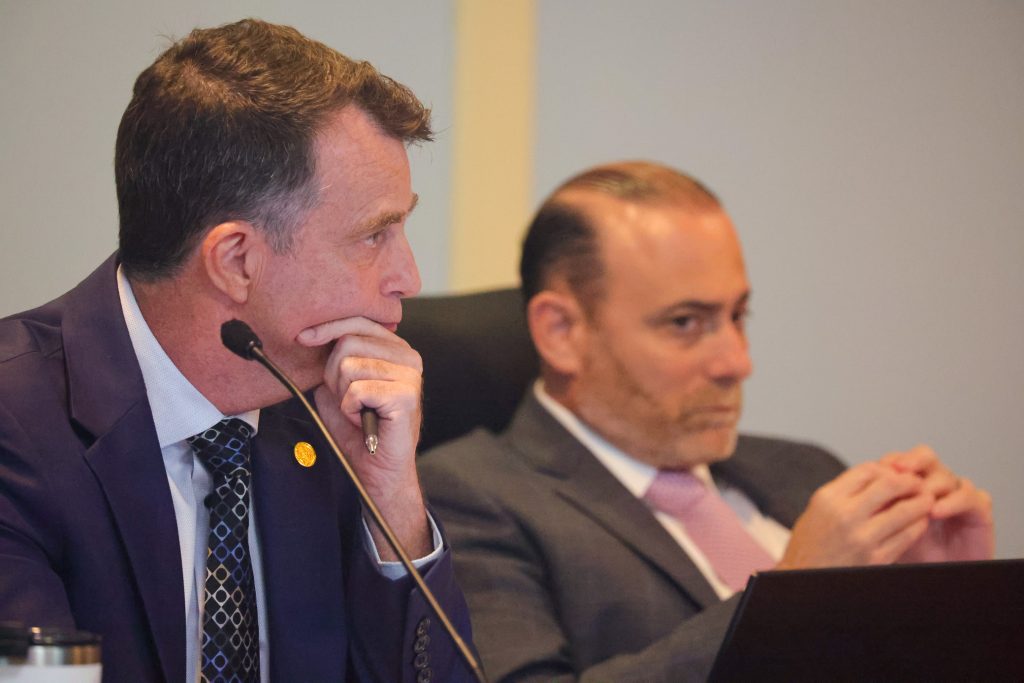 FILE — Key Biscayne Village Manager Steve Williamson and Village Attorney Chad Friedman listen to debate at Village Council meeting June 10, 2025 (KBI Photo/Tony Winton)
David Cuillier, director of the Freedom of Information Project at the Brechner Center, said Friedman was spot on.
“It creates a chilling effect throughout the agency, chilling employees who might want to express information the public needs to hear, such as problems or waste of tax dollars,” he said.
Cuillier said the media policy actually does the exact opposite of what Williamson claims. “Journalists do their most accurate work when they can talk directly to the source, not rely on hearsay,” he said.
“On its face, it makes sense” to many governments, he said. But,
“the negative ramifications cause far more problems for the public and agency by creating more chances for error – just like playing the telephone game.”
In court papers, the Independent had cited instances where the gag policy was chilling speech, which Friedman explained to the Council created legal risk for the Village.
The binding agreement, which the Independent had sought from the outset and the Village had had rejected for months, means Williamson will not reimpose his gag policy and that any future policy be discussed at a Council meeting with “reasonable” advance notice.
The Village also agreed to pay $25,000 towards the Independent’s legal fees.
Background
There is little discussion in the transcripts about the context of the media policy, which was enacted 12 days after the Independent wrote a story on Nov. 14, 2024 about the U.S. Rep. Maria Elvira Salazar moving into her Key Biscayne condo without the builder issuing a certificate of occupancy.
Salazar complained to the Village, and Williamson repeatedly asked Editor-in-Chief Tony Winton to make changes. Finding no factual issues, the Independent stood by its reporting. Williamson chose to reveal none of his interactions to the Council in the group session, but it’s not known what he may have said privately.
The transcripts show that the policy apparently had its origin with a consultant, Nery Ynclan, who was hired to train Village staff and council members in fielding media questions. A Sept. 2024 email from Drouet to staff said a session, led by Ynclan, would partly focus on how “you don’t have to answer the question directly.” The Village paid Ynclan $6,000, records show.
Strategy to “moot their claims”
The first of two closed meetings in September addressed legal strategy.
Village Attorneys Chad Friedman and Anne Flanigan told the Council they could defeat the First Amendment lawsuit by converting the policy into ‘guidelines,’ with the prediction that a federal judge would then decide that that Independent’s lawsuit was moot – or that the newspaper did not have “standing.”
“The resolution formally rescinding the policy will moot their claims,” Flanigan advised, although Council Member Nancy Stoner questioned why the Council had was being asked to pass a resolution when the manager had imposed the policy on his own.
Several council members were in agreement with this approach, although Council Member Michael Bracken asked if there was any real difference between a policy and ‘guidelines’ meant to delay or filter information.
But the Village’s resolution and legal maneuver did not succeed.
U.S. District Judge Ed Artau – a President Trump appointee – sided with the Independent. On December 19, Artau brushed aside the Village’s argument of mootness and instead ordered discovery — documents and depositions — to go forward. He ruled, essentially, that the newspaper had a right to prove key parts of its case.
The Independent received legal representation from the nonprofit Reporters Committee for Freedom of the Press, a national media freedom organization based in Washington, D.C.
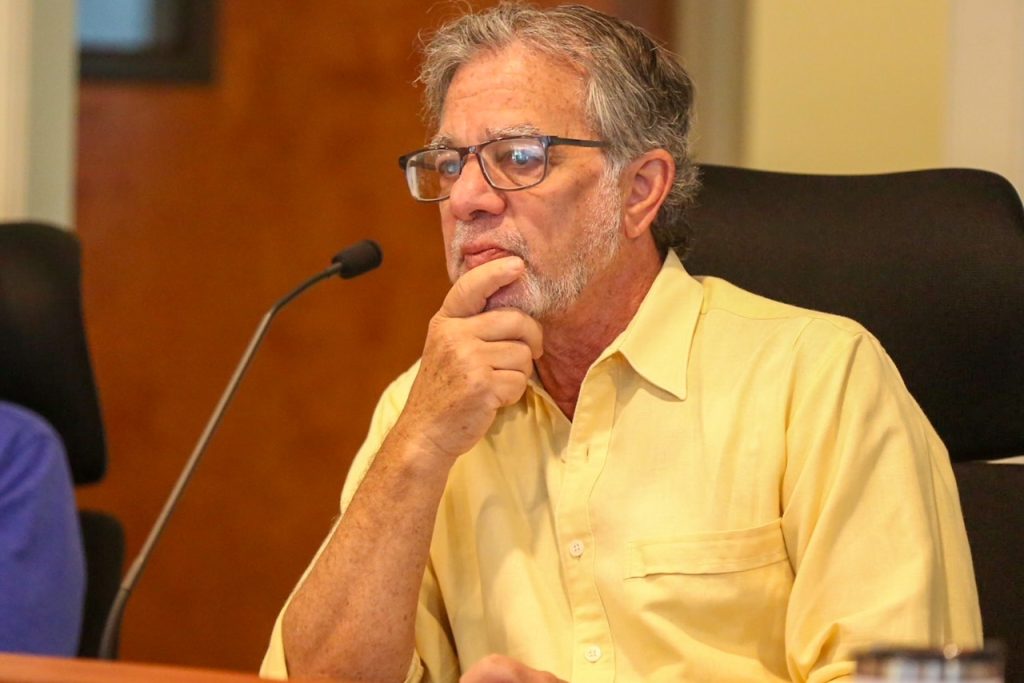 FILE – Council Member Frank Caplan listens to debate during a meeting of the Key Biscayne Village Council, Feb. 16, 2023 (KBI Photo/Tony Winton)
Artau also ordered the case to a settlement conference before Magistrate Judge Eduardo Sanchez. The five-hour session yielded a tentative agreement approved by Council following a second secret executive session March 10. The full Council was present for that session.
Williamson played innocent. “It’s just disappointing, you know, that something that really was intended with good intentions ended up this way,” the transcript of the second session on March 10 shows.
No First Amendment Champions
If residents were looking for the Council to be advocates for the First Amendment, they might be disappointed. Council Member Frank Caplan, a former mayor, attorney, and news publisher, agreed with Williamson’s media policy.
“It seems to me there is managerial discretion about ensuring the accuracy of communications,” Caplan said. “That is not always assured without some degree of coaching or clarifying what the actual talking points should be.”
Caplan then seemed to suggest the Village could play favorites with reporters: “It’s also true that one could elect to speak to a representative of the media but not all representatives of the media.”
The New York Times just sued the Pentagon over its media policy that allowed the government to revoke credentials if reporters spoke to employees to gather information. The lawsuit claims Defense Secretary Pete Hegseth aimed to replace established journalists with organizations favorable to the Trump administration.
U.S. District Judge Paul Friedman on March 20 ruled in favor of The Times, agreeing the policy violated the First and Fifth Amendments. His ruling was biting, stating:
“The policy is designed to weed out disfavored journalists and replace them with those who are ‘on board and willing to serve’ the government, a clear instance of illegal viewpoint discrimination.”
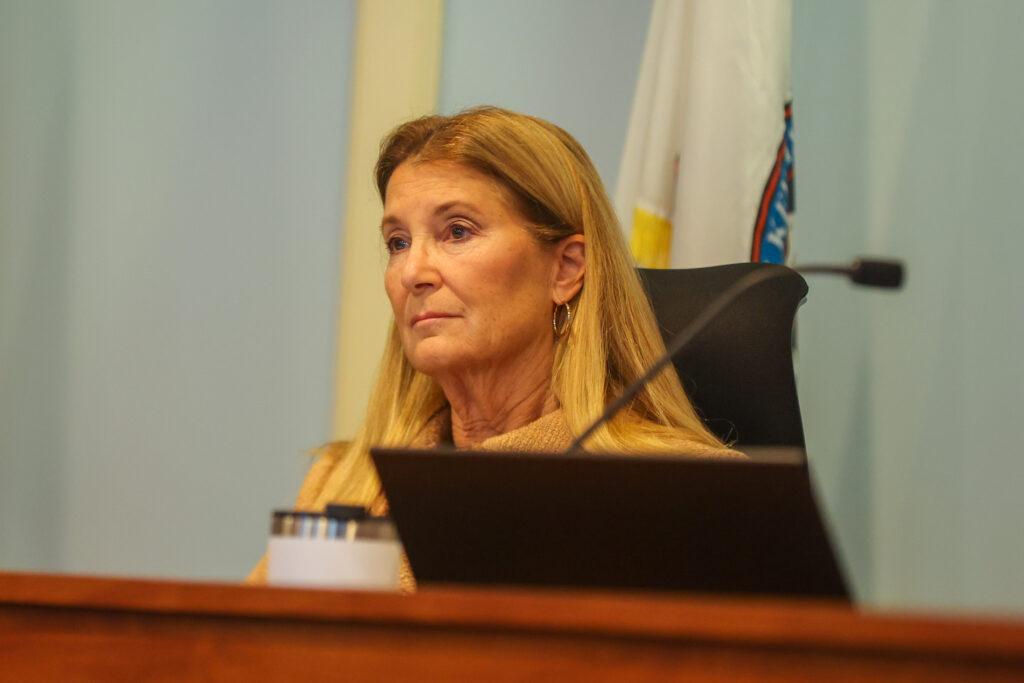 FILE — Key Biscayne Village Council Member Nancy Stoner at a meeting, Nov. 18. 2025. She is proposing doing away with the Village’s code enforcement board after an appeals court rebuked the way case involving a boat dock was handled (KBI Photo/Tony Winton)
As for any pushback on Williamson, only Council Member Stoner – who like Caplan is an attorney — questioned him.
“I think when we institute these policies, they have unintended consequences,” she said. “I think that we need to run them by counsel first, and then maybe run it by the Council.”
The transcripts show that the policy had its origin with advice from a consultant, Nery Ynclan, who was hired to train village staff in fielding media questions. A Sept. 27, 2025 email from Drouet said a session led by the former TV producer would partly focus on how “you don’t have to answer the question directly.”
New Public Records Fees
Since early this year, Williamson has instituted a policy to charge $70 an hour for the Independent’s public request for his emails. The emails have been provided free of charge for years.
Council Member Ed London, in the March 10 closed meeting, said he spoke to an Independent reporter on the subject of public record fees. “They think it’s retribution,” he said. “So that’s probably going to be their next case.”
Friedman told the Council the Village’s insurer would cover his firm’s fees, except for a small deductible. But he also cautioned that if the case went forward, it would be very costly and the Village could be liable – saying that governmental media policies across South Florida are “ripe for being challenged.”
“I don’t think that we feel this is the best case to go and fight,” he said.
Invest in Local News for Your Town. Your Gift is tax-deductible

JOHN PACENTI is a correspondent of the Key Biscayne Independent. John has worked for The Associated Press, the Palm Beach Post, Daily Business Review, and WPTV-TV.