
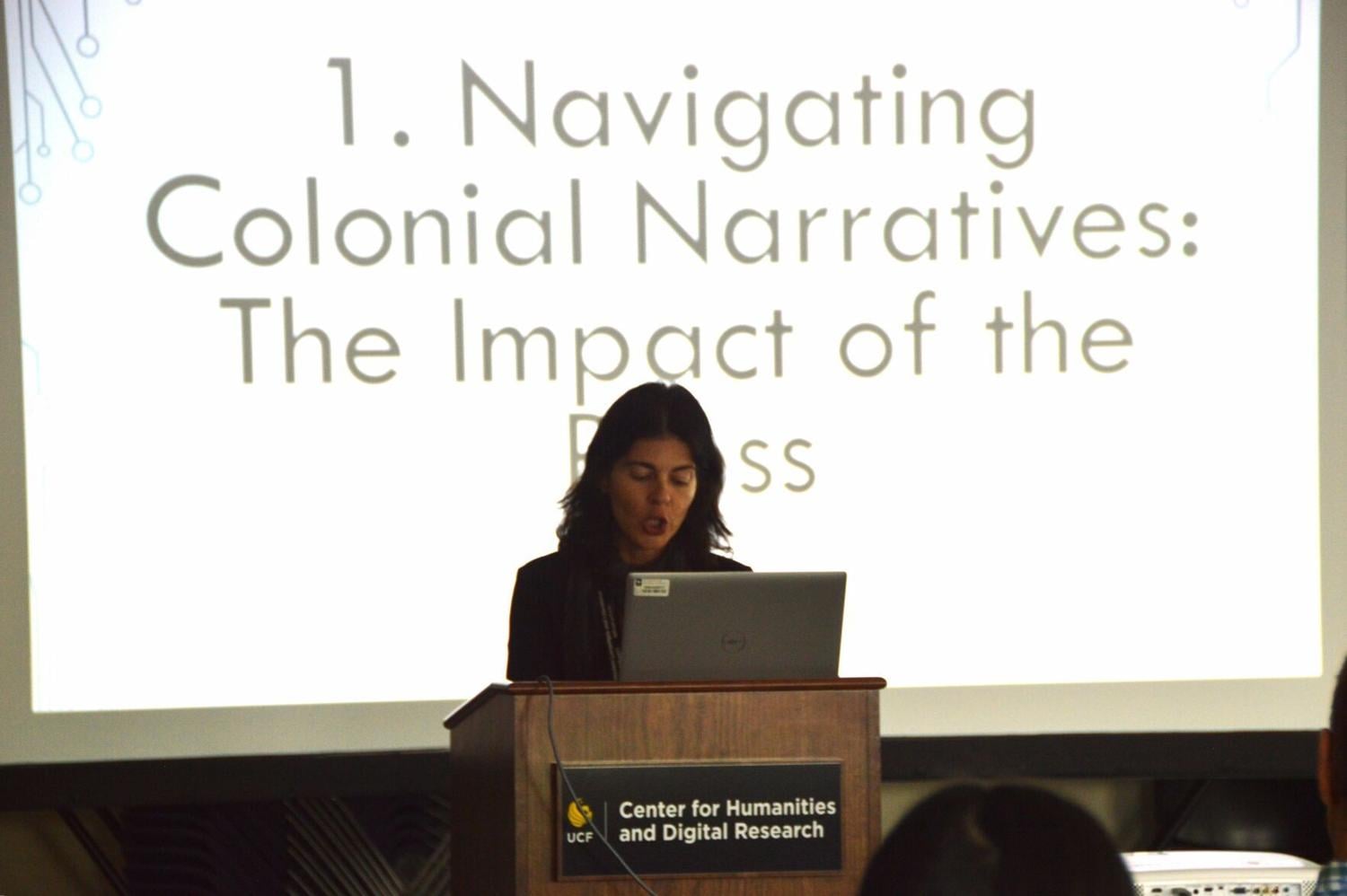

Dr. Sandra Sousa, associate professor of Portuguese, begins her Center for Humanities and Digital Research Presents lecture series talk by covering the different colonial narratives rampant in early 1900’s Mozambique press on Thursday at Trevor Colbourn Hall.
Fabio Braggion
A handful of students and faculty watched as an associate professor of Portuguese presented a talk on her research into the role of print media in shaping and contesting colonial rule Thursday in Trevor Colbourn Hall.
Dr. Sandra Sousa’s presentation was delivered as part of the Center for Humanities and Digital Research Presents lecture series.
“My godparents came from Mozambique, so I grew up listening to stories about Mozambique, so there was that part of me that wanted to know more about the place where they came from,” Sousa said.
She began this research by joining the International Group for Studies of the Periodical Press of the Portuguese Empire. There, she became more interested in the role the press specifically played in shaping Mozambique’s ideological landscape.
During the presentation, she spoke about two publications that were in opposition to each other in early 1900s Mozambique.
The first was O Brado Africano, a weekly editorial that tended to advocate for the rights of indigenous citizenship in the Portuguese Empire. The second was the Boletim Geral das Colónias, a pro-colonial publication sympathetic to the Portuguese Empire.
Sousa explained how they controlled information through the press, and how today, actions like that still happen and are more complicated.
“It’s human nature, and it’s all very, for me sometimes, so complex,” Sousa said. “And nowadays I feel like I’m actually living in the moment where what I’ve been studying comes out of these pages, of these books.”
She described similarities she’s witnessed between the language used today and that used during the Portuguese colonial rule of Mozambique. These connecting bridges are then brought into the classroom to better teach her students.
Sousa said she’s seen her students benefit from these comparisons.
“They do because then they can see, well, this is actually the same type of language that was being used 50, 60, 70, 100 years ago,” Sousa said. “Being able to identify how you can destroy narratives is a powerful weapon for my students to have.”
The presentation of her research is one of many in the CHDR Presents lecture series. The goal that Brook Miller, associate director for the Center of Humanities and Digital Research, said is to understand the history of who we are now.
“The speaker today talked a lot about issues around the development of nationalism, the importance of information networks, the spaces for resistance and resistance movements,” Miller said. “That’s a powerful message that resonates throughout history that we can continue to learn from today.”
Philosophy professor Dr. Bruce Janz attended the event and spoke about what it’s like to put on this lecture series. Janz specifically explained how building an intellectual cross-departmental community is difficult but important, and that every discipline is a humanities discipline.
“What I mean by that is that you can’t find a discipline that doesn’t ask questions about our life together,” Janz said. “Even if you’re in engineering, building something, you’re trying to figure out how to build it for a society.”
Sousa finished the talk by answering questions and chatting with the audience. After that, she spoke about the power of words and how people should be aware of that power.
“I think it was Toni Morrison — one of our biggest African American voices in this country — and she said, and I totally agree: ‘Words are powerful, they have power,'” Sousa said. “And they certainly do, and you need to be aware of that.”