
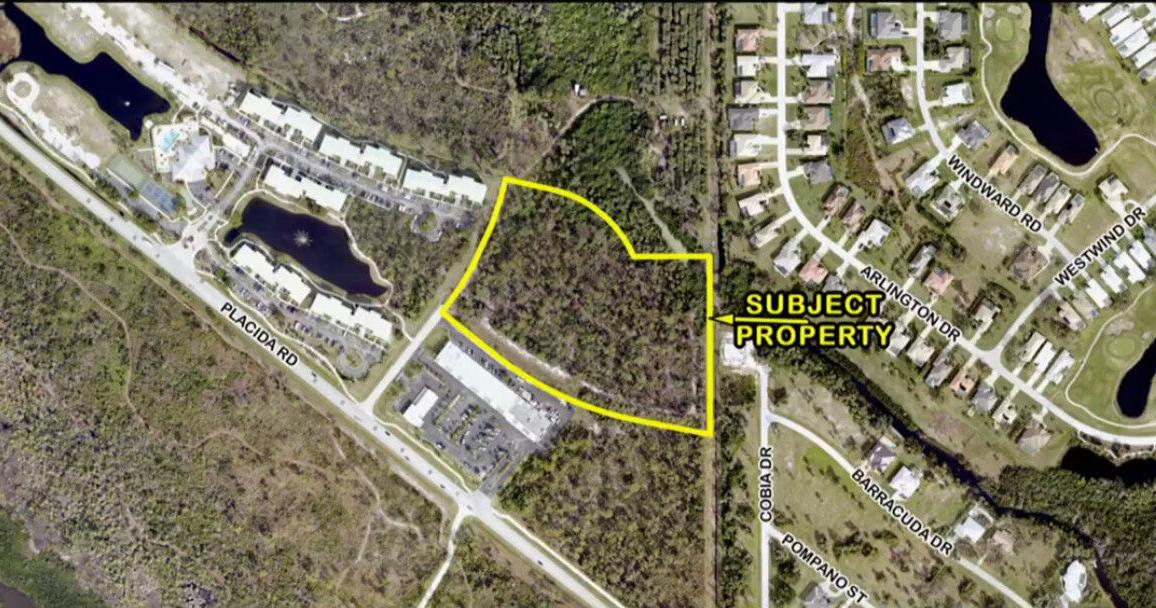
Charlotte County commissioners voted 3-2 on March 25 to deny a rezoning request that would have increased density at a proposed apartment development in the Placida area of Cape Haze, following hours of public comment and expert testimony from residents.
The applicant, Hutton MF Cape Haze LLC, sought to add 27 units to a project previously approved for 108 units. The request would have allowed up to 15 units per acre on the 9-acre site, up from the current 12 units per acre. The property is located northeast of Placida Road and southwest of Cape Haze Drive, west of Cape Haze Resort at 8401 Placida Road.
Roughly 18 residents spoke in opposition at the land-use meeting, including members of Friends of Cape Haze and nearby homeowners. Many raised concerns about flooding, environmental impacts and traffic, particularly given the site’s location within a Coastal High Hazard Area flood zone.

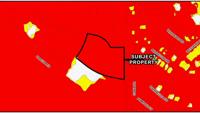
A Coastal High Hazard Area map highlights the proposed development site near Placida Road, underscoring concerns about storm surge and flooding risks.
Charlotte County government
Residents said stormwater runoff from the development could worsen flooding and potentially carry pollutants into nearby waterways. Others cited potential harm to wildlife and habitat, along with questions about whether portions of the site include wetlands.
Several speakers focused on elevation plans for the project. The proposed apartments would have a floor elevation of 13.1 feet, which some residents said could direct runoff onto neighboring properties, including the lower-elevation Cape Haze Resort community.
Opponents commissioned their own traffic and environmental studies, which they presented after the developer’s team outlined its plans. Residents said their findings conflicted with those submitted by the applicant.

Environmental consultant Church Roberts speaks before commissioners, citing potential wetland impacts and site conditions during the rezoning hearing.
Charlotte County government
Representing the developer, attorney Rob Berntsson of Big W Law Firm called on engineering consultants Shay Steck and Bill Barbaro of Bowman Consulting Group. They said the project was designed to avoid adverse impacts on surrounding properties.
According to the applicant’s team, the development would include a buffer exceeding code requirements, retention ponds to capture stormwater and prevent runoff, and nearly half the site set aside as open space. Plans also call for preserving 0.15 acres of wetlands in perpetuity.
Those measures did not ease concerns among many residents.
Percy Angelo, representing Friends of Cape Haze, presented maps from the applicant that he said had been overlaid with wetlands data by a resident, Rob Robbins. Angelo said the comparison indicated that project elements, including parking areas and portions of buildings, would be located on wetlands.

Cape Haze resident Rob Robbins presents maps and analysis during a Charlotte County meeting, raising concerns about wetlands and stormwater impacts tied to the proposed apartment project.
Charlotte County government
Robbins also challenged the applicant’s storm surge analysis, calling it flawed. He said achieving the proposed elevation would require significant fill, estimating more than 10,000 dump trucks would be needed.
Nearby resident Jay Eisenberg said the project’s design contrasts sharply with the existing Cape Haze Resort, which has 144 units on 24 acres. He said increasing the project to 135 units would represent overdevelopment and strain infrastructure while contributing to environmental degradation.
Environmental consultant Church Roberts, who has worked on permitting for projects including Babcock Ranch, also raised concerns. He said that based on site reports referencing Brazilian pepper trees, portions of the property appear to be wetlands.

Commissioner Chris Constance holds a document during the March 25 meeting as officials reviewed public input and technical data before voting to deny the rezoning request.
Charlotte County government
Commissioners Chris Constance, Stephen R. Deutsch and Chair Joe Tiseo voted to deny the rezoning request. Commissioners Ken Doherty and Bill Truex voted against the motion.
Truex said the proposed development is consistent with the county’s comprehensive plan for high-density areas, a position Doherty, an engineer, supported.
Constance cited increasing concerns about storm risks in coastal areas when explaining his vote.
“Since the flooding events, and since [Hurricane] Ian, a 100-year-storm is not a 100-year storm anymore, it’s a 10-year storm,” Constance said. “I can’t move forward adding any additional density in a high hazard area.”