
Fort Lauderdale Airport Delays Today March 27 — Here Is What Is Happening Right Now
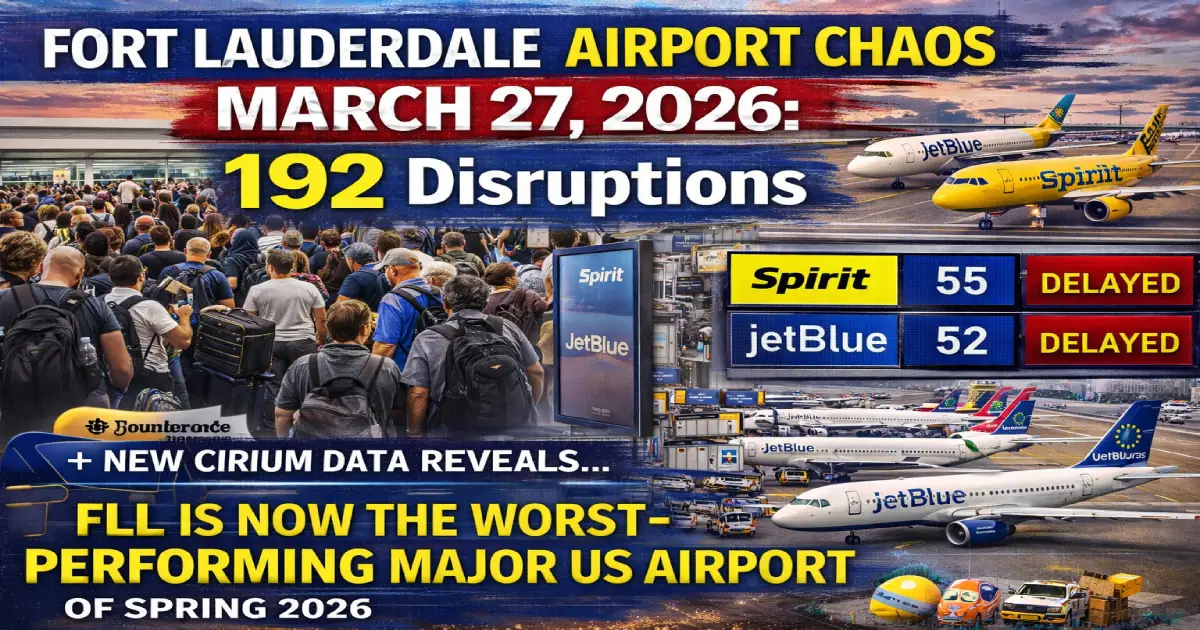
Fort Lauderdale airport delays today March 27, 2026 are worse than the numbers suggest. Yes — 186 delays and 6 cancellations are disrupting Spirit Airlines, JetBlue, Delta, American, and Southwest passengers across routes to LaGuardia, Los Angeles, Charlotte, Atlanta, Cancun, and Nassau. But the real story published just 7 hours ago by Travel and Tour World using Cirium data is bigger: Fort Lauderdale-Hollywood International Airport has recorded the steepest on-time performance decline of any major US airport between March 1 and March 26, 2026 — a collapse of 18.5 percentage points. That is not a bad day. That is a broken system.
Published: March 27, 2026 Total disruptions today: 192 (186 delays + 6 cancellations) Worst airline — delays: Spirit Airlines — 55 delays + 3 cancellations Second worst — delays: JetBlue Airways — 52 delays + 3 cancellations Delta Air Lines: 13 delays American Airlines: 13 delays Southwest Airlines: 10 delays Also disrupted: United Airlines, Allegiant Air, Frontier Airlines Worst domestic routes: LaGuardia (LGA) | Los Angeles (LAX) | Charlotte Douglas (CLT) | Atlanta (ATL) | Chicago O’Hare (ORD) International routes broken: Cancún (CUN) | Nassau (NAS) | Nassau Bahamas | Jamaica (MBJ) | Colombia Cirium D14% decline (March 1–26): –18.5 percentage points — steepest fall of any US airport — Travel and Tour World confirmed 7 hours ago On-time departure trend: Departure delays surged to levels not seen since late 2025 — Nomad Lawyer March 26 confirmed Tarmac hold times: Some flights exceeding 90 minutes on tarmac — Nomad Lawyer confirmed Causes confirmed: Weather volatility + staffing constraints + airspace congestion + network cascade from Northeast/Midwest storms Your previous FLL coverage: March 20 (216 disruptions, Spirit 39% delay rate) + March 20 US national chaos article Spirit delay rate today vs March 20: 15% today vs 39% March 20 — Spirit is stabilising but FLL overall is not Port Everglades: World’s #1 cruise port — FLL is its gateway airport — cruise passengers disproportionately affected FLL annual passengers: 40+ million DOT refund right: ✅ Full cash refund owed for cancellations — request specifically Duty of care (controllable delays): ✅ Meals + hotel for overnight delays on major US carriers Alternative airports: Miami International (MIA) — 30 min north | Palm Beach International (PBI) — 45 min north
The Cirium Data Nobody Else Has Published Today
Here is what separates today’s FLL story from every previous disruption article — including your own March 20 coverage.
Cirium — the aviation analytics firm whose data the entire industry uses — published updated March 2026 performance metrics today through Travel and Tour World. The headline number: Fort Lauderdale-Hollywood International Airport recorded a –18.5 percentage point decline in the D14% metric between March 1 and March 26, 2026.
D14% measures the percentage of flights departing within 14 minutes and 59 seconds of their scheduled time. It is the industry’s standard definition of an on-time departure. A decline of 18.5 percentage points means that if FLL was getting 80% of flights out on time at the start of March, it is now achieving approximately 61.5% — a collapse in operational reliability that has made Fort Lauderdale the worst-performing major airport in the United States over the past 26 days.
For context: Phoenix Sky Harbor recorded only a –2.1 percentage point decline over the same period. San Francisco International actually improved slightly. The divergence between FLL and the rest of the US airport system is not explained by a single bad weather day — it reflects a sustained, compounding breakdown.
Almost every major airport recorded a year-on-year decline between March 1 and March 26, 2026, suggesting a systemic issue rather than isolated disruptions. But FLL’s –18.5 point drop is in a different category from the national trend.
Why FLL Has Become the Worst-Performing Major US Airport of Spring 2026
Three simultaneous pressures have converged specifically at Fort Lauderdale — in a way that has not hit Miami, Tampa, or Orlando to the same degree.
Pressure 1 — Staffing + DHS Shutdown Compounding
Long lines, delays and cancellations have persisted at Fort Lauderdale due to bad weather and a Transportation Security Administration staffing shortage. Long early morning lines crowded Terminal 3 and stretched onto the sidewalk outside Terminal 4. The DHS shutdown — now Day 43 — has hit FLL’s TSA checkpoint throughput harder than many comparable airports because FLL’s terminal layout concentrates security pressure into fewer checkpoints than Miami or Orlando.
When passengers are delayed at security, airlines face an impossible choice: depart on time and strand passengers, or hold and cascade delays across the afternoon rotation. Long security queues, weather volatility, and airspace congestion are widely considered key factors. Airlines cannot easily delay flights intentionally to accommodate late passengers — doing so creates knock-on disruptions across tightly scheduled networks.
Pressure 2 — Network Cascade From Northeast/Midwest Storms
While local conditions in Broward County remained largely favorable for flying, the airport’s disruption levels appeared to be tied to a broader pattern of operational stress across the national airspace system. Recent severe winter storms across the northeastern United States earlier in 2026 disrupted airline networks for days, and recovery efforts have continued to reverberate through hub-and-spoke systems that connect to Fort Lauderdale. Meteorological and aviation reports indicate that earlier-season storms and traffic management initiatives at major hubs in the Northeast and Midwest generated recurring ground stops, reroutes and crew re-positioning challenges.
Fort Lauderdale is the termination point of some of the highest-frequency leisure corridors in the US — New York, Boston, Philadelphia, Chicago, Washington DC. When those origin airports have trouble, FLL absorbs the arriving aircraft late, turns around late, and departs late into the afternoon. The cascade compounds across Spirit’s and JetBlue’s dense FLL-based networks.
Pressure 3 — Spirit and JetBlue Are Both Primary FLL Carriers
This is FLL’s structural vulnerability. At Atlanta, Delta dominates and can redeploy aircraft efficiently. At Dallas-Fort Worth, American has the scale to absorb shocks. At Fort Lauderdale, two ultra-low-cost carriers — Spirit and JetBlue — operate at high frequency with lean crew reserves and minimal buffer in their rotations.
When Spirit suffers delays, it propagates through Spirit’s entire FLL rotation chain — because every late arrival becomes the next late departure. JetBlue faces the same dynamic. Today Spirit has 55 delays (vs 81 on March 20 at a 39% rate). JetBlue has 52 delays. Together they account for 107 of FLL’s 192 total disruptions — 56% of all disruption at the airport coming from two carriers.
Today’s Complete Airline Scoreboard
Spirit Airlines — 55 Delays + 3 Cancellations
Spirit is FLL’s highest-volume carrier and its most disruption-prone in 2026. Today’s 55 delays represent a significant improvement from March 20’s catastrophic 81 delays at a 39% rate — but they still make Spirit the single worst carrier at FLL today by volume.
Spirit’s core issue at FLL is structural: the carrier operates a dense point-to-point network from its South Florida base with lean crew reserves. Spirit Airlines’ delays expose the ultra-low-cost carrier’s chronic operational fragility. When Northeast weather disrupts Spirit’s New York-to-FLL inbounds, the cascade travels through every Florida-bound rotation for the rest of the day.
Worst Spirit routes today: LaGuardia ↔ FLL | Los Angeles ↔ FLL | Charlotte ↔ FLL | Atlanta ↔ FLL
If you are a Spirit passenger today: ✈️ Check the Spirit app before leaving home — Spirit’s disruption pattern at FLL means afternoon departures are being affected by morning cascades ✈️ Spirit is offering rebooking with no change fees for significantly disrupted flights — confirm via 1-800-401-2222 or spirit.com ✈️ If your flight is cancelled: request a full cash refund under the DOT automatic refund rule — Spirit is obligated to provide this within 7 business days
JetBlue Airways — 52 Delays + 3 Cancellations
JetBlue is FLL’s second primary carrier and today’s second-worst performer. At 52 delays and 3 cancellations, JetBlue’s FLL operation is under sustained pressure — compounded by LaGuardia simultaneously recording significant delays, which is JetBlue’s primary Northeast hub.
JetBlue Airways has LaGuardia and Fort Lauderdale operations simultaneously compromised — a dual-hub pressure that means JetBlue aircraft delayed arriving into FLL from LGA are also delayed departing LGA for FLL. Both ends of the corridor are disrupted simultaneously, producing a tighter squeeze on JetBlue’s network than either airport alone would create.
Worst JetBlue routes today: LaGuardia ↔ FLL | Boston ↔ FLL | Nassau (NAS) ↔ FLL | Los Angeles ↔ FLL
If you are a JetBlue passenger today: ✈️ JetBlue’s Mosaic elite members: call the dedicated line — rebooking priority applies ✈️ For Cancun and Nassau routes specifically: JetBlue leisure routes to Mexico and the Caribbean are concentrated in the afternoon departure bank — the highest-disruption window today ✈️ If your JetBlue flight is cancelled: request cash refund via jetblue.com/refunds
Delta Air Lines — 13 Delays
Delta’s 13 delays at FLL today represent secondary cascade impact — Delta’s FLL operation is smaller than Spirit’s or JetBlue’s, and the carrier’s larger fleet reserve provides more cushion. However, Delta connections onward to Atlanta (ATL) are specifically at risk: an FLL delay arriving into ATL can break connections to Delta’s international network at Hartsfield-Jackson.
American Airlines — 13 Delays
American’s 13 FLL delays are consistent with the airport-wide pattern. American operates primarily through MIA rather than FLL — its FLL disruption today is secondary cascade, not primary hub impact.
Southwest Airlines — 10 Delays
Southwest’s 10 delays at FLL are lower than expected given the airport-wide pressure. Southwest’s no-change-fee policy means passengers can self-rebook without cost — and the carrier’s point-to-point network provides more flexibility than hub-dependent carriers when individual airport delays occur.
The Cruise Passenger Problem — Port Everglades Angle
Fort Lauderdale-Hollywood International Airport is the gateway airport for Port Everglades — the world’s largest cruise port by passenger volume. Royal Caribbean, Carnival, Norwegian, Celebrity, and MSC all base ships here. On any given Friday, thousands of cruise passengers are transiting FLL to reach embarkation at Port Everglades — and today is a Friday.
Today’s 192 disruptions hit cruise passengers with a specific and brutal asymmetry: missing a cruise departure due to a flight delay is not a compensable event under most standard cruise booking terms. The cruise ship leaves. You are not entitled to a refund on the cruise. Your DOT flight cancellation refund does not compensate for the cruise cost.
What this means for FLL cruise passengers right now:
✈️ If your cruise departs today and your flight is significantly delayed — contact your cruise line’s emergency number immediately, before your flight even lands ✈️ Royal Caribbean emergency: 1-800-256-6649 ✈️ Carnival emergency: 1-800-764-7419 ✈️ Norwegian emergency: 1-866-234-7350 ✈️ Celebrity emergency: 1-888-751-7804 ✈️ MSC emergency: 1-800-666-9333
✈️ Most major cruise lines will hold embarkation for a documented flight delay if notified in advance — they will not hold for a passenger who simply arrives late without warning ✈️ The standard industry practice: fly to your cruise departure city the day before — never the day of departure. Today’s disruption at FLL is a live demonstration of why
FLL vs March 20 — What Has Changed and What Has Not
Your March 20 article covered Spirit’s 39% delay rate — the worst single-carrier delay rate at any major US airport in Spring 2026. Here is what the comparison tells us today.
Metric
March 20, 2026
March 27, 2026 (today)
Change
Total disruptions
216
192
↓ Better
Spirit delays
81 (39% rate)
55 (15% rate)
↓ Improving
JetBlue delays
49
52
→ Flat
Delta delays
Not broken out
13
—
American delays
Not broken out
13
—
Cancellations
5
6
→ Flat
Cirium D14% decline
Not measured
–18.5 pts (worst US airport)
🔴 NEW + WORSE
Cause
Spring Break peak traffic
Systemic + staffing + weather cascade
🔴 Structural
The headline improvement — 216 to 192 — is real but misleading. Spring Break is over. Demand has dropped. FLL should be recovering. The fact that it is still generating 192 daily disruptions after Spring Break ends — and recording the worst Cirium on-time decline of any US airport — is the structural story March 20’s article could not tell.
What To Do Right Now — Every Affected Passenger
If Your Flight Is Delayed (Not Cancelled)
✈️ Do NOT leave your gate area — FLL delays are moving targets. A 2-hour delay can become a boarding call 40 minutes before the original departure if a slot opens ✈️ Check the airline app — FLL’s disruption pattern today means real-time app data is more accurate than departure boards, which lag by 5–10 minutes ✈️ After a 2-hour delay on a controllable cause: ask airline staff for a meal voucher — Delta, United, American, Southwest, JetBlue, and Spirit have all committed to this for controllable delays under the DOT dashboard ✈️ After a 3-hour delay: escalate your rebooking request — ask specifically for the next available flight including partner airlines
If Your Flight Is Cancelled
The DOT automatic refund rule (effective 2024, in full force 2026) gives you a clear, legally enforceable right:
✈️ Domestic cancellation → full cash refund to original payment method if you choose not to travel — no vouchers required ✈️ International cancellation → same right applies ✈️ Refund timeline: 7 business days for credit card purchases — airlines cannot legally delay this ✈️ The words to say: “I am requesting a full cash refund under the DOT automatic refund rule for this cancellation.” ✈️ If refused at the desk: File a complaint immediately at transportation.gov/airconsumer — DOT actively enforces this rule
Alternative Airports — The FLL Escape Valve
If you have flexibility today, two alternatives serve South Florida:
Miami International (MIA) — 30 minutes north of FLL via I-95 or Florida Turnpike. American Airlines hub. Today’s disruption is not concentrated at MIA. American’s primary operation there is under less pressure than Spirit/JetBlue at FLL. Ground transport: Uber/Lyft $35–55, rental car available.
Palm Beach International (PBI) — 45 minutes north of FLL. Smaller, significantly less congested. JetBlue and Southwest both serve PBI. Worth checking if your destination has PBI service — for some East Coast routes (Boston, New York, Philadelphia, DC), PBI may have seats available with less delay pressure.
The Bottom Line
Fort Lauderdale airport delays today March 27, 2026 are not just today’s problem. The Cirium data published this morning tells the real story: FLL has recorded the worst on-time departure decline of any major US airport over the past 26 days. Spring Break is over. Demand is lower. The airport should be recovering. It is not — and the –18.5 percentage point Cirium decline confirms this is structural, not circumstantial.
Spirit’s 39% delay rate on March 20 was a single-day catastrophe. Today’s sustained 192 disruptions in a lower-demand post-Spring-Break week is a system that has not reset.
If you are flying through FLL today: arrive early, check the app before leaving home, and know your DOT refund rights before you reach the desk. If you are booked on a cruise departing Port Everglades today — call your cruise line right now.
Check your FLL flight status before leaving: flightaware.com | Check Spirit delays: spirit.com | DOT refund rights: transportation.gov/airconsumer
For More Resources:
Related Articles:
Posted By : Vinay