
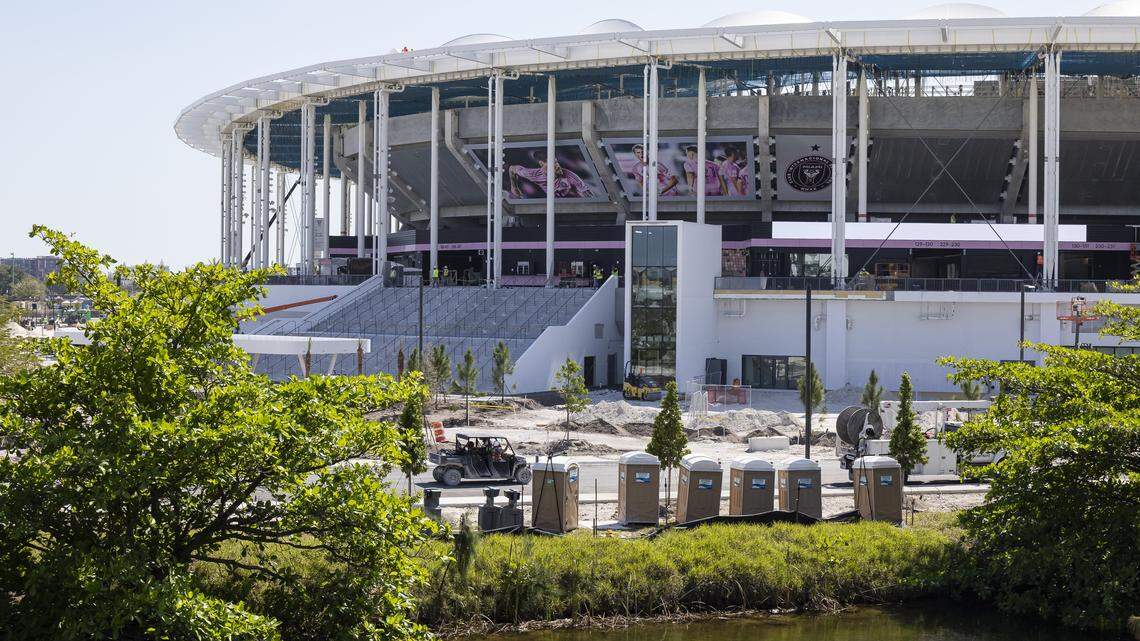
A general view of the construction site of Nu Stadium on Tuesday, March 24, 2026, in Miami, Fla.
Photo by Matias J. Ocner
mocner@miamiherald.com
Finally, 12 years after David Beckham arrived on the shores of Biscayne Bay in a tailored suit and announced that he was bringing Major League Soccer to Miami, after an odyssey rife with political battles and repeated roadblocks, after six years playing in a temporary stadium in Fort Lauderdale, the British icon’s vision will become reality.
Inter Miami, led by Argentine captain Lionel Messi, will play its inaugural game in the club’s newly constructed 26,700-seat home, Nu Stadium at Miami Freedom Park on April 4 at 7:30 p.m. against Austin FC.
“We’re Coming Home” declares the club’s promotional campaign.
It isn’t exactly the home Beckham originally envisioned. He dreamed of a waterfront stadium with picturesque views and tried to cut a deal for a site at the county-owned Port Miami.
But that proposal got blocked, leading to another failed waterfront bid for a stadium at the boat slip on Biscayne Boulevard next to what is now Kaseya Center.
Plan C was adjacent to Marlins Park in Little Havana, but that didn’t work out, either. A proposed Overtown site a few blocks from the Miami River started to take hold but faced community opposition. In all, Beckham, with various partnership groups, explored more than 20 sites.
It wasn’t until Beckham partnered with Miami brothers Jorge and Jose Mas, principles of construction and infrastructure firm MasTec, that a viable stadium plan began to take shape.
“My journey with Miami started in 2013, finishing playing for PSG and the next day jumping on a plane and announcing that I was going to bring a team to Miami,” Beckham said on the eve of the team’s historic MLS Cup win in December. “The only thing missing at that point were the right partners. The moment me, Jorge and Jose met, we didn’t even have to say anything at that point. I knew this was the partner that was going to make everything possible. It’s been an incredible journey.”
On April 29, 2022, Beckham and the Mas brothers got the green light to negotiate a 99-year no-bid lease for a commercial and soccer stadium complex on the site of the city-owned Melreese Golf Course. Miami commissioners voted 4-1 to support the stadium and commercial development.
Construction began on Aug. 28, 2023, one month after Messi signed with Inter Miami.
A crew of 1,300 workers has been on the site adjacent to Miami International Airport for months, toiling to get the stadium completed. The Bermudagrass field, grown on a farm in Loxahatchee, Florida, was installed during the past few weeks. The majority of the seats are in place, alternated in pink, black, gray and white with some positioned to depict a heron, the team’s mascot. The final seats are scheduled to be installed by early next week.
The complex will also include more than 4,500 parking spaces and 2.5 miles of new roads, plus a planned pedestrian bridge from the Miami Intermodal Center, which includes Metrorail and Tri-Rail stations. Inter Miami is urging (and incentivizing) fans to take public transportation to the games.
Fans will likely see cranes, bulldozers and dust on opening day, as the area will remain a construction zone for years, while the rest of the $1 billion, 131-acre project is completed. Following delivery of the stadium and initial retail and entertainment offerings in 2026, additional retail, hotel and commercial development will continue through 2030.
Inter Miami officials have assured fans that the centerpiece of the project, Nu Stadium, will be game-ready on Saturday.
“We’re kicking off April 4; it’s going to be an amazing day,” Jorge Mas said last month. “It’s a mad rush. The stadium will be ready; as close to 100% as a new stadium can be without rehearsals. I want to make an amazing fan experience. If there are some details left to do, they won’t be able to see them, paint and some finishes, but it will be fine. The stadium will be in optimal condition.”
“By the way, the stadium is stunning,” he added. “It’s absolutely beautiful. Through the course of the first few months, we’ll get all the kinks out.”
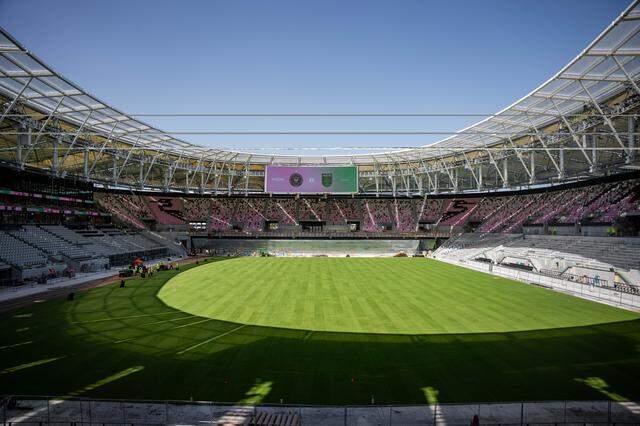 The field has been installed at Nu Stadium, the new home of Inter Miami, which plays its first game there April 4 against Austin FC. It is Bermudagrass, grown in a farm in Loxahatchee, Florida. Inter Miami CF
Xavier Asensi, Inter Miami’s president of business operations, echoed Mas’ optimism in a recent interview with the Miami Herald.
“The first game will happen on April 4,” he said. “There will be seats. There will be grass. There will be concessions, lights, speakers, two goals, four corner flags. Don’t worry.”
Asensi said while the club has enjoyed playing in Fort Lauderdale over the past six years, having a permanent home in the heart of Miami will vault the club to new heights.
“We have been waiting to be able to be in Miami-Dade, in 305,” he said. “Having a permanent home is like a before and after for our club. Day and night. We finally will have a place we can call our true home.”
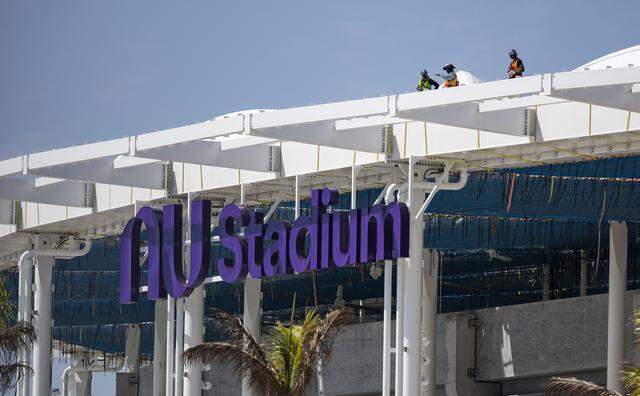 Construction is ongoing at Nu Stadium on Tuesday, March 24, 2026, in Miami, Fla. Photo by Matias J. Ocner mocner@miamiherald.com
MLS commissioner Don Garber kept close tabs on the project through all the twists and turns.
“We are very involved with all our stadium projects from the initial plans, and we looked at so many different sites, at the ship terminal, the place right near the museum, and here we are,” Garber said in December, when he visited South Florida to present Messi the MLS MVP trophy for the second year in a row.
“It’s going to be a game changer for the sport here. It’s going to be a game changer for MLS. I always believed that South Florida was the gateway to South America, and South America’s got such a passionate football culture and so many people here that love the game.”
In fact, the Miami stadium saga began long before Beckham showed up. It dates back three decades.
On July 8, 1997, in an 18th-floor ballroom of the Waldorf Astoria Hotel in New York City, MLS launched the Miami Fusion, the first incarnation of a South Florida team. The club’s name and logo were revealed with much excitement — a futuristic blue and yellow oval with the word “Fusion” over a sunburst.
“The name Fusion is explosive and powerful, and it symbolizes the unification of Miami’s multinational population,” team owner Ken Horowitz, the Palm Beach cellular phone mogul, said at the news conference. “It is a symbol that soccer fans of all nationalities will gather in Miami to see a dynamic team.”
From the league’s inception in 1996 the intent was to have a Miami team become a bilingual global brand that would extend MLS tentacles into South and Central America. The idea was to get fans from those regions to adopt the Miami team as their U.S. based team, watch games on TV, buy merchandise, and travel to Miami to see them play in person.
The plan was for the Fusion to begin play in March 1998 at the Orange Bowl. But Horowitz, Miami Mayor Joe Carollo and the City Commission could not come to terms on a lease agreement, so Horowitz took the team to Fort Lauderdale and upgraded Lockhart Stadium, where they played until they folded in 2001.
Then-MLS commissioner Doug Logan complained about Miami politics slowing down the franchise startup: “It’s no coincidence that this event is being held after the recent Miami elections. It was a long, bumpy road with political side trips.”
Beckham and the Mas brothers navigated through a similar saga.
In May 2013, upon Beckham’s retirement from the Los Angeles Galaxy, word got out that he planned to buy a club for a deep discount, which was part of his contract with the league. Miami was his first choice, and he initially teamed with Bolivian billionaire and Miami resident Marcelo Claure, who had been trying to bring MLS back to Miami since 2009.
In February 2014, at a waterfront news conference at the Perez Art Museum, Garber announced that Beckham would get an expansion franchise, and it would be in Miami, if a suitable stadium site could be found. The league preferred a privately funded 25,000-to-30,000-seat venue in the “urban core” of the city.
During the next two and a half years, Beckham and various investors tried, and failed, to land a stadium deal. In December 2017, when Beckham was running out of options, the Mas brothers came to the rescue and joined Beckham’s investor group after their deal to buy the Marlins fell through.
Six months later, Beckham and Jorge Mas released the first details of their plans for the Melreese Golf Course site. And in September 2018, the club got its name, Inter Miami, and its now recognizable colors, pink and black.
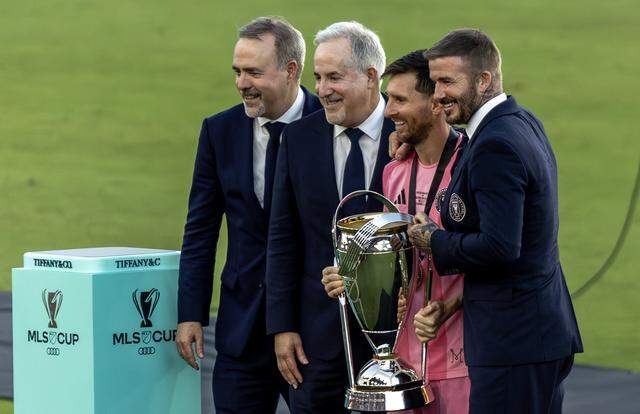 Inter Miami co-owners Jose Mas, Jorge Mas and David Beckham pose with the Philip F. Anschutz Trophy after their MLS Cup final win over the Vancouver Whitecaps at Chase Stadium on Saturday, Dec. 6, 2025, in Fort Lauderdale, Fla. Photo by David Santiago dsantiago@miamiherald.com
The Melreese referendum passed with about 60 percent support from Miami voters in November 2018, allowing the city and Inter Miami to begin negotiating a lease agreement.
Unable to secure a Miami venue in time to meet the MLS deadline, the Beckham-Mas group invested upwards of $100 million to build a stadium and training facility in Broward County, on the grounds of the former Lockhart Stadium, the very same place Horowitz resorted to three decades earlier.
The team played its first game on Mar. 1, 2020, a road loss at Los Angeles FC. Inter Miami’s long-awaited home opener, scheduled for Mar. 14 against the LA Galaxy, was postponed due to the COVID-19 pandemic shutdown, which halted the season immediately after their first two games.
It was five months before Inter Miami played its first home game in front of fans.
The 20,000-seat pink-and-black stadium, first called DRV PNK and then Chase Stadium, is as nice as a temporary stadium can be. Inter Miami made many memories there, including winning its first MLS Cup trophy in December 2025.
The adjacent training grounds are world-class and will remain the team’s practice facility. But the stadium was never intended as Inter Miami’s permanent home.
Since the days of the Orange Bowl plans in the late 1990s, the plan was for the Miami MLS team to play in the heart of Miami, smack in the middle of the city’s soccer-crazed international melting pot.
That is where it will finally be, starting next weekend.
“Opening our new stadium is a really special moment on our journey, a place for fans across South Florida and for people from around the world who feel connected to our Club to watch us play,” Beckham said. “Nu Stadium will be a home for the Inter Miami family and a place that reminds everyone who visits of the Freedom to Dream.”
INTER MIAMI NU STADIUM FAN GUIDE
Iner Miami Home Schedule: Apr. 4. vs Austin FC, Apr. 11 vs NY Red Bulls, Apr. 25 vs New England Revolution, May 2 vs Orlando City, May 17 vs Portland Timbers, May 24 vs Philadelphia Union, July 22 vs Chicago Fire, Aug. 1 vs. Columbus Crew, Aug. 6 vs Atletico San Luis (Leagues Cup), Aug. 9 vs. Monterrey (Leagues Cup), Aug. 13 vs. Leon (Leagues Cup), Aug. 22 vs Toronto, Aug. 29 vs CF Montreal, Sept. 5 vs Atlanta, Sept. 12 vs Nashville SC, Sept. 20 vs San Diego FC, Oct. 10 vs. D.C. United, Oct. 14 vs. NYCFC, Oct. 28 vs. Cincinnati, Nov. 7 vs. Charlotte FC.
Where can I buy Inter Miami tickets? intermiamicf.com/tickets
Where can I park for Inter Miami games at Nu Stadium? Fans driving to games must buy a parking pass in advance through the team website. On-site purchases will not be available on match day. Details here.
How can I get to Inter Miami games at Nu Stadium on public transportation? Trains, buses and the Metrorail will drop fans off at the Miami Intermodal Center, which is adjacent to Miami International Airport and across the street from the stadium grounds. Ticket holders who travel to matches using public transportation (Tri-Rail, Metrorail, Metrobus, Trolley, or Broward County Transit) will receive a $10 food and beverage credit upon arrival at Nu Stadium. Details here.
This story was originally published March 27, 2026 at 2:09 PM.
Miami Herald
Miami Herald sportswriter Michelle Kaufman has covered 14 Olympics, six World Cups, Wimbledon, U.S. Open, NCAA Basketball Tournaments, NBA Playoffs, Super Bowls and has been the soccer writer and University of Miami basketball beat writer for 25 years. She was born in Frederick, Md., and grew up in Miami.