
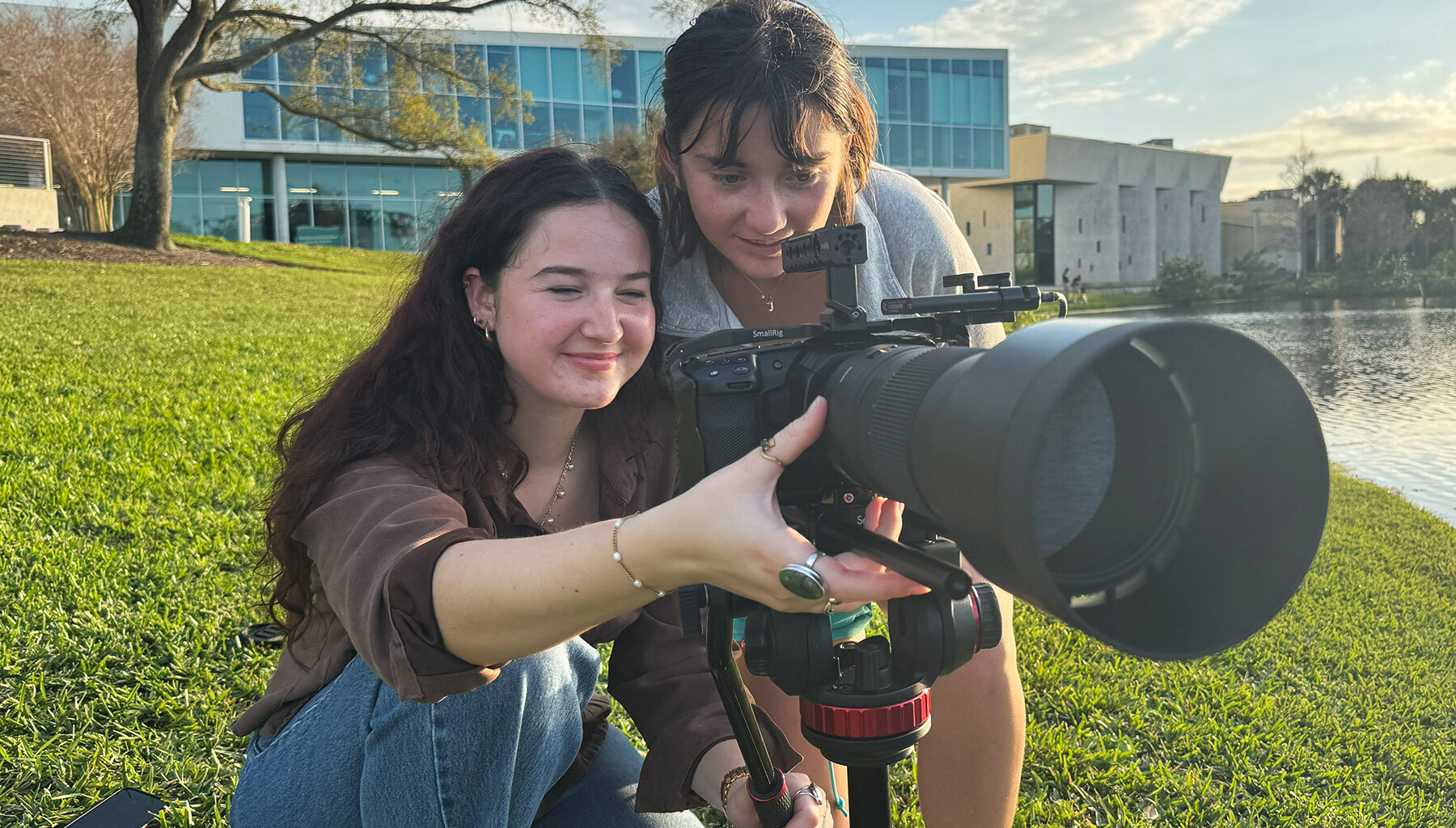
Gianna Barrows, a first-year student from Sagamore, Massachusetts, came to Eckerd to major in marine science but soon realized her Introduction to Filmmaking class was one of her favorites. She is now planning to major in film studies and take the nature and environmental filmmaking track. “This program brings together my love for the environment and my love for filmmaking,” Gianna says. “And we already have so many resources for this. Film studies students don’t have to pay a lab fee, and any student can check out a camera or other high-level equipment for a few days.
“Eckerd is a very environmentally focused college, and we have so much wildlife on campus. Many of the things we do in class you couldn’t do on [other campuses]. There’s so much more opportunity for environmental filmmaking.”
Nick Corrao, MFA, Nielsen assistant professor of film studies at Eckerd, says that when he arrived at the College in 2019 “it was very evident our students have an interest in the environment and natural sciences, but also in filmmaking and visual storytelling. Eckerd’s annual Environmental Film Festival is one example of the pre-existing campus offerings where these disciplines intersect. There’s always been a cross-discipline flavor.
“So Christina Petersen (Ph.D., Nielsen professor of film studies), Nate Andersen (Ph.D., professor of philosophy) and I started looking to find ways to expand film studies’ academic offerings and converge with the research being done in the sciences on campus. We could not find another undergraduate program that offered a minor or a major track in nature and environmental filmmaking in the U.S., so we saw a unique opportunity to create something that could gain some attention. Last year, Katrin took the reins and we all collaborated on the shape and structure of the program.
“Interdisciplinary is the key word,” he adds. “We believe that the students will become stronger filmmakers as they find ways to integrate their scientific research into their creative work, and they will become stronger scientists as they find ways to communicate their ideas through the tools of cinema. There’s tremendous power in that. It gives students a whole new communication toolset.”
And it gives students like Aleah Dyson, a junior environmental studies student from Montpelier, Vermont, a welcome addition to her course of study. Aleah will be taking the nature and environmental filmmaking minor this fall.
“I have no background in filmmaking, but I’m very passionate about the environment and I’ve been trying to figure out the best way I can make positive change in the world,” she says. “I did a semester abroad last year at the University of New South Wales in Sydney, Australia and I took a class in environmental activism. Watching the documentaries … it really spoke to me.
“I grew up watching (British biologist and broadcaster) David Attenborough, and my family has always been passionate about the environment. The last three years I’ve been bouncing around from idea to idea as to what I want to do … environmental law, urban planning. But I could see myself doing something more artistic, something in film.
“When I learned about the nature and environmental filmmaking minor, I immediately had to see if I could get in. And I did. It’s so special because we need to educate as many people as possible about the environment, and film is a great way to do that.”