
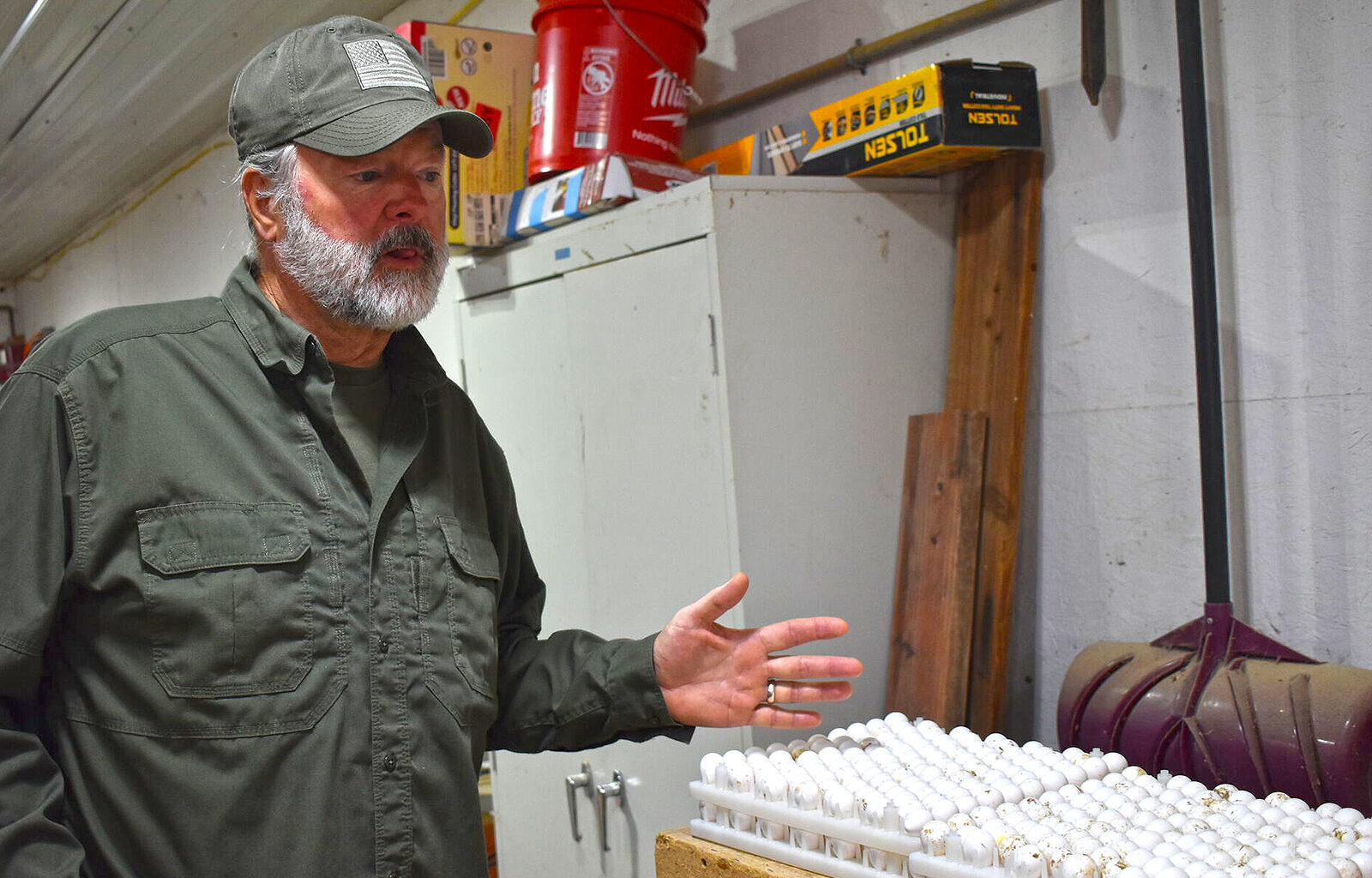
John and Kristy Clegg raise quail at their farm east of Jacksonville. They raise the birds through every stage, from eggs to adults.
Samantha McDaniel-Ogletree/Journal-Courier
On a farm east of Jacksonville, a covey of quail is growing as the landowners expand the number of birds they raise and the products they offer.

From eggs and meat to birds used in dog training and hunting, the Cleggs are building their quail operation after establishing it just two years ago.
Article continues below this ad
“I grew up with chickens and I’ve raised pheasants,” said John Clegg. “We thought why not give quail a shot.”
John and Kristy Clegg have decided to spend their retirement from livestock on a new venture. With very few quail farmers in the area, John Clegg said they have gotten a fair bit of support locally.
An incubator rotates fertilized eggs to ensure they remain at optimal temperatures while hatching.
Samantha McDaniel-Ogletree/Journal-Courier
While they established their first covey of about 7,000 birds last year, they are still learning and trying new things as they expand. The number of birds is expected to double this year.
Article continues below this ad
“We just started two years ago and the first year was us doing our due diligence,” Clegg said. “We were told quail are hard to raise. We are looking to experiment with a couple species to see if we are willing to take them to market.
Though they can’t say for sure where the closest farm is, they don’t believe there are any close and have had customers from several hours away.
At their farm, the Cleggs are raising birds through every stage, from eggs to adult birds.
Article continues below this ad
While similar to chickens in many ways, John Clegg said there are some important differences…, such as ensuring the habitat for the birds is clean as quail like to peck at anything and could pick up their feces if not provided the right environment.
John and Kristy Clegg rotate birds in their aviaries based on age.
Samantha McDaniel-Ogletree/Journal-Courier
“The management, collecting the eggs, incubating and hatching are all very similar,” he said. “Quail eggs are also harder to incubate and require a very reliable temperature and humidity environment. Chicken eggs are a bit more forgiving.”
John Clegg said quail must be monitored closely.
Article continues below this ad
In addition to elevated enclosures, John Clegg said they have to be aware of other hazards, as he has found quail easily escape their enclosures and are prone to being self-destructive.
“I don’t know what a quail’s IQ is, but I would guess it’s single digits,” he said.
Each year, the Cleggs add something else to their services.
Quail roam the barn on the Clegg Farm property.
Samantha McDaniel-Ogletree/Journal-Courier
“Our first goal was to sell flight-ready birds for hunter or landowners,” John Clegg said. “We’ve had some buy birds to help propagate their land. We’ve had clients who were dog trainers that would buy them to train new dogs or to help keep dogs in shape. We are trying to get out of the hunting side and trying to create a market for meat and eggs.”
Article continues below this ad
The Cleggs are looking at other products they can offer, including pet treats made from the eggs, however, they have to get other specialty licenses before they can begin to offer those products.
The Cleggs have been working with the Morgan County Health Department and the Illinois Department of Natural Resources and Illinois Department of Agriculture to get licenses for different aspects of their operation and find different avenues they can explore.
While both are birds, John Clegg said quail have different requirements for their enclosures and different nutritional needs.
While they are working on expanding what they offer, John Clegg said they are trying to work with other people who have shown an interest in quail.
Article continues below this ad
Being one of the few local quail farmers, he said they’ve gotten many phone calls about how to help protect the natural quail populations on other properties.
While working on the production side, the Cleggs are also working on the conservation side and promoting conservation efforts that support the growth of the natural population as well.
“There has been a decline in the natural population,” John Clegg said. “Before, they used to be on every farm and roadside.”
Kristy Clegg said their natural habitat has been declining for years.
Article continues below this ad
“It’s all timber and less habitat,” she said.
Quail do well in areas with prairie grass, light woodlands and shrubbery.
John Clegg said he is converting a portion of his land into habitat for the natural quail population, but said it is a longer process as much of it was used for farming.
Article continues below this ad
He said they are also working with others who have expressed interest in establishing conservation areas and want to see quail on their property.
“We are willing to talk with anyone and try and help where we can,” Kristy Clegg said.