
Welcome to the Catalyst’s Community Voices platform. We’ve curated community leaders and thinkers from all parts of our great city to speak on issues that affect us all. Visit our Community Voices page for more details.
“We’re full.” “Too much traffic.” “Overcrowded.” If you’ve sat through a public hearing in a fast-growing community, you know the script. Residents line up at the microphone. Schools are maxed out. This isn’t the community I moved to anymore. The roads can’t handle it.
As a Floridian and St. Petersburg resident who has sat through his share of public hearings on both sides of the dais, I’ve watched this anxiety play out countless times and close to home. There are genuine worries that St. Pete is transforming into a luxury oasis, and I understand the fear.
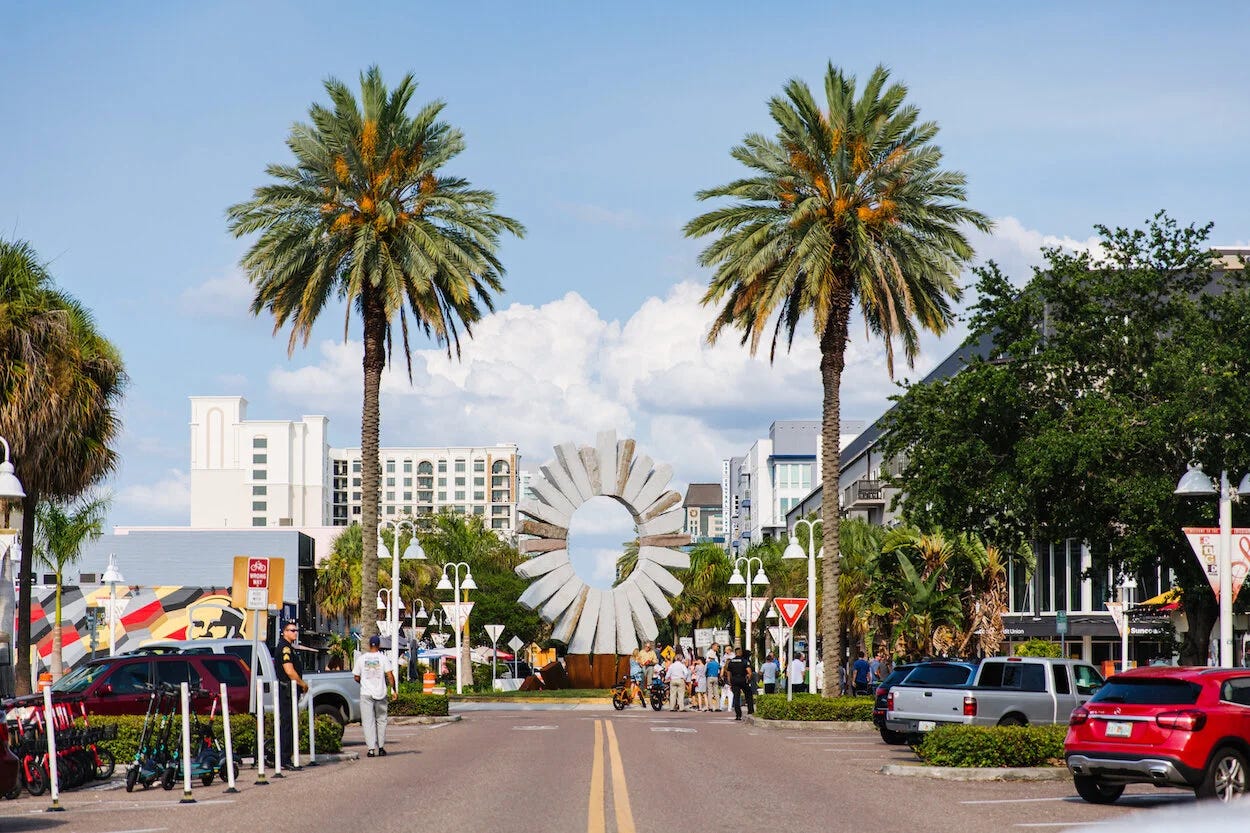
I love walking down Central Avenue, St. Pete’s main commercial corridor, and seeing the small shops lining the street. The locally owned restaurants, the independent boutiques, the places with personality. But I also keep watching them close as rising rents price out the very businesses that made the street worth walking in the first place. St. Pete is becoming a victim of its own desirability, and I’m not sure we’re paying enough attention to what we’re losing in the process.
What’s happening on Central Avenue is happening everywhere, just with different street names. Tampa is grappling with the erosion of its distinctive character. Voters in Boca Raton recently rejected a mixed-use development at the ballot box. Different communities, different issues, the same underlying fear: the place we love is becoming something we don’t recognize.
That fear doesn’t exist in a vacuum. We live in a world that is transforming at a pace most of us have never experienced. Technology is reshaping how we work, communicate, and make sense of the world, and it’s doing so faster than our institutions, our habits, or our sense of self can absorb. When everything around you seems to shift, the community you call home becomes one of the last things that feels fixed. Losing it, or watching it change beyond recognition, is like losing an anchor in a rough sea.
My vantage point on this is a little strange. I’m raising a family in the fast-changing city I love. I serve on the local Development Review Commission where I hear cases on site plans, zoning, and questions of community character. Professionally, I’m an economic developer who advocates for large-scale development projects across the Southeast. I hear these debates at the coffee shop from my neighbors, wrestle with them when I’m voting on a commission item, and feel them directly when the public rises to speak on a project I’m seeking approval for. It’s an uncomfortable place to stand. It’s also a clarifying one.
When I hear complaints against a new high-rise tower or million square-foot warehouse, traffic is rarely the real grievance. What residents are mourning is something harder to quantify: the feeling that their community is slipping away. Familiar faces outnumbered by strangers. Open fields giving way to apartment complexes. A skyline that was once mostly nature and low-rise rooftops now punctuated by office towers. Growth changes the texture of daily life, and for people who loved what it felt like before, that loss is real.
When someone describes their community as “small town,” they’re rarely talking about population. They’re talking about a feeling. An identity. A soul. The store clerk who knows your name. Fellow patrons who treat you like a neighbor, not a stranger. A sense of safety rooted less in crime statistics than in familiarity. Streets and storefronts so particular to a place that they couldn’t exist anywhere else on earth. What makes a small town feel small isn’t fewer people. It’s feeling closer to them.
Some people genuinely prefer isolation, a place that stays small by the numbers. But for most of us, it’s the feeling that matters. My hunch is that when residents oppose new development, they’re not really opposing more people, more jobs or more investment. They’re opposing the erosion of something harder to name: the identity of their community, and what that identity does to them. The way it shapes how they see themselves. It’s existential. It strikes at the heart of who they believe themselves to be.
The community we call home is where we’ve marked life’s milestones: a first job, a wedding, children growing up. The way we perceive that place shapes how we see ourselves. It’s personal and intimate. And when the place changes, it can feel like losing a piece of one’s own story.
Here’s what I’ve come to believe: communities have been winning the economic argument for growth while losing the human one. Economic developers, policymakers, and residents who dismiss anti-development grievances as simple NIMBYism do so at their peril. These anxieties are genuine. In many cases, the critics are right, just not about the solution. They’ve correctly identified that something real is being lost, something that goes to the heart of community identity. If we want to make the case for why growth matters, we have to start by understanding what people fear they’re losing and demonstrate that opposing economic opportunity isn’t the answer. The goal isn’t more or less growth. It’s growth that makes people feel more at home, not less.
People change. Communities change. Architecture changes. Technology and climate reshape how we live. As much as we wish time would stand still, it won’t. Most of us can look back at the hardest chapters of our lives and recognize that those moments, wanted or not, shaped who we became.
The same is true for communities. Evolution is inevitable. The question is whether that evolution is healthy, haphazard or hollow. Healthy evolution requires growth that works for the people already there and the people arriving. Haphazard growth leaves behind a diminished identity and a disengaged population. Hollow communities become places the next generation can’t wait to leave.
The instinct that something real is being lost turns out to be well founded. Community itself is in genuine decline. As technology has accelerated, more Americans have retreated into their phones and social media.
Close friendships are disappearing. The share of Americans reporting no close friends quadrupled between 1990 and 2021 and continued climbing through 2024. Younger Americans are forming romantic relationships at lower rates too. Only 56 percent of Gen Z adults say they were involved in a romantic relationship at any point during their teenage years, compared to more than three-quarters of Baby Boomers and Gen Xers; researchers tie that decline directly to immersive technology and the replacement of in-person time with screen time.
Isolation has risen across the board, and the platforms people have migrated to don’t offer a neutral substitute. Algorithms built to maximize engagement systematically amplify the most extreme political content from both sides, crowding out the moderate majority and distorting people’s sense of what their neighbors actually believe. I’ve fallen victim to it myself, angrily telling a friend on the other side of the aisle what “they” believe, only to be reminded that my friend holds far more nuanced views than anything my feed had shown me. I’m not unique in that experience. The result is a more polarized public, and research shows the lonelier people are, the more susceptible they become to that polarization.
Meanwhile, local civic life has quietly hollowed out. Local voter turnout has fallen dramatically over decades. In the typical off-cycle mayoral race, three-quarters of registered voters don’t show up. The “third places” where communities once formed organically – the bars, coffee shops, civic organizations and recreation centers that are neither home nor work – have been closing, with rural and lower-income communities hit hardest. The infrastructure of casual connection is contracting.
None of this is a coincidence. Ask any happiness researcher what the key ingredients of a good life are, and you will always get some version of the same answer: meaningful connection to others and a sense of purpose beyond yourself. In a word … community.
Community is what makes us happier, healthier and more resilient. It is also what makes democratic life possible. Shared physical space is where we learn to see our neighbors as people rather than opponents; it’s where different stops feeling threatening and starts feeling ordinary. We have never needed strong, close-knit communities more than we do right now, and we have rarely been further from having them.
So when a longtime resident says a new development feels like a threat to what their community means to them, they may be naming something real. The community they’re trying to protect is already under pressure from forces that have nothing to do with any single project. That’s not an argument against growth. It’s an argument for taking seriously what’s already being lost, and for asking what growth can do to give it back.
The communities that will thrive in the next decade are not the ones with the most announcements. They are the ones where residents feel the growth is theirs. That requires all of us, residents, policymakers, and the people who advocate for development, to ask a harder question than how much is being built. The question is who it’s being built for.
Growth should reinforce what a community values most: its people, its character, its sense of belonging. Community is not a byproduct of growth; it’s the point. Central Avenue still has it. The question is whether we’re willing to do the work to keep it. A place people are proud to call home doesn’t build itself. That’s on us.
Sam Blatt is a certified economic developer with over a decade of experience in the field. This piece is a personal opinion and does not reflect the views or policy positions of his employer, or any of the organizations with which he is associated.