
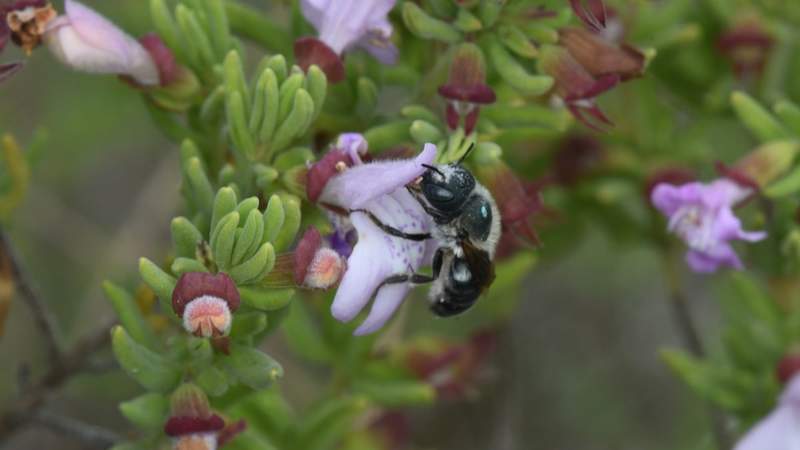
Florida’s native bees come in all shapes and sizes, often with their own quirks.
Blueberry bees gravitate toward their namesake, blueberry plants. Buzzing bumblebees, with their fluffy, plump bodies, visit a wide range of Florida crops. And sweat bees are attracted to, well, human sweat.
These bee species are among about 320 local Florida bees.
While the state’s mild climate is great for blooming plants and native pollinators, population increases and overdevelopment are threatening bee species.
“For native bees, land use change, habitat loss, is arguably the biggest threat, and that in Florida is primarily due to development,” said Rachel Mallinger, a pollinator ecologist at the University of Florida.
Native bees are easy to miss if you’re not looking — but they’re the state’s lifeblood, providing a boon to Florida’s crops and ecosystem.
Here are five things youmay not know about the state’s native bees.
Native bees don’t always look how you may expect.
“Traditionally, most people think of the honeybee when they think of any bee,” said Jaret Daniels, an entomologist and curator at the Florida Museum of Natural History.
Honeybees were imported from Europe in the 17th century, according to the U.S. Geological Survey. And while they’re important for honey-making and crop pollination, they aren’t the only bees around.
Florida’s native bees can come in spectacular colors, and can appear as if from a science fiction novel.
Take sweat bees, for example. They’re often an iridescent green. Or mason bees, which can be a dark, metallic blue.
“We have many that are beautifully colored, all different sizes — large and small — have cool, different nesting requirements and different lifestyles,” Daniels said.
Buzzing Florida bees live different lifestyles. Some prefer scrubland. Some are active at different times of the year. Most live and die within a year.
A majority of Florida’s native bees live in the ground. Take mining bees, for example. Adult females often dig tunnels in clay and carve out homes for themselves and their future babies, according to the University of Florida.
Daniels said you may find multiple burrows, or even hundreds, in an area made by bees. Often, they may be mistaken for ant nests.
Other bees take up residence in cavities or dead wood.
Carpenter bees, which may be considered pests, like to burrow in old wood, making an old barn or house ideal nesting areas.
Unlike honeybees or bumblebees, most native bees don’t have a colony to protect. Instead, they live solitary lives.
“They’re not social, meaning that they’re nonaggressive,” Daniels said.
Often, female bees make their nests, sometimes underground, and lay their eggs — and then they’re gone, Daniels said.
“There is no social structure to that nest,” he said.
Native bees are easy to bring into a yard because they’re so docile.
Helping native bee populations can start in your own backyard, Daniels said. And the more neighbors join in, the better. These gardens won’t replace wild landscapes, but they provide resources for pollinators that are becoming increasingly hard to find.
“It’s sort of like that recycling mentality,” Daniels said. “In this case, there actually is something that every person can do.”
Roughly 90% of all flowering plants use insects for pollination, Mallinger said. Experts often consider bees to be the most efficient pollinators.
A University of Florida study, for which Mallinger was an author, estimated pollinators contribute at least $50 million per year to seven of Florida’s most valuable crops.
That number is likely an underestimate.
“This is what we would lose for our major crops,” Mallinger said. “It’s not even including what we would lose for our minor crops, and it’s also not including any effects on both the flavor and nutritional value of the crop.”
Of the state’s top 10 animal pollinator-dependent crops, four (blueberries, watermelons, cucumber and squash) are consistently stocked with managed bees (typically honeybees), the 2021 study said.
Native species, along with other pollinators like flies or butterflies, largely pollinate the others.
The Florida State Wildlife Action Plan outlines 25 native bees with the “greatest conservation need.”
According to the University of Florida, these species are included in the list if they meet several criteria, like vulnerability to a drastic decline in their range or population.
Among them are several endemic Florida bees, including a rare bee found only in coastal Titusville and in Tampa. The bee went unseen for years until it was spotted again in 2013.
Some native bees are specialist bees, meaning they rely on certain plants, Mallinger said.
The blue calamintha bee is considered a specialist bee because it largely gravitates toward the Ashe’s calamint, a purple flower.
For specialist bees, habitat protection is vital.
Most already live in wildlife refuges or in state and national forests, so the key is to protect them.
• • •
The Tampa Bay Times launched the Environment Hub in 2025 to focus on some of Florida‘s most urgent and enduring challenges. You can contribute through our journalism fund by clicking here.