
Minutes after the Orange County School Board voted this month to close seven half-empty schools, it had to make another seemingly contradictory decision: Choose names for two new schools set to open in August.
The votes underscored the two realities facing Orange County Public Schools.
District and state officials project a steep, nearly 10,000-student decline in traditional public school enrollment in Orange County over the next five years, fueled by lower birth rates, a loss of immigrant students and the increasing popularity of state-funded voucher scholarships for private school and homeschooling services.
At the same time, continued population growth in the burgeoning areas of Lake Nona and Horizon West means those communities need new schools, even as campuses in the county’s older, more established neighborhoods suffer from declining enrollment.
“We have two different, very distinct areas. Areas that are growing and areas that are not growing,” said Thomas Moore, OCPS’s demographer responsible for monitoring growth and projecting enrollment. “Overall, the district is not growing.”
The two new schools are needed and likely will be full in two years, Moore said. But then district officials don’t plan to build any other new “relief” schools, or campuses meant to relieve crowding, for the next five years, a significant pause for a district that has been in a building boom for decades.
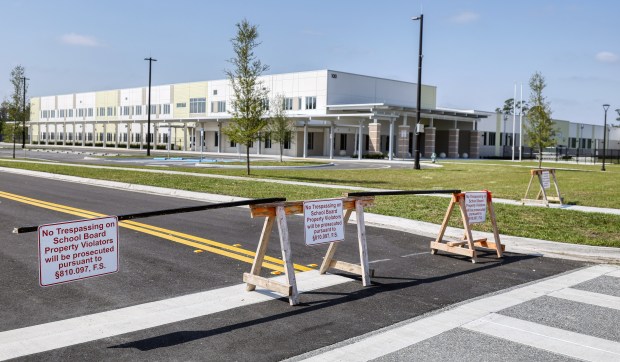 Innovation Elementary school, under construction in in Lake Nona, on Tuesday, March 24, 2026. (Ricardo Ramirez Buxeda/ Orlando Sentinel)
For more than 20 years, OCPS has been building new schools to relieve crowding on existing ones, as student enrollment grew rapidly. At times, Orange County led the state in new school construction.
In the last ten years, Orange, the eighth-largest school district in the U.S., has opened almost 30 new schools.
But last summer, the district announced a sharp drop in enrollment. Many of its elementary schools had hundreds fewer students on their campuses than they were built to hold. In December, districts officials said seven of the most empty — Union Park Middle School and Bonneville, Chickasaw, Eccleston, Meadow Woods, McCoy and Orlo Vista elementary schools — were slated to close. The school board finalized that decision on March 10.
The schools that will close when the school year ends were mostly built in the 1950s and 1960s, though they now operate in newer campuses, and sit in established Orange County neighborhoods such as Orlo Vista, Richmond Heights and Union Park.
“This is certainly one of the most difficult days in my superintendency,” said Superintendent Maria Vazquez, after the closure vote.
Still in August, as has been an annual tradition, OCPS will celebrate new schools, opening Innovation Elementary School in Lake Nona and Ovation Elementary School in Horizon West.
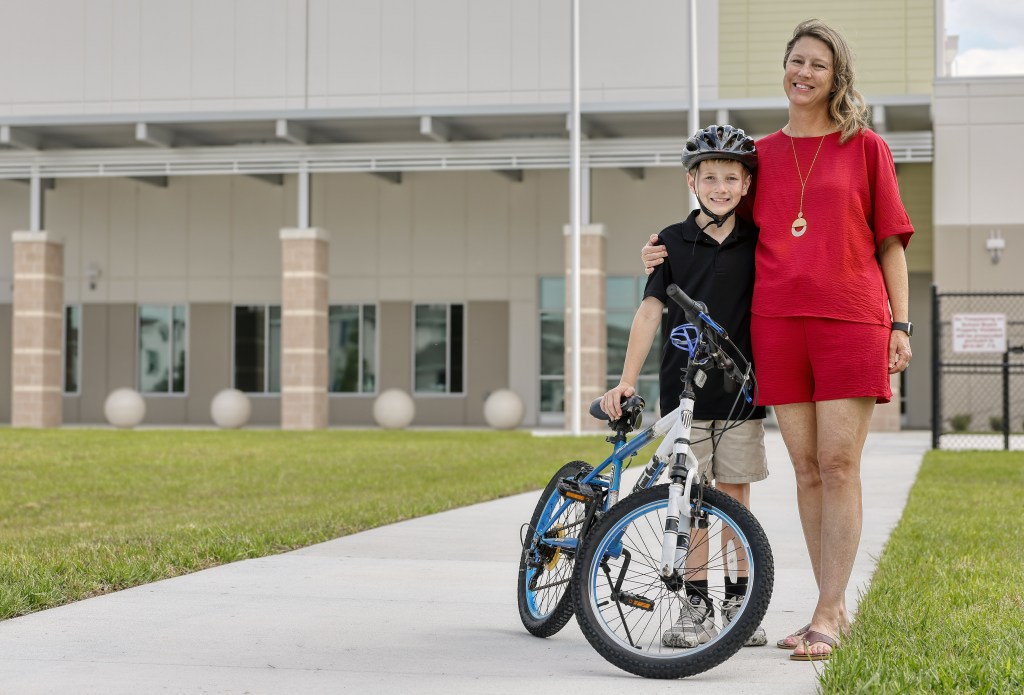
Meredith Swanson is excited that her son Jordan will go to the new Innovation Elementary. He’s been at Sun Blaze Elementary School, which has 1,034 students but was designed for about 800. Recess is done in shifts, she said, because the playground can’t fit everyone.
Jordan is excited to finally live close enough to bike to school instead of taking the bus.
Swanson, a mother of three, moved to the Lake Nona area in 2008 with plans to send her future kids to the nearby public schools.
“I knew I wanted to be somewhere already where we were going to be in good schools, and then I wouldn’t have to move,” she said.
Tom Keen, who represents Lake Nona on Orlando’s City Council, said the area sees so much growth in part because there’s “space to grow.”
The area near Orlando International Airport is home to about 24,000 residents with more developments planned.
“This is where it’s all happening for the City of Orlando. The rest of the city is basically landlocked,” he said.
The same is true in Horizon West, a development roughly on the north border of Walt Disney World that has grown from about 22,000 residents in 2016 to more than 73,000 now.
Sacia Qaqi, a Horizon West mother of two, moved to the area in 2020 for work and to be close to Walt Disney World. In the six years since, the area has “exploded,” she said.
The new Ovation is slated to relieve overcrowding at Panther Lake and Water Spring elementary schools, both designed for about 840 students. Panther Lake now has more than 850, and Water Spring more than 1,000.
But not everyone who moves into an area chooses public schools.
Qaqi’s daughter Evelyn, 4, will be school-age next year, but she doesn’t know whether she’ll send her to the nearby elementary school. She’s concerned about school safety and the rigidity of the day-to-day school schedule.
“People are wanting to be able to take their kids off and have more of those life experiences. People are learning that life is more valuable,” she said.
Qaqi could be one of the thousands of Floridians increasingly opting to take state-funded scholarships to homeschool their kids or send them to private school.
This year, more than 2,600 OCPS students left public school to use those scholarships, also called vouchers, according to Step Up For Students, which administers most of Florida’s scholarships.
A total of more than 36,000 Orange students are using the scholarships this year, though many are students who were already in private schools. Some number are likely kindergarten students, who without the scholarships might have opted for public schools.
Moore said the spike in voucher use — which jumped after a 2023 law made all students, not just those in low-income families or with disabilities, eligible — has changed district enrollment calculations.
In 2016, about 93% of the county’s school-age kids entered kindergarten in OCPS. Ten years later, that number has dropped to just 78%, he said.
Enrollment among students from immigrant families also has plunged amid the Trump administration’s push for massive deportations.
Last year, OCPS had 4,346 new immigrant students, Moore said. This year, that figure dropped to 1,846, with most of the change among Haitians and Venezuelans.
And almost 1,000 fewer kindergarteners enrolled in OCPS this year compared to last, according to state data.
“It is new territory,” Moore said.