
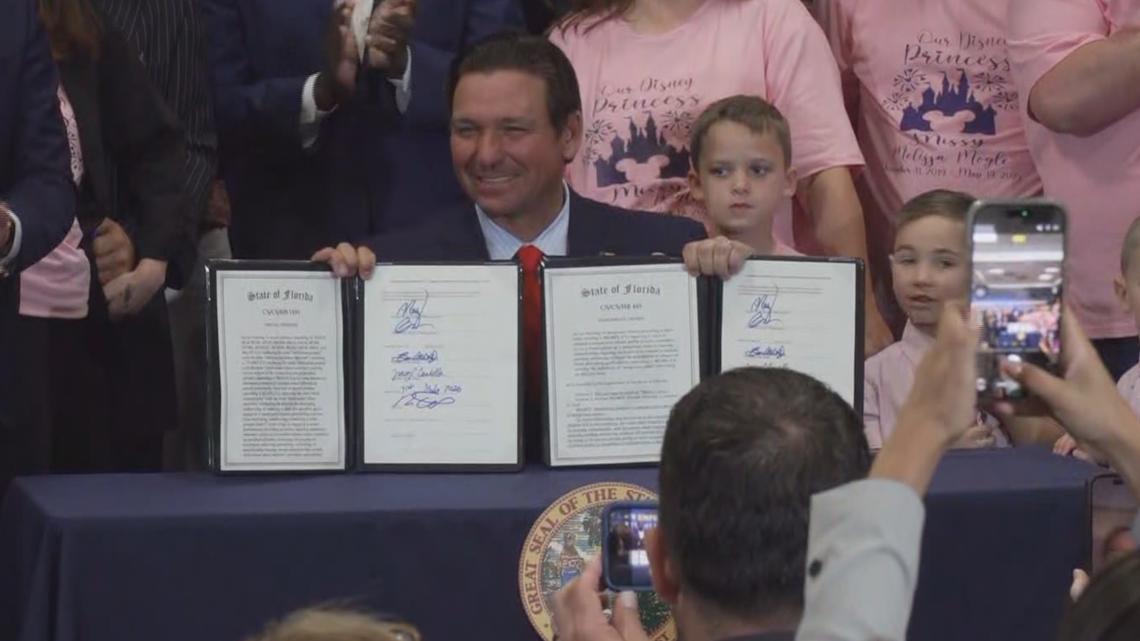
DeSantis signed two bills aiming to have better protect children and enhance penalties for sexual offenses. One was named after a girl murdered by her stepfather.
TAMPA, Fla. — Gov. Ron DeSantis signed a bill to place better protections for children and to increase punishments for sexual offenses to honor the life of a 5-year-old girl.
During a news conference Tuesday morning in Tampa, DeSantis was joined by local and state law enforcement for the signings of House Bill 445, referred to as Missy’s Law, and House Bill 1159.
Missy’s Law is named after Missy Mogle, a Florida girl who DeSantis said had a stepfather, Daniel Spencer, who had been convicted in a case involving an attempted sex crime against a 15-year-old, but was allowed to remain out on bail before sentencing by Judge Tiffany Baker in Leon County.
Between the time Spencer was on bail and the time he was sentenced, the governor said he murdered Missy.
“Totally preventable,” he said. “A miscarriage of justice. A dereliction of judicial duty.”
Missy’s Law strengthens Florida’s pretrial detention system for specified dangerous crimes.
Under the new law, individuals found guilty of or entering a plea for a dangerous crime will be immediately remanded into custody and held without bond while awaiting their sentence.
The bill also expands the statutory list of dangerous crimes to include certain computer pornography and child exploitation offenses, ensuring individuals arrested for these crimes do not automatically get released at their first appearance.
“Last year, we proposed Missy’s Law after the tragic murder of five-year-old Missy Mogle at the hands of a convicted, abusive pedophile who was allowed to remain out on bond by Judge Tiffany Baker,” Attorney General James Uthmeier said in a statement. “Missy’s Law removes judicial discretion and ensures dangerous criminals are locked up after conviction. I am grateful to Governor DeSantis for signing this bill, and Senator Martin and Representative Greco for carrying this legislation, and Missy’s memory, during the 2026 Legislative Session.”
The other bill, HB 1159, enhances penalties and expands criminal offenses related to child sexual abuse material by increasing penalties for using a child in a sexual performance, possessing and distributing abusive material, and creating generated sexual abuse material.
The bill places mandatory minimum prison sentences for certain offenses committed by adults and creates a life felony for the aggravated exploitation of a child under the age of 12. It also addresses “emerging threats” by criminalizing new forms of exploitation involving generated content.
“I think this bill is a great first step in dealing with this really horrible exploitation of minors,” DeSantis said. “And the market for this, unfortunately, is robust.”