
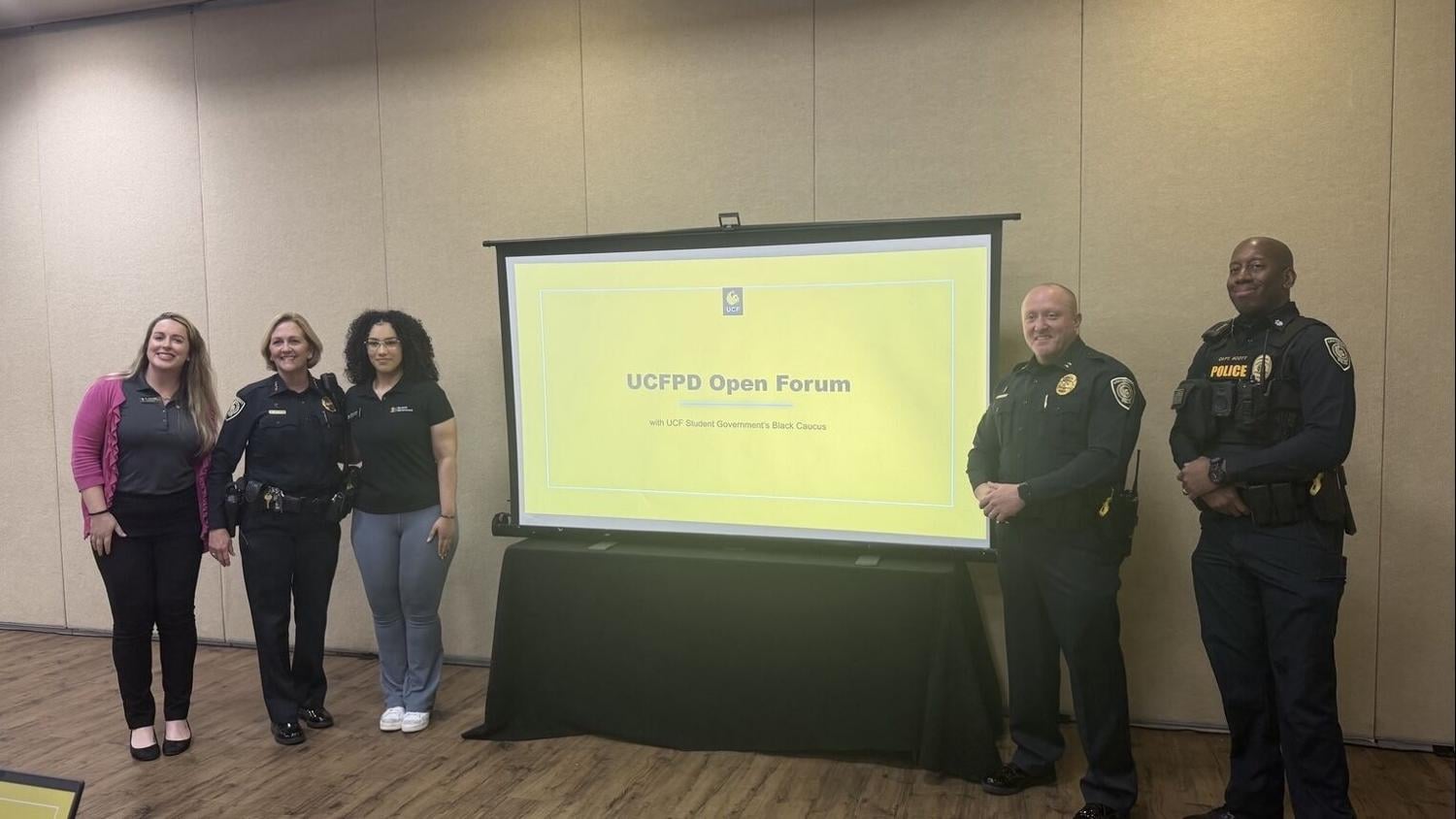

From left, Dr. Laura Valle, director of Victim Services; Dr. Robin Griffin-Kitzerow, chief of police and associate vice president of public safety; Dyne’ Smith, sophomore double majoring in legal studies and psychology and Student Government Black Caucus chair; Deputy Chief Scott Freeman; and Capt. Matthew Scott of Patrol stand together after the UCFPD open forum Feb. 25 in the Key West Ballroom.
Keyla Franklin
Students questioned campus policing policies and learned about violence prevention during an open forum hosted by the UCF Police Department in partnership with the Student Government Black Caucus on Feb. 25.
The forum, held in the Key West Ballroom, focused on how UCFPD works to prevent violence before it occurs through proactive programs such as threat assessment, crisis intervention and emergency preparedness training.
Dr. Robin Griffin-Kitzerow, police chief and associate vice president for public safety, led the discussion alongside Deputy Chief Scott Freeman, Capt. Matthew Scott of patrol and Dr. Laura Valle, director of victim services.
Griffin-Kitzerow said the department’s approach to safety centers on prevention rather than reaction, emphasizing early intervention and community trust.
“Success is never owned. It is rented, and the rent is due every single day,” Griffin-Kitzerow said, stressing the department’s ongoing responsibility to maintain campus safety.
One of the department’s primary prevention tools is the Threat Management Team, which identifies individuals who may be on a pathway to violence. The team monitors behavioral changes and online activity to intervene early and connect individuals with appropriate resources before situations escalate. More information about the department’s public safety leadership and related efforts can be found on the UCFPD website.
UCFPD also trains faculty and staff using the “Avoid, Deny, Defend” model for active shooter preparedness, focusing on coordinated responses during emergencies.
The UCF police department on Libra Drice. UCFPD recently held an open forum to address student concerns and safety programs.
Courtesy of UCF Police Department
Mental health support plays a key role in the department’s strategy. All officers are Crisis Intervention Trained, allowing them to recognize and de-escalate psychiatric crises and prioritize care over force. The department also partners with behavioral counselors and offers programs such as therapy dogs to support students experiencing distress.
Griffin-Kitzerow said effective safety efforts depend not only on reducing crime, but also on how safe students feel on campus.
“Being safe and feeling safe, those are two parts of the safety message,” she said. “It’s not just about, you know, you are safe. It’s about how you feel when you come here.”
While the forum highlighted prevention strategies, students also raised concerns about how certain policing policies affect trust, particularly the department’s participation in the 287(g) agreement with U.S. Immigration and Customs Enforcement.
The 287(g) agreement is a federal program that allows ICE to partner with state and local law enforcement agencies. Through the agreement, selected officers receive training and authorization to perform certain immigration-related functions under ICE supervision.
Supporters of the program say it enhances cooperation between local and federal authorities, while critics have raised concerns that such partnerships may affect community trust, particularly among immigrant populations, and influence how residents interact with local law enforcement.
“The fact that they signed on to 287(g) when they weren’t legally required to shows that they chose to go against the wishes of the student body and the faculty,” Grisha Glozman, junior studio art major and member of the UCF Young Democratic Socialists, said.
In response, UCFPD leadership emphasized that immigration enforcement is not part of their mission. Freeman said the department has had zero interactions with ICE regarding on-campus enforcement and is not focused on students’ immigration status.
The department added that federal agencies are required to notify UCFPD before coming onto campus and that the agreement is intended to maintain relationships with federal partners rather than initiate enforcement actions.
Concerns about communication and emergency response were also discussed, particularly following last year’s September email hoax that caused widespread panic. UCFPD officials explained that coordination with federal agencies can delay public alerts, but it is necessary to verify threats and avoid misinformation.
The forum ultimately highlighted the balance UCFPD aims to strike between proactive safety measures and maintaining student trust.
“Campus safety isn’t just a job for the police; it’s a shared responsibility,” Griffin-Kitzerow said. “Forums like this help us earn students’ trust and work together to keep UCF safe.”