
The cities of tomorrow will have autonomous flying cars that whisk passengers to work, the grocery store, and movie theaters; drones that deliver medicine to the sick; quantum computing technology that prevents traffic jams and reduces power outages; and AI platforms will forecast local weather, letting residents know if they should pack a raincoat or don a sweater before leaving home.
While this may sound like Orbit City of Jetsons’ fame, many such innovations are now either reality or in the development phase in metropolitan areas nationwide. And during Smart Cities MIAMI 2026, held on the University of Miami’s Coral Gables Campus on March 26, hundreds of attendees learned from industry experts, scientists, and researchers about how such burgeoning technology can be used to improve our cities.
“Today’s conversation is really a conversation about curiosity,” Joel H. Samuels, the University’s executive vice president for academic affairs and provost, said in opening the daylong conference, noting that great innovators of the past such as Leonardo da Vinci, Steve Jobs, Benjamin Franklin, and Albert Einstein all shared the desire to learn, explore, and understand.
Samuels hailed the interdisciplinary nature of the conference, pointing out that the School of Architecture, College of Engineering, and Frost Institute for Data Science and Computing all collaborated in staging the event, which now in its 10th year.
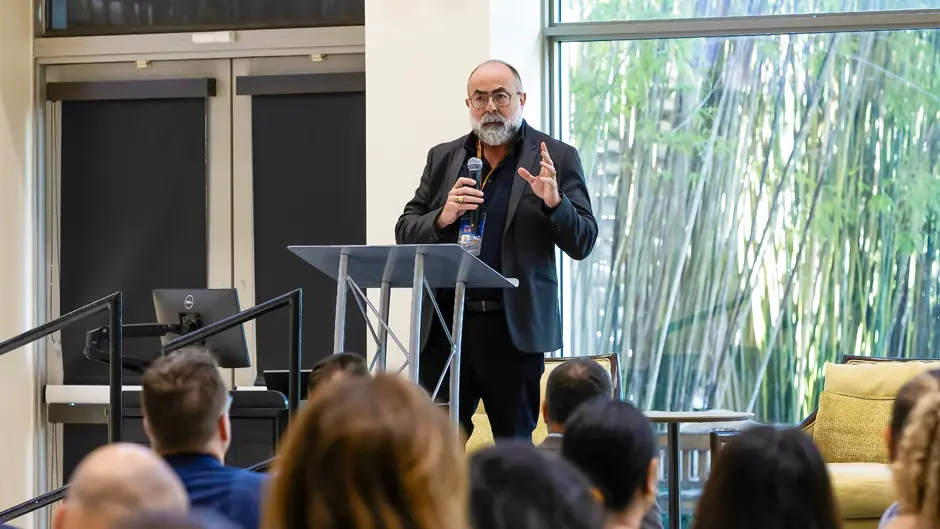
School of Architecture Dean Rodolphe el-Khoury welcomes attendees to Smart Cities 2026.
Through talks and panel discussions, Smart Cities MIAMI explored three themes: the built environment and infrastructure, focusing on how smart cities are constructed; health and well-being, which delved into how technology is helping to monitor patients’ health, advance medicine, and improve hospital efficiency; and community and resilience, which explored how innovation can help municipalities prepare for and recover from natural hazards.
“Over the past decade, [Smart Cities] has emerged as an important platform for both exploring how new technology is shaping cities and speculating about the future of our cities,” said School of Architecture Dean Rodolphe el-Khoury, who moderated a panel on the built environment. “From the beginning, the goal has been to bring academic research and industry innovation under the same roof to inform one another. And the goal has never been technology for technology’s sake, but rather understanding how new tools can help us address the major challenges of the 21st century in thoughtful, ethical, and responsible ways.”
During a series of 8-minute lightning talks, University of Miami researchers and outside industry experts presented their projects aimed at making cities “smarter”—from low-cost, high-tech environmental sensors to flying cars and coral reef protection devices.
“We want to take off from and land on top of skyscrapers. We want to have short takeoff and landing vehicles that will help us take short hops very quickly and personalize our trips,” Sivakumar Ramanathan, an assistant professor of practice in the Department of Mechanical and Aerospace Engineering, said during his lightning talk on the Miami Engineering Autonomous Mobility Initiative, or MEAMI.
The endeavor is a consortium dedicated to developing a pilotless, electric vertical takeoff and landing (eVTOL) aircraft that would shuttle people to work, restaurants, and tourist attractions; transport accident victims to hospitals; and perform a multitude of other tasks.
“We want to transform autonomous mobility, and that’s especially important in the context of Miami, primarily because Miami has become one of the test beds for autonomous vehicles,” said Ramanathan, noting Waymo’s self-driving taxis that are now operating across a 100-square-mile area covering communities such as Brickell, Coral Gables, Miami Beach, and Wynwood.
In his role with MEAMI, Ramanathan is working with the initiative’s corporate partners to help build sustainable infrastructure—low-carbon resilient structures—to support the eVTOL industry.
But not all innovative projects that will help transform cities are taking place on land and in the air. As attendees at Smart Cities learned, some projects are underway at sea, particularly in the offshore waters of coastal communities where coral reefs—vital in providing as much as $9.9 trillion in annual global economic value through tourism, fisheries, and coastal protection—are being threatened by devastating bleaching events. In the summer of 2023, for example, the Florida Keys and the Caribbean experienced a mass bleaching event due to a record-breaking marine heatwave with ocean temperatures exceeding 100 degrees Fahrenheit.
In response, Kylee Rux, a Ph.D. student in civil engineering, and a team of other College of Engineering graduate students created Kanopi, a floating and expandable shading device of interconnected hexagonal-shaped units that essentially provide shade for coral reefs, protecting them from ultraviolet rays during hot summer months and helping to reduce thermal stress on the ecosystems.

Rux, a Ph.D. student in civil engineering, gives a lightning talk on Kanopi, an expandable shading device of interconnected hexagonal-shaped units that provide shade for coral reefs that are increasingly under threat from extreme heat waves and rising ocean temperatures.
Designed for daily deployment and removal, the inflatable units are designed for reefs at water depths exceeding 5 feet, and the device can be anchored to mooring walls of preexisting reef sites, Rux said during her Smart Cities lighting presentation. The shade fabric, she pointed out, is actually elevated just above the water surface, allowing marine mammals to surface as well as for the gaseous exchange between the ocean and the atmosphere to occur.
The team tested a Kanopi prototype at the Scientific Dive Training Facility at the Rosenstiel School of Marine, Atmospheric, and Earth Science, finding that the device reduced light levels at all depths tested, ranging anywhere from 70 percent at the water surface to 51 percent at a depth of 15 feet, according to Rux.
They also recently deployed a prototype at Flamingo Reef near Key Biscayne, with results showing the units reduced light levels by 64 percent and temperatures by about half a degree Celsius at a depth of 10 feet, according to Rux. “We’re also planning for extended resite testing at a nursery site to continue validating Kanopi’s performance,” Rux said.
In other lightning talks by University researchers, Minghui Cheng, an assistant professor jointly appointed by the College of Engineering’s Department of Civil and Architectural Engineering and the School of Architecture and who served as the Smart Cities chair, presented his project called Civilbot, an AI agent for structural modeling and analysis that can significantly reduce the structural design process from months to days.
And Jiayu Li, an assistant professor in the Department of Mechanical and Aerospace Engineering, presented a talk on her low-cost environmental sensing technologies for air- and water-quality monitoring.
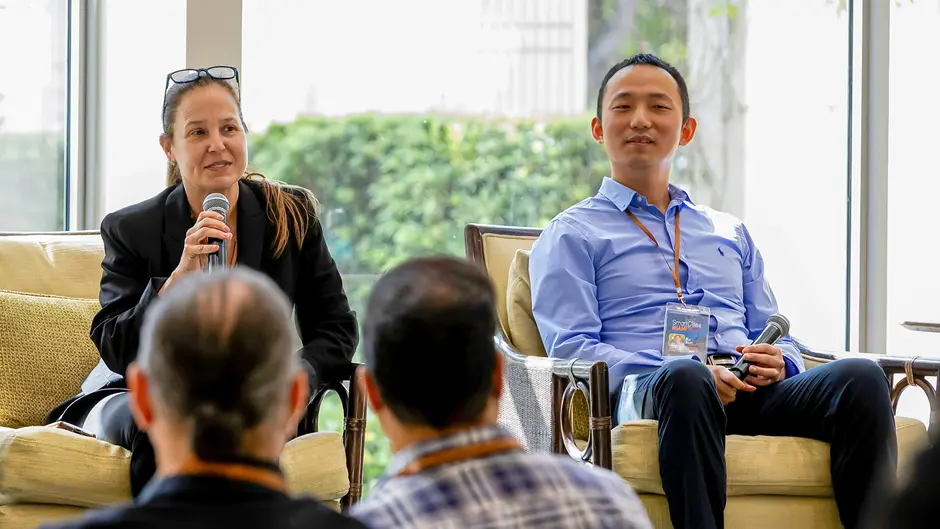
Such technologies will only help improve public health, industry experts at the conference agreed. And during the health and well-being panel moderated by Vincent Omachonu, interim dean of the College of Engineering and professor and chair of the Department of Electrical Engineering, panelists discussed some of the advances in health care technology that are helping to improve public health outcomes.
“During the height of COVID-19, the nature of work changed,” said Helena Solo-Gabriele, a professor in the Department of Chemical, Environmental, and Materials Engineering, whose research focuses on evaluating the relationship between the environment and human health. “But through COVID-19, we learned of a new discipline called wastewater epidemiology where we now can track disease in communities through the sewer system. Now we know where outbreaks of not only COVID-19 are happening, but we can look at all diseases through our wastewater. So, one of the challenges that remain is can we now design a city smarter so that we can help stop disease before it starts?”
Omachonu noted the advancement made in hospital design, specifically in the way emergency departments are now built. “About 67 percent of the people who go into the emergency room at a hospital end up needing or requiring some kind of imaging—an X-ray, an MRI,” he said. “And so, one of the things you see immediately in the design of hospitals, especially the emergency room, is the fact that almost always in a great design, the emergency room is adjacent to an imaging department.”
Xu Sun, an assistant professor in the Department of Management Science at the Miami Herbert Business School who studies how applied probability, optimization, and data-driven analytics can be used to design intelligent and resilient service systems in smart cities, called for more “creativity in the way we’re using technology” to build smart cities.
“How to allocate or route resources, especially in the presence of emergency events, and how to pre-position staff—those are some of the challenges cities face,” said Sun, who develops online algorithms for real-time decision-making under uncertainty, with applications in call centers, emergency response, smart manufacturing, and energy and mobility systems. “So, I’m a firm believer that a smart city is only as smart as the decisions that it makes.”