
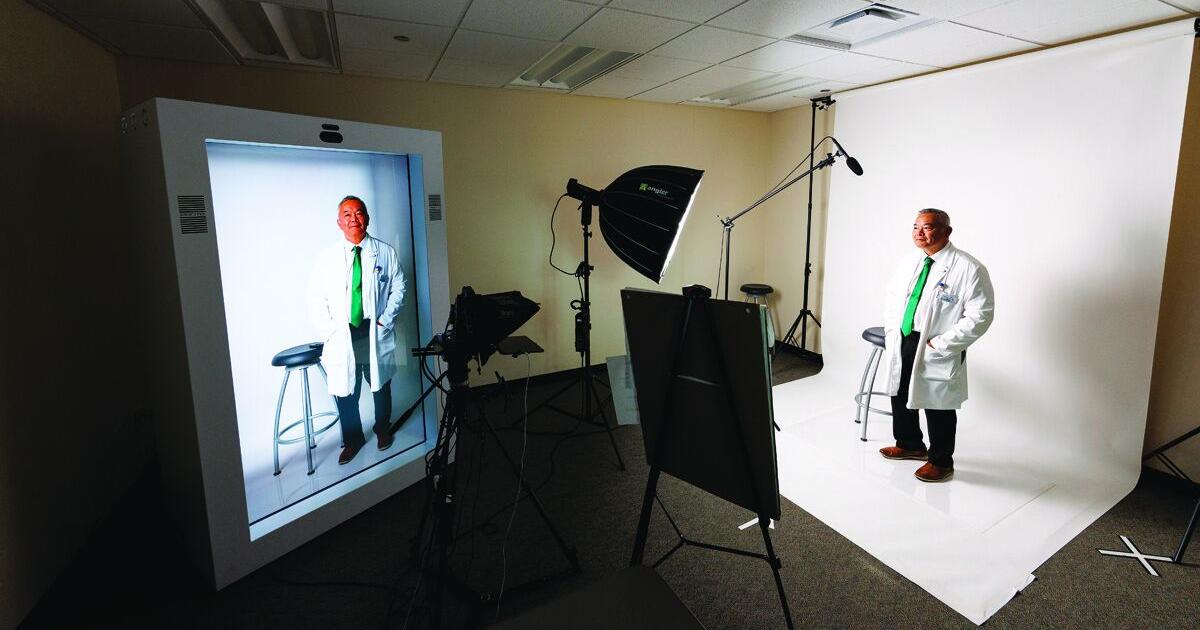
With the help of an AI-powered platform called “Dr. Hologram,” students at Florida Gulf Coast University’s Marieb College of Health & Human Services are using cutting-edge technology to prepare for their futures as health care practitioners.
Marieb College trains students for careers including nursing, physician assistant, physical therapy, occupational therapy, exercise science and social work.
Joseph Buhain, director of interprofessional simulation and emerging technology at FGCU in Fort Myers, said the university is seeking to advance not only innovation in learning, but innovation in medical technology.
“One of the things that we’re doing is we’re taking innovation to the next setting,” Buhain says. “We’re not teaching based on what is right now; we’re teaching students on what it means to be a practitioner in the future. We want students to be independent in thinking about process, care and management. We teach based on what we see right now and what we believe the future’s going to hold for clinical practice.”
On the advanced technology front, in 2024, the university acquired seven Proto Hologram units, including one EPIC-model hologram, about 4.5 feet wide and 7 feet tall, that can deliver a life-size human holographic-style image. The other units are tabletop models that can be moved between classrooms. All are designed to help students “experience realistic scenarios and develop skills needed to provide better patient care,” Buhain says.
The life-size model, he explained, can help students from both learning and clinical standpoints. For example, a professor based in Europe could use a 3-D hologram to “beam into” the classroom at FGCU. On the clinical side, a patient in Immokalee or Lehigh Acres who can’t get to a clinic could incorporate a 3-D hologram image into a clinic setting.
“You can take that image and beam it into the doctor’s office of them showing you their condition, and then use that hologram through AI to say, ‘Based on this condition, what am I seeing?’” Buhain says. “You have the innovation of artificial intelligence that can help incorporate what’s happening to that patient and get more feedback.”
All of this technology and more will eventually be housed in the university’s new simulation center, which Buhain said is scheduled for completion in 2028.
And while the advanced technology brings a lot of bells and whistles to students’ training, Buhain said the human interaction and interprofessional aspect of Marieb College’s programs are equally vital.
“In a clinical setting, we know that when a patient is sick, it’s not one professional that treats a patient alone,” he says. “It takes an integrated team of different specialties to help take care of that patient. It’s the cooperation, the partnership, the collaboration, ethics and values that work in the team-building concept of treating that patient.”