
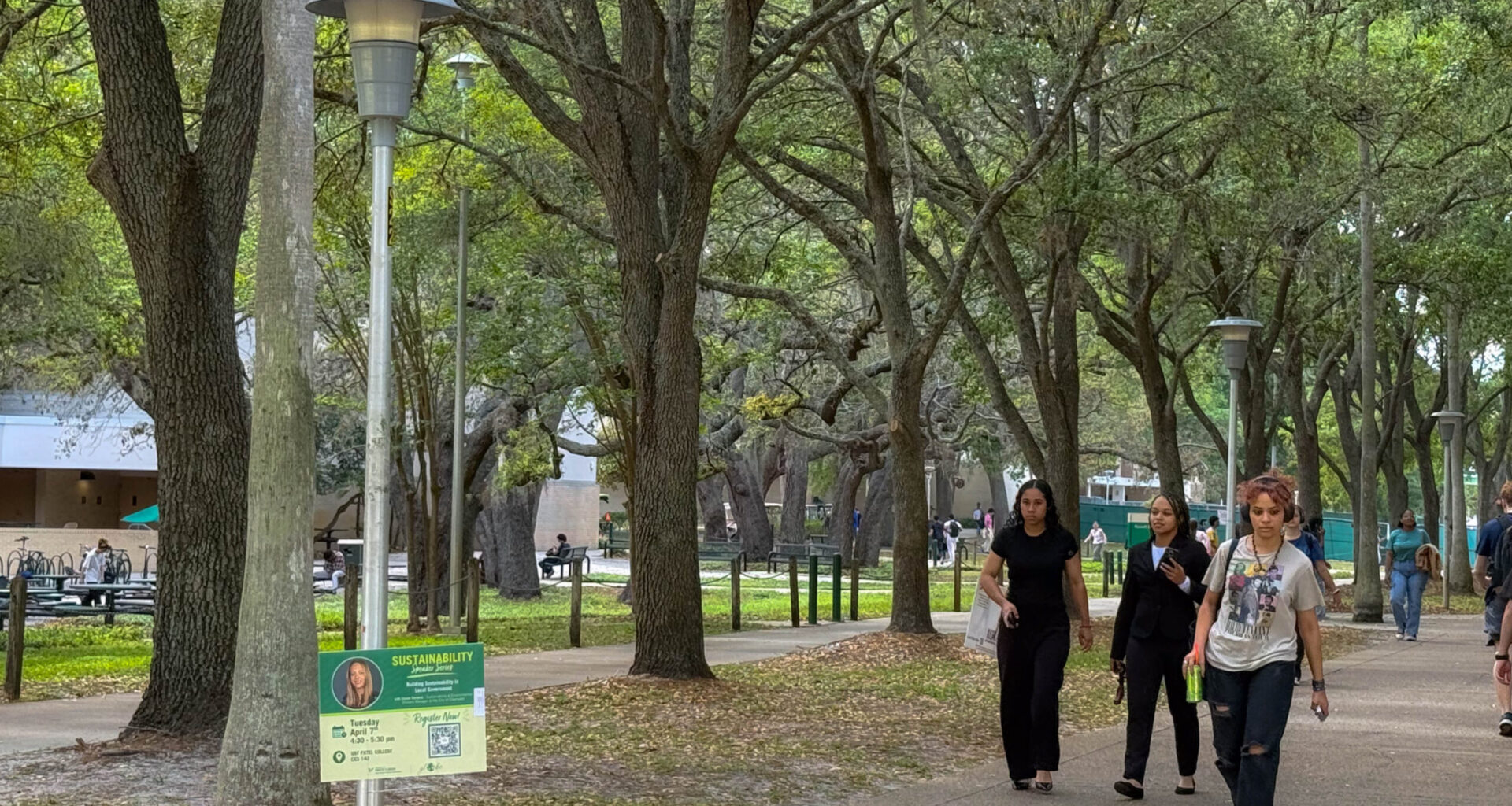
 Protesters often set up near Cooper Hall in USF’s Sessums Mall area, which is an open, public space for demonstrations within policy guidelines. ORACLE PHOTO/ELLIE FROST
At USF, the sidewalks, plazas and pathways serve as more than just ways to get to class — they’re an outlet of free expression for students and the broader community.
USF’s Activities, Signage, and Use of Public Space policy was established in 2017 and addresses the university’s goal of balancing freedom of speech and campus safety.
The policy tasks USF with protecting students’ First Amendment rights while ensuring their ability to access education and university resources remains undisturbed.
Additionally, the policy states that “public spaces” — defined as areas not generally used for academic or athletic purposes — are open to the public for free expression without approval, provided the expression is non-commercial and unamplified.
However, while these areas are open, activities must comply with campus policy.
Activities involving the use of tents, stages, fences, amplified sound or the setup of fixed displays and tables are categorized as reserved activities and require formal administrative approval.
University student organizations and departments also take priority over visitors for posting signs related to their activities or demonstrations.
Some USF students said they appreciate that the campus can be an outlet for free expression, but hope protesters remain respectful of the university community and space.
Related: USF faces lawsuit from student group over protest sanctions
USF’s conduct guidelines mandate that on-campus activities and protests — student or otherwise — do not block sidewalks or building entrances.
Furthermore, under Florida Statute 876.12, protesters are prohibited from wearing masks if the intent is to disrupt or conceal their identity.
Regarding speech, the university’s Center for Leadership and Civic Engagement states that all people have the right to exercise their freedom of speech.
However, there are limits on speech that are against the law, such as defamation or threats, according to the Student Equal Opportunity Office.
USF also has an “expectation” that speech should maintain and respect the safety and property of the community, and distribute information that is relevant to the cause, according to the Center for Leadership and Civic Engagement.
Students who violate USF’s policy are referred to the Office of Student Conduct and Ethical Development, while protesters external to the university are subject to other restrictions, including no-trespass warnings or total restrictions, according to the policy.
These restrictions and guidelines are meant to guide protesters rather than forbid them, and some USF students said they frequently encounter students and non-students protesting or presenting for their causes.
Andrea Gonzalez, a freshman biological health sciences major, said she mainly encounters anti-abortion protesters near Cooper Hall while on her way to class.
USF’s Sessums Mall area is not designated as an academic or athletic space, meaning it can be used for free public expression as long as protesters do not violate policy guidelines.
“My experience passing by them has been fine, as I simply do not engage with them even if I disagree with them,” Gonzalez said. “However, they are extremely pushy and will bombard me with questions if I walk too close to them, even if I do not make eye contact.”
Gonzalez said her prior experiences with on-campus protesters have not changed her generally positive perspective of USF’s activism policies.
“I think USF’s policies are fine with balancing free speech and my ability to study,” Gonzalez said. “I only ever feel mildly annoyed.”
Still, she said she wishes people were more polite while protesting on campus.
“If I was in charge of campus policy, I would advocate more for respectful interactions,” Gonzalez said. “I hope to see respect and passion from people visiting our campus to protest, as well as to not disrupt anyone’s path when walking by.”
Related: USF students protest university ties to immigration enforcement
Jon Dacalos, a freshman business advertising major, said he has been stopped by the same anti-abortion protesters several times near the Judy Genshaft Honors College.
Dacalos said he felt “targeted” by the protesters while walking to class with a group of friends in mid-March.
“I was walking ahead of a group of girls that I know, and I got stopped by a group of abortion protesters, while the three girls behind me did not get stopped at all,” Dacalos said.
He added that he thinks the anti-abortion protesters he has encountered often prioritize “shock value” rather than information when they are on campus.
“They were asking me about my opinion on abortion, asking me to stop and hear them out,” Dacalos said. “I’ve been stopped multiple times.”
Dacalos said that if he could change one thing about USF’s campus policy on activism, he would limit the number of people protesting in a single area.
“There shouldn’t have been [multiple] groups [protesting] in the same area,” Dacalos said. “It’s really distracting and frankly, annoying.”
Despite this, Dacalos said he feels it is important for people to maintain a “multifaceted view” of political issues to broaden their political perspectives.
“There definitely should be protests about political issues,” Dacalos said. “It’s really important to see things that challenge your own beliefs.”