
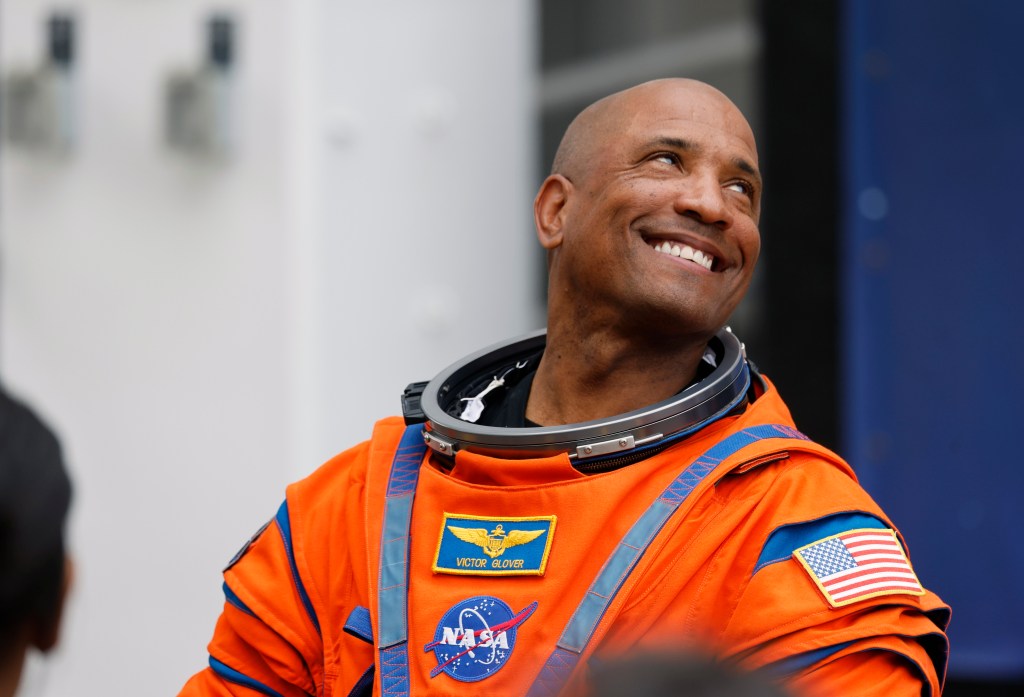
NASA today aims to launch four astronauts on the Artemis II mission for a 10-day trip that will fly by the moon sending humans into deep space for the first time in more than half a century. It’s targeting liftoff during a two-hour window that opens at 6:24 p.m. Follow along with our live updates:
Weather now 90% go for launch
5:32 p.m.: Space Launch Delta 45 just upped its forecast now saying there is a 90% chance for good conditions at the launch site during the launch window. It had been 80% including an update just before 5 p.m.
2nd hatch closed on Orion
5:19 p.m.: The closeout crew closed the second of two hatches keeping the four crew safe inside Orion. This is the final step before they can clear the White Room and the five members of the closeout crew would vacate the mobile launcher.
That will leave the four astronauts alone on the SLS rocket with the next major step to be the swinging away of the crew access arm.
Flight termination system issue resolved, weather still 80%
5:13 p.m.: There was good news after the Eastern Range earlier had placed the launch in question.
“The good news is the range is ‘Go,’” said NASA commentator Derrol Nail during NASA’s countdown live stream.
The Eastern Range had to verify a fix to the flight termination system was working, and NASA’s launch team was able to assist in that effort.
“This is a fix the range had come up with to clear the range and work the FTS system. They are go,” Nail said. “The rocket, the ground systems, no constraints, clear board here.”
Nail also reported the latest weather update from Space Launch Delta 45, noting the odds for good conditions during the launch window remain at 80%.
Orion would be 7th new U.S.-based spacecraft for NASA astronauts
5:04 p.m.: If they launch, Orion will become the seventh spacecraft to fly NASA astronauts from the U.S., and third crew-capable spacecraft still in NASA’s arsenal. That doesn’t include the Soyuz spacecraft that launch from Kazakhstan.
The spacecraft include the crew capsules of the Mercury, Gemini and Apollo programs in the 1960s and 70s, the space shuttle orbiters used from 1981-2011, SpaceX’s Crew Dragon that first flew in 2020 and Boeing’s Starliner, which flew once in 2024.
Eastern Range is ‘no go’ for now because of flight termination system issue
4:40 p.m.: NASA’s flight termination system (FTS), also known as the self-destruct component, of the Space Launch System rocket has an issue.
The launch team has been asked for assistance by the Eastern Range, run by the Space Force, for work being done on the FTS. NASA will verify if the work being done is OK. The FTS console operator inside the firing room has been asked to go over to the Vehicle Assembly Building and get some heritage equipment used during the Space Shuttle Program.
This equipment is able to receive commands from the Eastern Range through the flight termination system.
This console operator was granted permission to go to the VAB and get that equipment.
“So that is in work right now. The bottom line of all this is at this moment, the range is ‘No Go.’ But that is not stopping us from moving forward in the countdown,” said NASA commentator Derrol Nail.
Congressman feeling optimistic
3:45 p.m.: U.S. Rep. Mike Haridopolos, who represents the Space Coast, was making the rounds at the press site.
“It does feel really good. We’re optimistic. You know, these clouds rolling in, but I think they’re supposed to roll out before the 6:24 launch,” he said. “And we got a two-hour window, and I talked with Jared Isaacman this morning, he says, ‘All systems go,’ as we just saw the astronauts making the way to the van, it’s it’s one step closer to putting us around the moon for the first time since 1972.”
He spoke about the value of the Artemis II mission.
“Artemis II is the linchpin,” he said. “This is a progression, just like we did with the Apollo program. We need to gear up before we land on the moon, and this will be a great dress rehearsal as we get geared up for that.”
Capsule hatch being sealed
3:35 p.m.: The closeout crew had closed the first of two hatches that need to be shut tight before launch. First up is the crew capsule side hatch, so now only the four Artemis astronauts are within Orion. The second hatch to be closed is for the launch abort system, which is what would launch away with Orion from the SLS rocket in the event of an emergency.
Bill Nye the Artemis Guy
3:32 p.m: Bill Nye released a statement about Artemis II ahead of launch. Nye recently stepped down as CEO of the Planetary Society, but is now the group’s “chief ambassador.”
“The launch of Artemis II will excite and inspire people everywhere on Earth. Just a few months ago, NASA was facing extinction-level budget cuts to dozens of science missions designed to explore the Solar System and beyond, but The Planetary Society pushed back,” he said. “By leading the largest movement for space science in history — including a coalition of 20 science organizations with more than 100,000 people writing letters and emails, and more than 300 people showing up on Capitol Hill — NASA funding was reinstated and the cuts were canceled. The Artemis II mission reminds us all — no matter our age, political party, or background, the drive to explore is deep within us. NASA’s budget is a tiny fraction of federal spending, but it inspires generations of explorers. We’re going back to the Moon!”
Elmo sends Artemis best wishes
3:19 p.m: Sesame Street’s Elmo is among those interested in today’s launch of Artemis II.
Bringing more exposure of the NASA moon mission to a younger generation, Elmo posted on X: “Elmo heard that @NASA’s Artemis II crew is going to space! Tell Mr. Moon that Elmo says hi!”
Elmo heard that @NASA’s Artemis II crew is going to space! 🚀 Tell Mr. Moon that Elmo says hi! 🌕❤️ pic.twitter.com/fJtX7kQMx8
— Elmo (@elmo) April 1, 2026
Astronauts take seats in capsule
2:51 p.m.: All four astronauts have taken seats in the Orion spacecraft at the launch pad. They were assisted by the five members of the closeout crew who helped them put on their helmets taking in the last breath of fresh air until they return for a landing if the launch goes off. They will do communication checks. Before climbing on board, they signed the White Room wall joining previous astronaut names, a tradition since Gemini.
Artemis astronauts head to launch pad
2:10 p.m.: The four Artemis II astronauts drove past KSC’s Vehicle Assembly Building to the shouts and waves from gathered crowds on their way to the pad. Headed to space are NASA astronauts Reid Wiseman, Victor Glover and Christina Koch as well as Canadian Space Agency astronaut Jeremy Hansen.
Ready to roll
1:48 p.m. The four astronauts made their way outside the Neil A. Armstrong Operations & Checkout Building to climb into a van to take them to the pad.
Astronauts play cards
1:30 p.m.: After getting suited up, the four astronauts played the traditional card game with chief of the astronaut office Scott Tingle at the Neil A. Armstrong Operations & Checkout Building before their walkout. The point of the game from the astronauts’ perspective is to lose, meaning that might be the only bad luck they have on launch day.
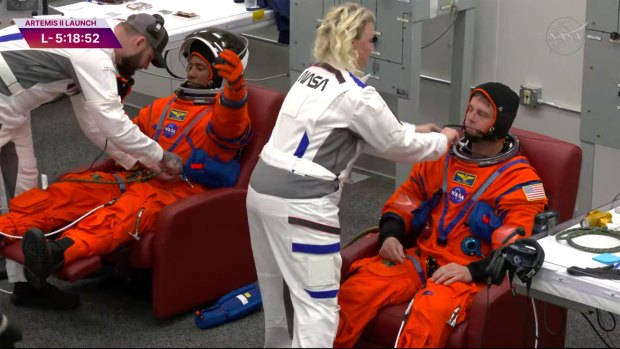 NASA astronauts Victor Glover, left, and Reid Wiseman, right get suited up ahead of their trip to the launch pad for the Artemis II mission on Wednesday, April 1, 2026. (NASA)
Time to suit up
1:05 p.m.: The four astronauts are at the Neil A. Armstrong Operations & Checkout Building are getting suited up in their orange spacesuits ahead of walkout slated before 2 p.m. and trip to the launch pad.
Rocket fueled for launch
12:51 p.m.: NASA has now reached 100% fill for all propellants for the SLS, with the last portion, the liquid oxygen for the upper stage, or interim cryogenic propulsion stage, having moved to top off operations. Both the LOX and liquid hydrogen (LH2) for both the core stage and upper stage will be maintained in replenish mode until launch.
Weather looking good for launch
12:45 p.m. Space Launch Delta 45’s weather squadron kept its forecast at 80% chance for good conditions during the launch window.
“We are watching some precip that is making its way toward the pad, but we expect that that is going to dissipate as get closer to our window,” said Artemis Launch Director Charlie Blackwell-Thompson.
“Really good to hear the crew’s voices and talk through the day-of-launch ops. You know it’s something we simulate, but there’s nothing like the real day.”
Fueling update
12:03 p.m. Both the liquid hydrogen and liquid oxygen propellants in the SLS core stage have been filled and are now in replenish mode, which means gas will be added as needed through launch. The upper stage, or interim cryogenic propulsion stage (ICPS), had its LH2 filled to 100% while work continues to load the LOX.
The LH2 is kept at -423 degrees Fahrenheit and the LOX at -297 degrees Fahrenheit. The core stage 733,000 gallons of propellant and the ICPS has 22,000 gallons. That includes for the core stage 537,000 gallons of LH2 and 196,000 gallons of LOX. The ICPS has a bout 17,000 gallons of LH2 and 5,000 gallons of LOX.
Lots of folks will see the Artemis launch
11:51 a.m.: NASA posted a visibility map for just where people might catch a glimpse of the SLS rocket after launch.
People looking up from South Florida up to the Carolina coast should be able to catch a view.
Can you see our Moon rocket lift off from your backyard?
Skywatchers in Florida and southern Georgia will have a shot. Check out this map to see when you should look up! Artemis II is targeted to launch no earlier than April 1. pic.twitter.com/3WsJlEVufK
— NASA (@NASA) March 31, 2026
News on fueling
11:45 p.m.: The SLS core stage has all of its propellant and the liquid hydrogen is at 100% on the upper stage with only the liquid oxygen remaining to be filled on the upper stage, the interim cryogenic propulsion stage (ICPS).
Looking good
11:09 p.m.: The most problematic propellant on both the Artemis I mission in 2022 and wet dress rehearsal earlier this year for Artemis II had been liquid hydrogen (LH2). But there has been no sign of any leaks during filling today of the SLS rocket. Both the core stage and the upper stage, the interim cryogenic propulsion stage (ICPS), have now reached 100% fill. The core stage liquid oxygen continued to be under fast fill operations, at 93%, while the ICPS LOX is getting ready to begin slow fill.
— John Kraus (@johnkrausphotos) April 1, 2026
Moon to moon
11:04 a.m.: Satellite High School grad and now NASA photographer John Kraus posted to X a photo of the SLS rocket and Orion spacecraft backed by a near full moon shot early Wednesday, April 1.
Kraus had been hired by NASA Administrator Jared Isaacman for his personal trips to space, Inspiration4 and Polaris Dawn, before following Isaacman into the agency after his confirmation last December.
Dominick here to watch launch
10:45 a.m.: NASA astronaut Matthew Dominick, a member of the Crew-8 mission to the International Space Station, was on hand at the press center at Kennedy Space Center. A commander in the U.S. Navy, Dominick’s astronaut name badge sports a yellow border, just as two of the four members of the Artemis II crew. That includes commander Reid Wiseman and pilot Victor Glover, both Navy test pilots before they joined NASA.
Dominick smiled when asked about Navy vs. Air Force astronauts said “check the stats. There’s have been far, far more” naval aviators in the astronaut corps. He referenced the first man on the moon Neil Armstrong telling an interviewer that all but one of the Apollo moon landing commanders was from the Navy, and that they had him train the one from the Air Force.
“Don’t quote me, quote Neil,” Dominick said.
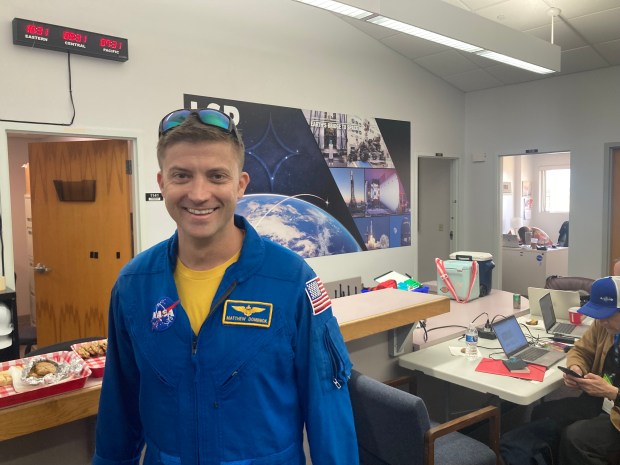 NASA astronaut Matthew Dominick was on hand at Kennedy Space Center’s press center on Wednesday, April 1, 2026. (Richard Tribou/Orlando Sentinel)
Core update
10:35 a.m.: Propellant load of liquid hydrogen (LH2) reached 100% after fast fill operations on the core stage. The core stage liquid oxygen (LOX) fast fill was at 70% while LH2 fast fill on the upper stage, the interim cryogenic propulsion stage (ICPS), was at 71%, and LOX fill on the ICPS had yet to start. Once the propellants reach 100%, they will move to topping off and then replenish mode to keep the rocket completely fueled until liftoff.
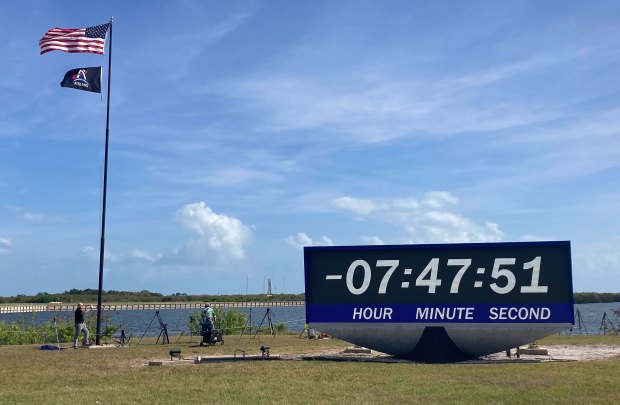 The countdown clock ticks down on launch day Wednesday, April 1, 2026 as NASA tries to get its Artemis II mission of the ground. (Richard Tribou/Orlando Sentinel(
Propellant load
9:52 a.m. Propellant load has moved to fast fill of liquid hydrogen (LH2) for the upper stage, the interim cryogenic propulsion stage (ICPS). Slow fill of liquid oxygen (LOX) into the ICPS continues, while fast fill of both LH2 and LOX on the core stage also continues.
9:51 a.m. The Space Launch Delta 45 weather squadron’s L-1 forecast states there is an 80% chance for good launch conditions.
“Forecast Discussion: Moisture trapped in the low levels of the atmosphere will be continually replenished with breezy onshore flow over the next several days, yielding intermittent showers across the Atlantic pushing onshore, with additional development over land during the afternoon hours. Afternoon shower activity is likely to be further enhanced with the daily afternoon passage of the seabreeze, where an isolated thunderstorm may also form,” it states.
Artemis II countdown to launch and moon mission timeline
“The bulk of organized shower activity should then retreat to the west side of the Florida peninsula each evening, with lingering showers also across the Atlantic. Thus, the main weather concerns for launch opportunities this week are the extent of showers and their associated clouds as well as continued breezy onshore winds.”
9:36 a.m.: Propellant load for the upper stage of SLS, the interim cryogenic propulsion stage (ICPS), is beginning with teams chilling down the liquid hydrogen. The ICPS, like the core stage, has both liquid hydrogen and liquid oxygen, which will be used to power its lone RL-10 engine. The ICPS has a bout 17,000 gallons of LH2 and 5,000 gallons of LOX.
9:25 a.m.: NASA astronauts Reid Wiseman, Victor Glover, and Christina Koch, along with Canadian Space Agency astronaut Jeremy Hansen had their wakeup call at 9:25 a.m. They will head to the Operations & Checkout building later this morning to suit up before their trip out to the pad before 2 p.m.
9:04 a.m. Fueling switched to a fast fill of the cryogenic liquid hydrogen into the core stage of the SLS having completing the initial slow fill phase used to make sure there are no leaks.
8:45 a.m.: The SLS core stage liquid hydrogen tank switched from slow fill to fast fill.
8:35 a.m.: The slow fill of two cryogenic propellants began on the SLS core stage. The core stage has a combined 733,000 gallons of the super-cold fuel used to power the four RS-25 engines at the core stage base at liftoff. It has about 537,000 gallons of liquid hydrogen and 196,000 gallons of liquid oxygen.
Combined, the core stage with two solid rocket boosters give the SLS 8.8 million pounds of thrust at liftoff.
When it launches, the four astronauts will be traveling on the most powerful rocket to ever launch humans.