
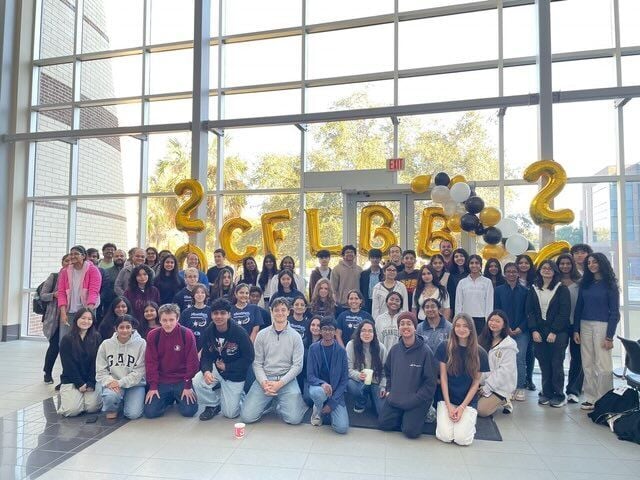

High school students in the UCF Psychology building on Feb. 7 during the 2026 Central Florida Brain Bee competition. “It was a pretty intensive experience and we’re kind of reliving the memory together,” Selena Shen said, first-place winner and junior at Pine View School.
Courtesy of Nadire Gencoglu
The student-led chapter of the Neuroscience Alliance at UCF brought together gifted high schoolers from around Central Florida to test their neuroscience knowledge for a chance to compete in the national Brain Bee competition in February.
The Neuroscience Alliance is made up of UCF students interested in pursuing careers in neuroscience. Through events like Brain Bee and lectures, they promote research, awareness and opportunities in neuroscience.
The UCF Brain Bee, also known as the Central Florida Brain Bee, is part of a national competition dedicated to inspiring high school students to pursue careers in neuroscience and includes poster sessions, exam competitions and workshops for both parents and students.
UCF students in the organization volunteer at high schools by teaching students about their knowledge of neuroscience, as well as including the university’s own neuroscience-specific biomedical science professors.
Nadire Gencoglu, junior biomedical science major, is the event manager for Brain Bee. Gencoglu said that, along with the college readiness workshops, they also host UCF guest speakers.
“This year, while the students were taking their competition exams, we had a college readiness workshop for the parents,” Gencoglu said. “And then we also had three guest speakers: we had a neuroscientist, we had a neurologist, and then we had another neuroradiologist.”
The UCF Brain Bee gathers volunteers to recruit students in high school for the Central Florida Brain Bee, speak with their teachers to have them become faculty sponsors and host the event in February at the high school.
“We come to their schools to do weekly teaching sessions with them,” Gencoglu said. “We teach them, then they study, we give them study materials and then we have a competition on that day.”
The competition is made up of three phases: a written exam, a brain anatomy exam and an oral exam. Only the top 10 students make it to the last phase of the competition.
Fatima Alziyad, senior health sciences major, is the education manager for Brain Bee. Alziyad said that her favorite part of the process is compiling the information she teaches to the students and creating the exam for the competition.
“I get to create all the education material that the students are working on every week, so we have volunteers that go out every week and I make the activities,” Alziyad said. “We go through two chapters a week from the Brain Bee book and a brain fact book that they go through.”
The main goal is to bring accessible neuroscience education to high school students who may not have the opportunities, or know that they have opportunities to do so, Alziyad said.
“It was honestly perfect because I like to teach, I like to help out the community and it was working directly with the community, but it’s also doing it for free and that’s the most beautiful part,” Alziyad said. “Having accessible information – you don’t have to be rich to join this competition, anyone can do it.”
When planning to recruit high school students, the team makes sure to look for schools that may not be as well-off to branch out and give students of all backgrounds the chance to learn about neuroscience, Alziyad said.
“I remember last year when we were planning what high schools we were going to go to, we were like maybe we should not just focus on the big high schools in Orlando, like the big funded ones,” Alziyad said. ”We really focus on going to areas that are not as well funded and I think that’s what made it more rewarding.”
Andrei Nesterenko, senior neuroscience major and executive of Brain Bee, said how much the team supports each other throughout the big event and how important cooperation is regarding running an event like Brain Bee.
“The teamwork aspect is huge because we do have a team of six people and it’s very important that everyone does their specific jobs,” Nesterenko said. “We’re all very good at supporting each other and taking responsibility and taking accountability. This year was incredibly smooth going for us.”
Clara Martins de Bellis Silva, junior at Horizon High School and first-place poster winner, said the Brain Bee has helped her envision her future career plans and share experiences with her peers.
“Since I want to go to a more neuroscience field, I think that the Brain Bee has not only allowed me to meet a lot of people who are sharing the same ambition as me, but also just share the research that I’m doing and truly see what’s out there,” Martins de Bellis Silva said. “They do have a lot of opportunities that are out there, it’s been pretty cool and it’s definitely helped me with truly envisioning my future a bit more.”
Martins de Bellis Silva’s research has to do with the differences in the effects of matcha and coffee on the brain and uses fruit flies as her test subjects. She presented her research during the poster session of the Brain Bee and won first place.
“My favorite part about the research is getting to be hands-on with it,” Martins de Bellis Silva said. “These past few years I’ve done research with fruit flies so they’ve just been in my house for a couple of weeks and just getting to really get that experience firsthand has been really nice.”
Brain Bee has allowed her to come out of her shell and meet like-minded, bright people all interested in the neuroscience community, Martins de Bellis Silva said.
“I’d say I mean in terms of impact like it’s definitely changed who I am as a person,” Martins de Bellis Silva said. “I tend to be more introverted in school but when you’re out there and you’re talking to people about something, I truly love it.”
This year’s first-place winner of the Central Florida Brain Bee, Selena Shen, junior at Pine View School, based her research on tinnitus and how hearing affects certain parts of the brain.
“I just figured that because I’m a musician I’ve always been pretty inclined towards the hearing sense and learning about it in the Brain Bee, I was pretty fascinated by how physical of a process it was with the air waves being transduced into electrical signals,” Shen said. “I was curious about what happens when it goes wrong.”
Being able to hear from guest speakers during the competition, including UCF professors, was a highlight of her experience in Brain Bee, Shen said.
“My favorite part of the competition was definitely to hear from the guest speakers,” Shen said. “There were two UCF professors who talked about their neuroscience research and there was also a neuroradiologist who came in so it was pretty eye-opening to see the different careers in such specific fields.”
Brain Bee not only uplifts bright and eager high school students, but it also manages to give them a sense of what their futures are going to look like if they pursue their passions, Alziyad said.
“I see amazing futures for them,” Alziyad said. “They’re already 15, 16-years-old and they already know all this information. I definitely see them doing something huge in their life and they’re very passionate.”