
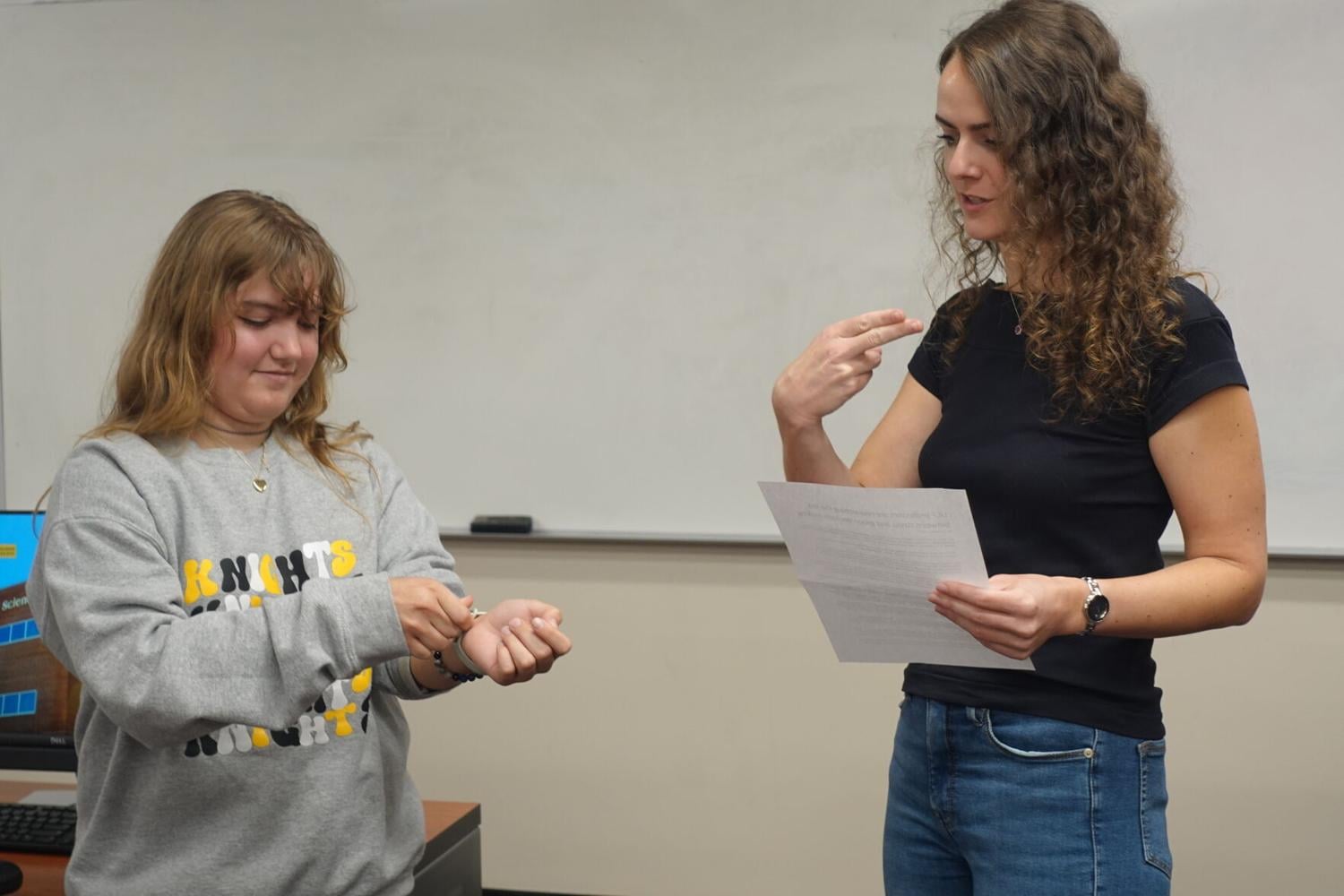

Ellie Prohaska, research assistant, and Maren Mainx, graduate student and research assistant, give a demonstration on how to put on the wristband for the “eACM Foraging” experiment in the experiment room on Monday.
Christopher Diaz
Closed blinds, a wall of shelves and two desks with chairs are all that is in the office of associate professor Dr. Jacopo Baggio. A minimal space, representative of minimal stress levels, a topic he is currently researching.
Baggio, who works in the School of Politics, Security and International Affairs, said his research covers decision-making and stress — and how they interlink.
“We do not have a technology problem; we do have a social behavioral, political and economic problem, and that is what we’re trying to solve,” Baggio said.
Baggio and Dr. Kelsey Larsen, associate professor in the School of Politics, Security and International Affairs, are researching how stress arousal affects group decision-making. The research began at Utah State University in 2015.
Baggio said he and his colleague were working on understanding how cognition affects a group’s ability to manage resources.
They were focused on “non-excludable but rivalrous resources,” meaning a resource with open access. However, one’s use of the resource may affect the larger group’s use of the resource. They found that understanding the system is important, but if a person is unable to communicate well, they will not perform well. Baggio brought this project with him when he began teaching at UCF in 2018.
“At the same time, one part of this is being understudied is really the link between individual cognition and group decisions when it comes to shared resources,” Baggio said.
Dr. Jacopo Baggio reviews the web platform being developed from his experiment Monday afternoon in the experiment room. This platform allows users to determine factors that are causing individuals stress and how that affects group dynamics.
Christopher Diaz
In March 2024, Baggio and Larsen received a $347,829 grant from the Decision, Risk and Management Sciences Program of the U.S. National Science Foundation. Using this grant, they created an evolution of the original project from Utah State, this time adding the element of stress arousal.
The in-person research sessions involve taking surveys and “participating in a resource management simulation game similar to Pac-Man while wearing a ‘Fitbit’ comparable bracelet (EmpaticaPlus bracelet) that will gauge your stress levels,” according to an announcement Baggio and Larsen sent to professors encouraging student recruitment for the experimental session.
Maren Mainx, graduate student of security studies, is an assistant to this project. She said what makes this research unique is that they are not just collecting survey answers, but also physiological data. Mainx said they can study the difference between what participants report and the physiological changes that occur. Recruitment for the research began in Fall 2025, and Mainx said they expect the study to stretch into Summer 2026.
Baggio said the data they collect is being added to a web platform. He said the data will be “integrated into a teaching module” that will allow anyone to assess team dynamics and ways to reduce stress arousal of individuals. Within the platform, students can play with friends or bots with predetermined behaviors.
While this may not be the final version of Baggio’s original project, he feels the factor of stress arousal was the key element missing before. By researching stress arousal and group decision-making, Baggio hopes to address the communication problem identified in his original project.
“If we can’t create shared interests or shared common goals, then we wish to nullify the advances when it comes to actually making decisions that affect wider strands of population,” Baggio said.