
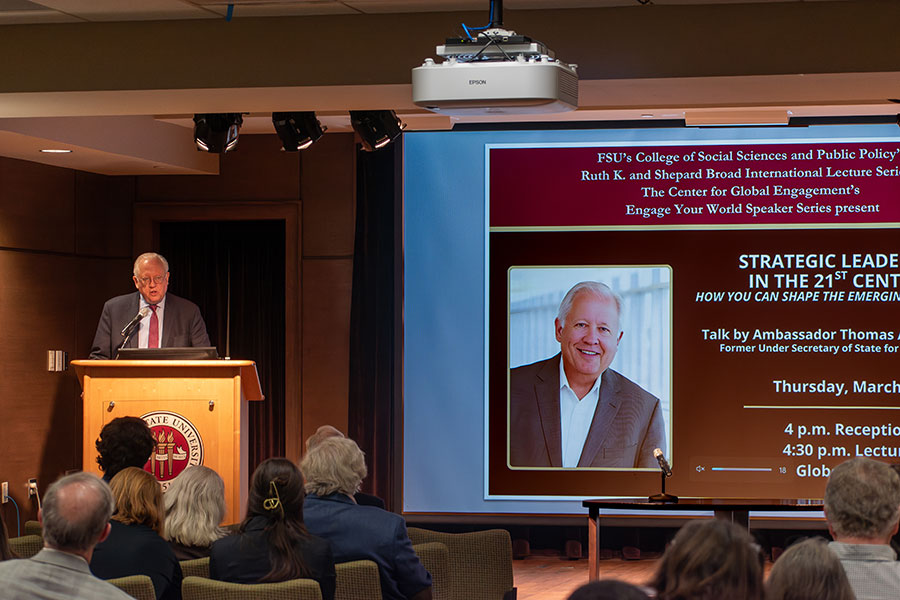
 Ambassador Thomas A. Shannon, the former Under Secretary of State for Political Affairs, delivered the lecture “Strategic Leadership in the 21st Century: How You Can Shape the Emerging Global Order” March 26 at The Globe Auditorium. (Jalisa Redding/Center for Global Engagement)
Florida State University welcomed the former Under Secretary of State for Political Affairs for a lecture last week, where he spoke to students, staff and faculty about the shifting global order and opportunities to shape future paradigms.
Ambassador Thomas A. Shannon, Jr. delivered the lecture “Strategic Leadership in the 21st Century: How You Can Shape the Emerging Global Order” March 26 in the Globe Auditorium as part of the Center for Global Engagement’s Engage Your World Speaker Series and the College of Social Sciences and Public Policy’s Ruth K. and Shepard Broad International Lecture Series.
“I wanted to speak to all of you, especially as students, about the kind of world that you’re going to be sailing into and the kind of impact you can have in that world,” Shannon said.
Shannon’s diplomatic career spans nearly 35 years, from 1984 until his retirement in February 2018. Before his term as Under Secretary of State for Political Affairs, he held positions including U.S. Ambassador to Brazil and Assistant Secretary of State for Western Hemisphere Affairs.
The Under Secretary of State for Political Affairs, the third-ranking position at the State Department, reports to the Secretary of State and is responsible for directing the day-to-day operations at the Department of State, including managing international crises and U.S. foreign policy. Shannon served in this role from 2016 until his retirement in 2018. While in this role, Shannon helped manage the 2017 presidential transition and led bilateral and multilateral foreign policymaking and implementation.
Having served in multiple presidential administrations and embassies, Shannon offered insight into what he calls a “transformative” global era and challenged audience members to consider their place within it.
“The nature of this moment means that we are capable of changing the world around us,” he said. “We’re capable of rethinking our national political purpose, but also how we project ourselves into the world.”
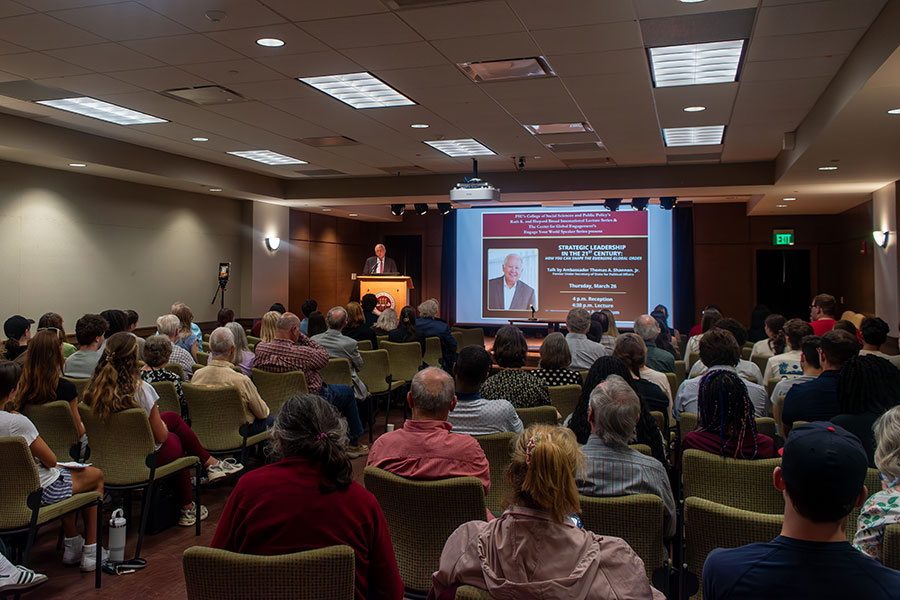 Ambassador Thomas A. Shannon, the former Under Secretary of State for Political Affairs, delivered the lecture “Strategic Leadership in the 21st Century: How You Can Shape the Emerging Global Order” March 26 at The Globe Auditorium. (Jalisa Redding/Center for Global Engagement)
Shannon argued that while states are central to the global order, societies and cultures will play an increasing role in defining the future.
“A country like the United States, which is really one of the few global countries in the world, not just cosmopolitan, but global, is uniquely positioned to take advantage of this kind of environment and uniquely positioned to be able to communicate beyond our frontiers,” he said. “Not just government to government, but society to society and people to people.”
Shannon also cited technology as the medium for driving global engagements, maintaining that the ability to evolve with these changes will determine state success.
“With the kinds of dramatic technological advances we’re going to see today, lack of access or inequality is going to become a defining feature of almost all political dialogue and engagement,” he said. “The successful politicians and the successful countries are going to be those that empower societies, empower individuals, and that open access to the kinds of changes that we’re going to see in the world.”
He emphasized that future generations have a responsibility to both answer and shape the world’s shifting demands.
“It doesn’t matter where you are. You could be a hermit living in a cave with a goat, and the world is going to come and find you, and it’s going to ask you to participate in this larger effort,” he said. “You are going to be called upon. People are going to want to know what you think. People are going to want to know how things should be resolved. And this is an opportunity that is rarely given.”
After the lecture, Shannon sat down with Mark Schlakman, the senior program director for the FSU Center for the Advancement of Human Rights, to answer questions about current affairs and the United States’ interests.
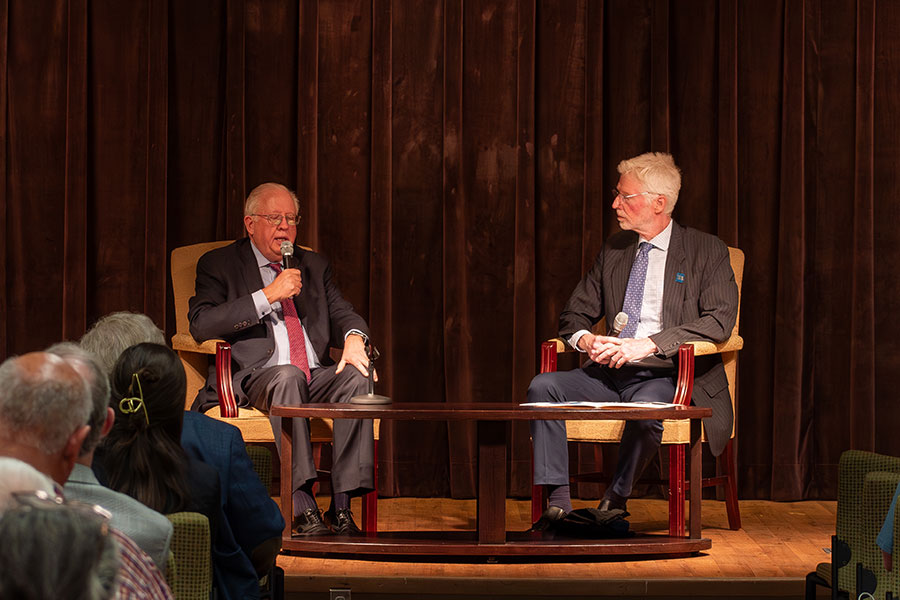 Ambassador Thomas A. Shannon (left), the former Under Secretary of State for Political Affairs, sits down with Mark Schlakman (right), the Senior Program Director for the FSU Center for the Advancement of Human Rights, for a question-and-answer session following his lecture Thursday, March 26, at The Globe Auditorium. (Jalisa Redding/Center for Global Engagement)
“I want you to understand that there is a significant shift taking place in how the president and his party are thinking about the U.S. position in the world, and what it is we need to be focused on, and how we need to be protecting it,” Shannon said.
Shannon’s lecture served as both a lesson and a roadmap to students as they prepare to navigate an interconnected world.
“This is not a time to be fearful,” he said. “This is not a time to be doubtful. This is a time to understand that we are in a moment of change and that this change is going to be profound. It’s not only going to be profound for our nation. It’s going to be profound for how we relate to the world and therefore, how the world progresses.”
For more information about the Center for Global Engagement, visit their website at cge.fsu.edu. To learn more about the Center for the Advancement of Human Rights, visit their website at cahr.fsu.edu. For more information about the College of Social Sciences and Public Policy, visit their website at cosspp.fsu.edu.