
Health-related research demonstrates undergraduate student role in FSU Health
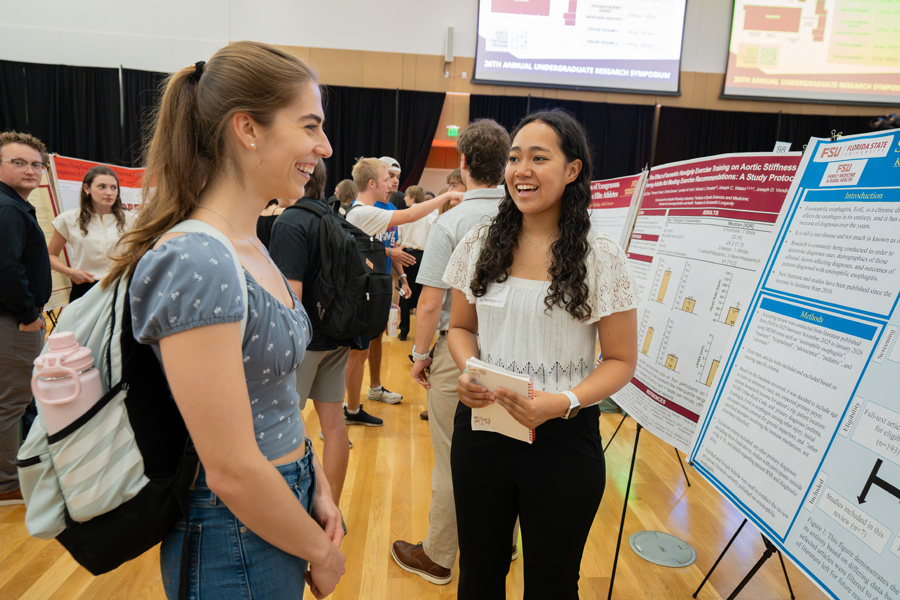
A record number of students participated in Florida State University’s annual spring symposium for undergraduate researchers, hosted by the Center for Undergraduate Research and Academic Engagement (CRE) on April 1 in the Student Union Ballrooms.
More than 800 undergraduate students from across the university showcased their research projects at the 26th annual event, which included over 600 poster projects and creative presentations and attracted nearly 2,000 attendees from the FSU community and beyond.
“We’re proud for FSU to host one of the largest university-wide undergraduate research events of this kind,” said CRE Director Latika Young. “This is the culmination of so much impressive student work, representing a wide variety of disciplines and hundreds of examples of mentors sharing their wisdom and guidance with our students.”
Those presenting at the event have worked under the guidance of a faculty, postdoctoral or graduate student mentor to pursue a research or creative project. That research is supported by the Undergraduate Research Opportunity Program, the Honors in the Major program, Directed Individual Study within academic programs and other opportunities.
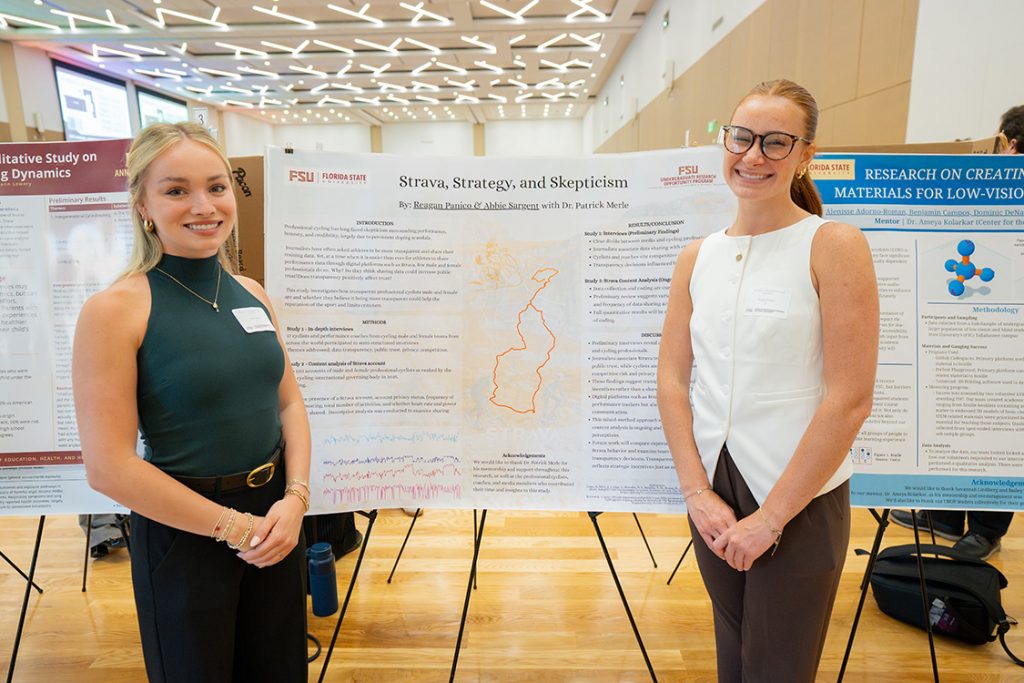 From left, clinical professions student Abbie Sargent and interdisciplinary medical sciences student Reagan Panico. (Brittany Mobley/Division of Undergraduate Studies)
Interdisciplinary medical sciences student Reagan Panico and clinical professions student Abbie Sargent conducted research through the College of Communication & Information about professional cycling by looking at trends around the use of the workout tracking app Strava.
With their mentor Patrick Merle, professor and director of FSU’s School of Communication, Pancio and Sargent analyzed habits and perspectives around sharing personal data such as power and heart rate.
“I am so grateful to have worked with my mentor, Dr. Merle, and my partner, Reagan Panico, to create such a great research project,” Sargent said. “I learned how to properly communicate and reach out to professional cyclists, coaches and media around the world to conduct successful interviews to learn their perspectives on data transparency.”
In a year that saw many exciting developments for FSU Health, which brings together researchers, educators and clinical partners under one umbrella to transform health and health care in Florida, the symposium highlighted the robust undergraduate student engagement in health research.
Student researchers tackled real-world, health-related problems, exploring topics such as how to improve localized drug delivery through microvessels and small arteries with the help of magnetic nanoparticles and identifying which cellular conditions tend to produce more positive outcomes for those with spinal cord injury.
Cell and molecular neuroscience student Davion Slocum conducted research examining the cognitive markers that could support earlier detection and diagnosis of Alzheimer’s disease. His interest in the subject comes from personal experience as a volunteer in an organization called Perfect Pair, where he is paired with a resident in an assisted living facility who has Alzheimer’s disease.
“Seeing the difficulties of dealing with that, I wanted to learn the behind the scenes of why he can’t do these things, what is it that’s causing him to be like this,” Slocum said. “That’s why I chose to do all of this.”
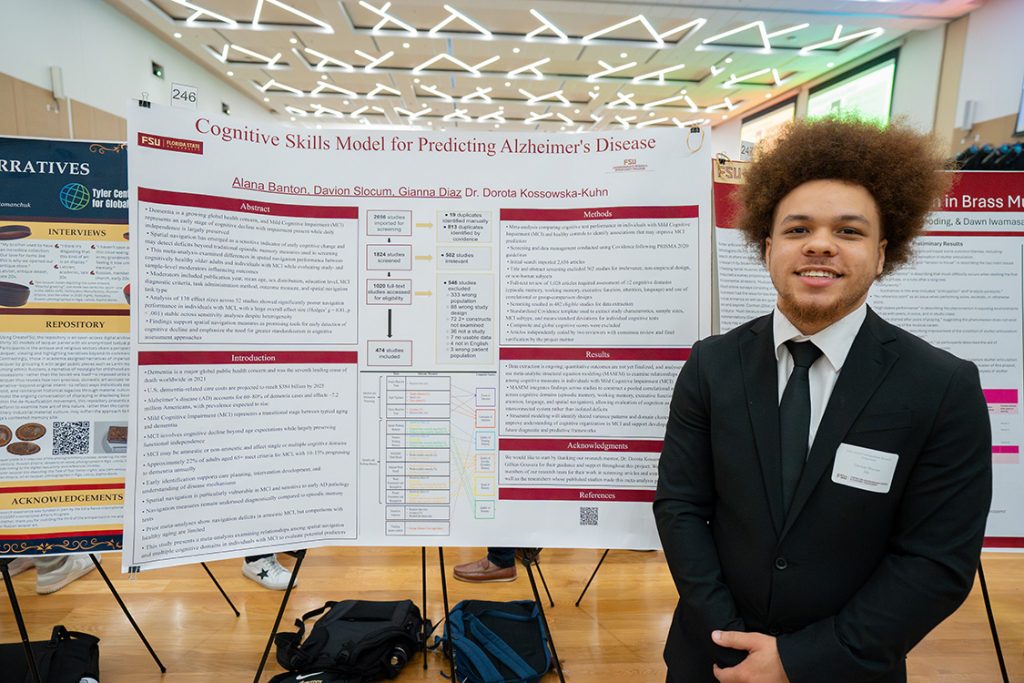 Cell and molecular neuroscience student Davion Slocum. (Brittany Mobley/Division of Undergraduate Studies)
Beyond health-related research, student presentations represented a vast array of interests and fields. Alongside their mentors, students examined post-disaster debris management, the effect of private equity firms entering the accounting industry, the use of generative AI in academic settings, the influence of the ballet “Swan Lake” in contemporary pop culture and hundreds of other topics.
“I’m so impressed by our students’ curiosity, work ethic and collaborative abilities, which are demonstrated in this event,” said DeOnte Brown, dean of Undergraduate Studies. “Thanks to the time and energy of our faculty, postdoctoral and graduate student mentors, so many of our students get to engage in the transformative learning experience of research during their undergraduate years. I’m grateful to the CRE for coordinating this extraordinary opportunity for students to present their work and share what they’ve explored and discovered with a wider audience.”
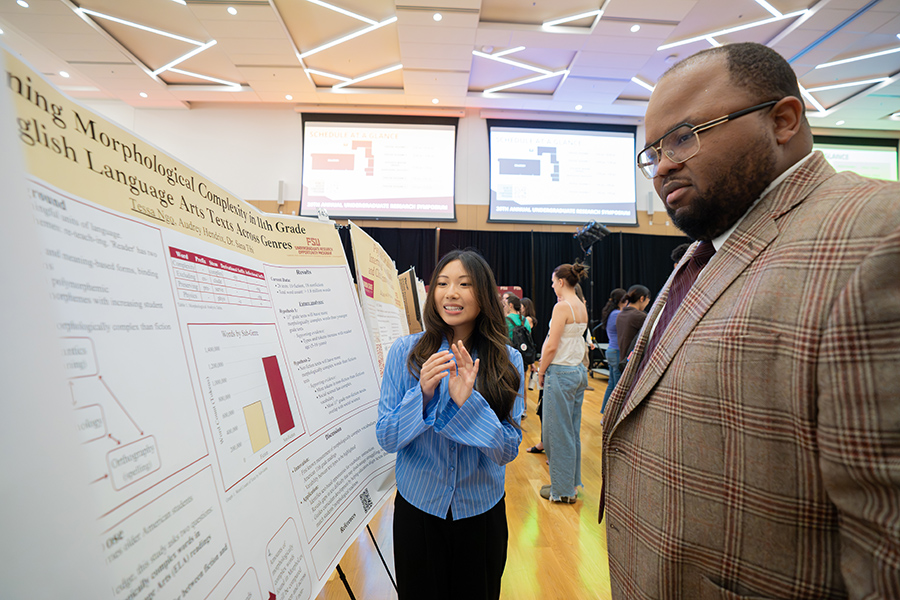 DeOnte Brown, dean of Undergraduate Studies, listens to a student presentation at the symposium. (Brittany Mobley/Division of Undergraduate Studies)
Students also participated in creative inquiry, with five presentations taking place during a lunch-hour Nourishing Creativity event. That included anthropology and studio art student Raven Watkins, who shared her stop-motion animation informed by her research about the Spanish Civil War, and architecture and design student Lucia Salvato Valiente, who presented a handmade table she designed in a style inspired by Gothic architecture.
“I’m interested in how physical environments influence the way people feel and interact, which has led me to explore the influential role of decorative arts across history,” Salvato Valiente said. “By opening a window to the past, I hope to draw connections to the present and help shape a future where design and architecture promote empathy, cultural awareness and inclusivity. Since the human factor is crucial to my work, I was incredibly grateful for the opportunity to share my designs and involve more people in my process.”