
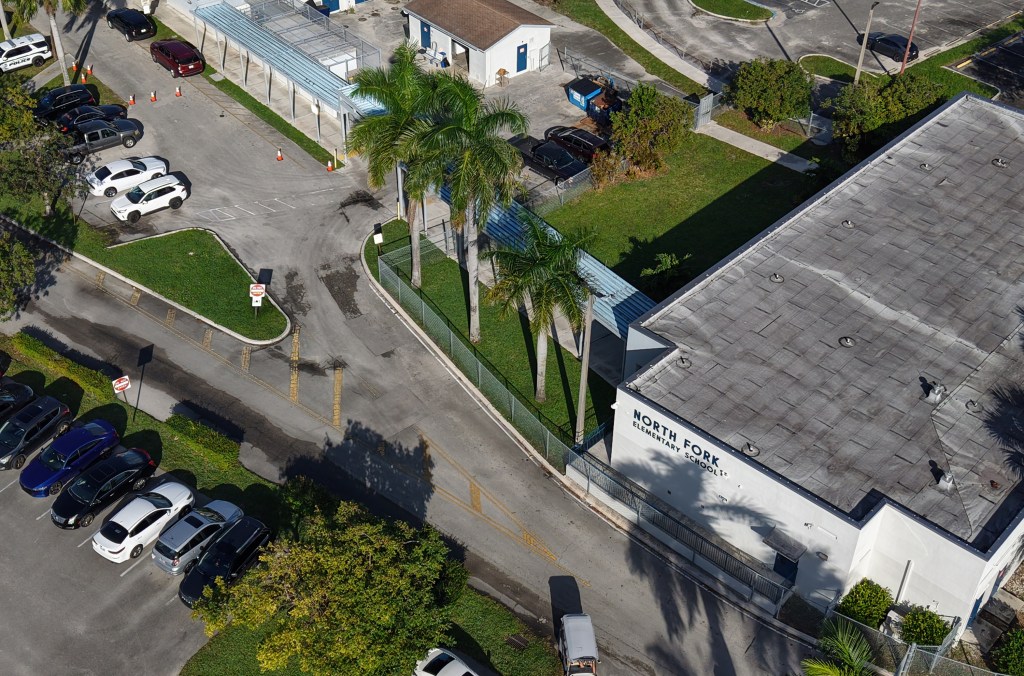
Six Broward schools scheduled to close could transform into sites for affordable housing, workforce education and school district office space, under proposals the school district is reviewing.
But a redevelopment plan for at least one of those schools, North Fork Elementary, could face some snags. The school sits in the vicinity of archaeologically significant Native American land, including burial grounds, according to a letter from the city of Fort Lauderdale. Now, the district is planning to conduct an archaeological survey.
The School Board voted in January to close North Fork, Sunshine Elementary in Miramar, Panther Run Elementary and Palm Cove Elementary in Pembroke Pines, Plantation Middle and Seagull Alternative High in Fort Lauderdale due to low enrollment. The district has been looking for how to reuse these sites as part of its initiative known as “Redefining Broward County Public Schools.”
“We know that school facilities are buildings that were erected through public funds for the best use of the public and the community,” Valerie Wanza, the school district’s chief of strategy and innovation, told the South Florida Sun Sentinel. “And so that’s what we look for in each entity. If we don’t have an immediate need to solve a district need, then we want to look at what is the next best use for the good of the community?”
A future use for Seagull could be a public safety training center, which the city of Fort Lauderdale has proposed for the site on Southwest 28th Street.
Three schools — Panther Run Elementary, Plantation Middle and Sunshine Elementary — are expected to be used for office space as the district sells or gives up leases for some of its office buildings.
The sixth closed school, Palm Cove Elementary in Pembroke Pines, may be converted into a branch campus of Sheridan Technical Center, which has its main location in Hollywood.
This could be one of two major expansions of vocational education in the district. The site of the former Arthur Ashe Middle in Fort Lauderdale, which closed in 2013, has been used both for office space and as a satellite of Atlantic Technical College, which has its main branch in Coconut Creek.
But the district has proposed moving the office staff at Arthur Ashe to other schools and expanding the technical college.
While the district has been largely shrinking, vocational high schools and colleges have remained popular, and they generate revenue from tuition as well as state and federal workforce education dollars, Wanza said.
“The tech colleges have done some future forecasting, and they are desperately looking for space through this whole redefining process,” Wanza told the Sun Sentinel.
School officials have already made decisions on several of the closed schools. But they are still in discussions without outside entities for North Fork and Seagull. The School Board held preliminary discussions during a March 24 workshop and plans to hold another workshop in May.
The school district has received two formal proposals from groups that want to lease North Fork.
Junior Achievement of South Florida proposed a “Workforce Innovation Center” to teach career readiness skills for high school students throughout the district.
An organization called “Sistrunk Rising” proposed creating a “teacher village” that may include workforce training, a teacher and family resource center, an affordable housing complex and a hotel, according to the proposal. Officials from both Junior Achievement and Sistrunk said they are willing to collaborate.
“We’ve been looking at how we can turn that site not just into a reuse that only benefits what’s going on on the site, but benefits the district and the community,” Brian Johnson, a lead partner in the Sistrunk project, told the School Board on March 24.
The city of Fort Lauderdale has determined that the North Fork area is subject to archaeological requirements, according to a Jan. 29 letter City Manager Rickelle Williams sent to City Commission members.
Williams’ letter says the property is located in the North Fork New River Archaeological Zone, which contains portions of a historic camp and a burial ground for the Seminole Tribe of Florida.
“Annie Jumper Tommie, a respected Seminole matriarch, along with her family, established a Panther clan camp around 1902 near the north fork of the New River, east of today’s Broward Boulevard bridge,” the letter states. “Known as Annie Tommie’s Camp, it was the final enduring Seminole settlement within Fort Lauderdale and became a notable tourist destination, especially renowned for Annie’s innovation in crafting and selling Seminole Indian dolls, which later became a significant industry for the tribe.”
Tommie and her family were later convinced to move to the federal Indian reservation in what is now Hollywood, according to a Sun Sentinel news article from 2015. Tommie became tribal matriarch in 1924, and she died in 1946 at age 90. Her New River settlement was the last permanent Seminole camp in Fort Lauderdale, the story states.
“The location of the site within an archaeologically significant zone does not prevent or preclude alteration, demolition, or new development from occurring on the site so long as appropriate archaeological testing and/or monitoring is provided,” Williams’ letter states. “However, if any unmarked human remains are encountered during development activity, then excavation in the vicinity of the remains shall halt immediately,” and further archaeological review will be required.
Wanza told the Sun Sentinel that the district is in the process of contracting with an archaeological consulting firm to conduct the first phase of the assessment.
“One way or the other, a historical marker needs to go up, and I believe the district committed to ensuring that a historical marker was placed in the appropriate place,” she said.
But she said there could be significant restrictions if the archaeological study determines that there are areas that shouldn’t be disturbed. She said the district was not aware of the archaeological issues until recently.
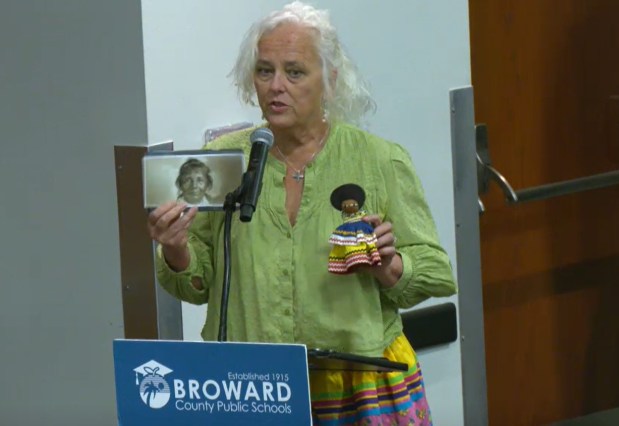 Sister Robin Haines Merrill, an artist and minister, speaks at a March 24 Broward School Board Workshop. She is holding a photo of Annie Jumper Tommie, a Seminole matriarch who ran a camp. Merrill said the school district needs to work with the Seminole Tribe of Florida related to the future use of the school, which will soon be closed. (BECON / Screen grab)
Sister Robin Haines Merrill, an artist and Christian minister who said she is working with the Seminole Tribe on this issue, told the School Board at the March 24 meeting that they shouldn’t proceed without consulting with the tribe.
“This is a burial land, so it is incredibly important that you not just talk to archaeologists, but that you talk to the rightful heirs of this land,” Merrill told the board. “They were removed. They are still alive. They are friends of mine. … You need to be speaking to them about what their wishes are for their ancestors that are buried on that land.”
Gary Bitner, a spokesperson for the Seminole Tribe, said Florida has “a very robust historic preservation program that requires sites to be identified but also allows local government to implement their own preservation ordinances. The Seminole Tribe believes preservation of Tribal burial sites is of the utmost importance.”
Wanza said, “Obviously, as a district, we will work with the Seminole tribe. The results of the archaeological study will pretty much set the stage for the entire property.”
The other major proposal discussed at the March 24 meeting was a proposed public safety training facility on the Seagull site.
The center would provide training opportunities for firefighters, police and emergency medical services workers, according to a proposal from the city of Fort Lauderdale.
Student and community education also would be provided, including CPR, defibrillator use, and first-aid training for the community, including fire and police explorer programs for high school students, exposure to careers in public safety, disaster preparedness training, public safety awareness programs and regional emergency response exercises and training, the proposal states.
A partnership with the school district for the Seagull site “would continue to benefit the public, using that public building built with public funds to continue to serve the public,” Michael Owen, assistant chief for Fort Lauderdale Fire Rescue, told the School Board on March 24. “We’re ready to negotiate those terms and design these future programs together and start creating this facility.”
Some School Board members say they are interested in pursuing the agreement.
“The public good that this serves is incredible on multiple different layers. The public safety aspect, number one. The job creation and the job training, and these are jobs that won’t be soon replaced” by artificial intelligence, School Board Chairwoman Sarah Leonardi said. “These are things that add an incredible amount of value to our community.”