
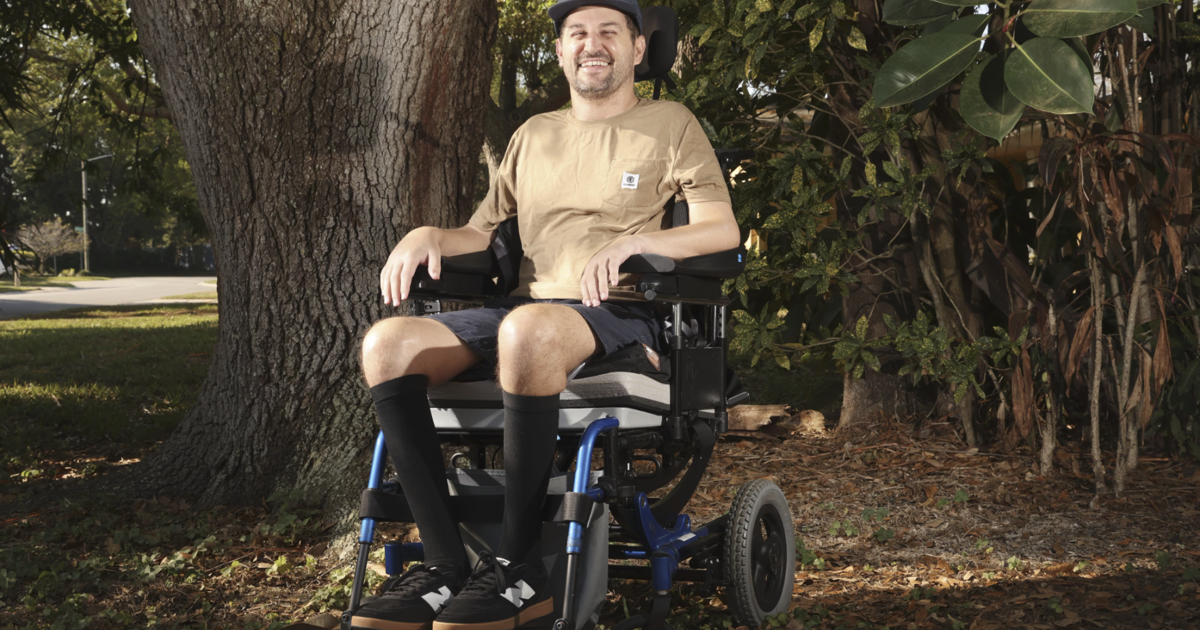
James Fernandez sat in a wheelchair in his sunny living room in Clearwater wearing the nylon shorts, flat brimmed cap and New Balances of a hiker, plus some effortlessly cool beard scruff.
The Palm Harbor Middle School science teacher who’d charmed students and their parents with his enthusiasm was surrounded by the ephemera of his world travels. There were shells, prints of snakes and birds, a stack of National Geographic magazines and a seed-pod rattle. Above that, a woven llama tapestry purchased during his fateful trip to Peru.
“It was beautiful,” he said recently.
The trip nearly killed the 42-year-old father of two, paralyzing him from the neck down. But even now he smiled with his whole face as he recalled verdant vistas of Cusco, one of the world’s highest cities. He’d been mountain biking there in December when lightning struck and caused his catastrophic crash.
Fernandez was warming up for what was coming. The following day, television news crews would arrive to interview him for the first update on his condition since returning home on March 4. That was followed by a welcome-home party with more than 100 guests.
Some of those people saw him for the first time in a while. He was clearly the same guy, but much had changed.
He remembers the ride, the beauty and the unexpected storm.
Then he remembers waking up on the ground unable to feel his arms or legs. An electrical burn covered his foot. The damage to his spinal cord had come from the unprotected fall.
His friend, Yuri Botelho, had been killed by a direct hit, and their tour guide — the only other person there — panicked and froze. The incapacitated Fernandez took charge.
“Leave,” he told the guide. “Go to where your phone gets service and get help.”
After that, Fernandez’s memories are fuzzy.
There were the struggles to breathe, surgeries, intubation, infections. There were transfers within Peru, misunderstandings over bills and a very different medical system. At one point, his father, James A. Fernandez, said officials blocked a door over a $1,400 bill.
His wife was with him for the trip with their baby. His parents flew in to help. They worked the phones tirelessly for days, seeking a medical evacuation company that would send a plane to get Fernandez home.
Though it’s a major city, flying into Cusco requires specialized training and skill due to the airport’s high altitude and location. The narrow Andean Valley brings tricky winds and a runway that can only be approached from one direction.
Fernandez’s friends, meanwhile, organized a crowdfunding campaign to help pay the massive expense of a hospital room aboard a plane. To date, the effort has raised more than $206,000.
When the family found a company that would evacuate Fernandez, they hit another snag. A medical evacuation plane won’t take off with a patient unless they’re sure there’s a hospital bed waiting on the other end. A hospital in Miami told them there was no space, that they already had patients stacked three wide in hallways.
They instead flew Fernandez to Tampa General. Then he was transferred to Shepherd Center in Atlanta, which specializes in brain and spinal cord injuries.
Since returning home, Fernandez’s wife, Alexis, and his parents, who are moving in, have been helping make the house accessible. He’ll control devices with his voice to turn on lights or set the thermostat. A digital screen with a daily calendar showed his upcoming slate of interviews.
Ramps allow him to reach the backyard where he can watch the family’s adopted tortoises, Beans and Leo, roam the wooden pen he built for them. He loves to be outside, to get some sun, to watch his children who are 8 and 8 months.
An arm attached to his wheelchair holds his phone, which he controls with his voice, “so that I can be part of the world,” he said. “Have to be able to scroll Instagram.”
He is optimistic but also accepting.
“It’s not the end,” he said. “That’s what I’d want people to know. I’m learning how to get back to what I love.
“But I think one of the things I learned at Shepherd is that I have to accept and be happy with where I’m at. That’s life in general, right? This is where I’m at right now. It could change. I hope it changes. But if it doesn’t, I have to accept and find ways to keep living, right?”
His days are very busy, filled with breathing exercises, physical therapy and occupational therapy. There are so many calls to make to insurance companies or to search for a family van that can accommodate him. Getting stronger is physically exhausting, but he’s also grieving his close friend.
He knows eventually he wants to work. He’s unsure if he can teach in a classroom again, but maybe something in education. Before he settled down as a teacher, he’d guided tours around the world. Before that, he was a zookeeper.
What he wanted out of the next year? He couldn’t quite answer.
His mother, Michele Fernandez, dug through a plastic bin filled with hundreds of cards. Many came from students.
“I need to go there and pick up the others,” she said.
“I want to go to the school to do that,” he said suddenly. “Before this school year is over, I want to go. I want to go to the school.”