
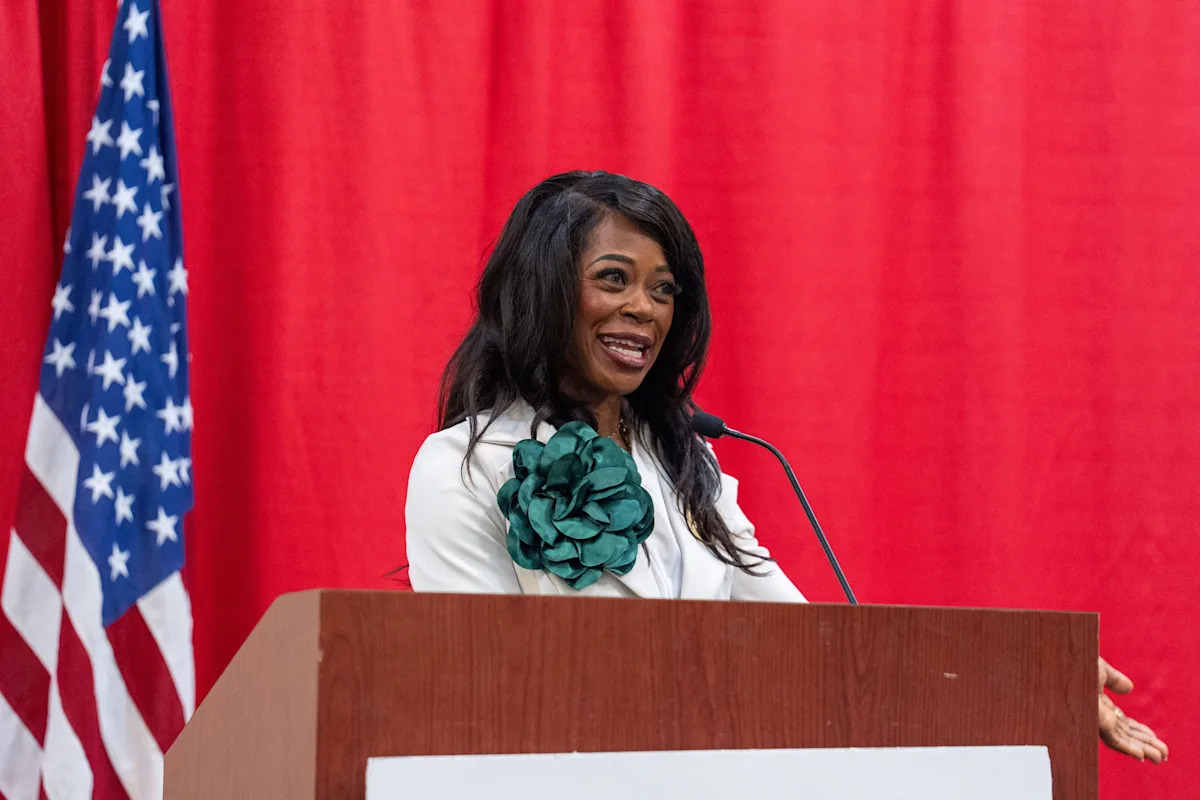
After nine months in office, Florida A&M University President Marva Johnson faced the Capital Tiger Bay Club and took the opportunity to tout FAMU’s success while reiterating some of her main goals.
Johnson was tapped by the organization – which is a nonpartisan group that brings together business, political and community leaders for discussions on public affairs and current issues – to take part in the April 3 forum.
There, she shared her insights before taking questions from members who questioned her on the critical issues of the university and her recruitment efforts.
“This is probably, in truth, the hardest job that I’ve ever had, but it’s also the most rewarding,” Johnson told the club members during her remarks, referring to the president position. She began her role on Aug. 1 amid pushback from several alumni and others in the community.
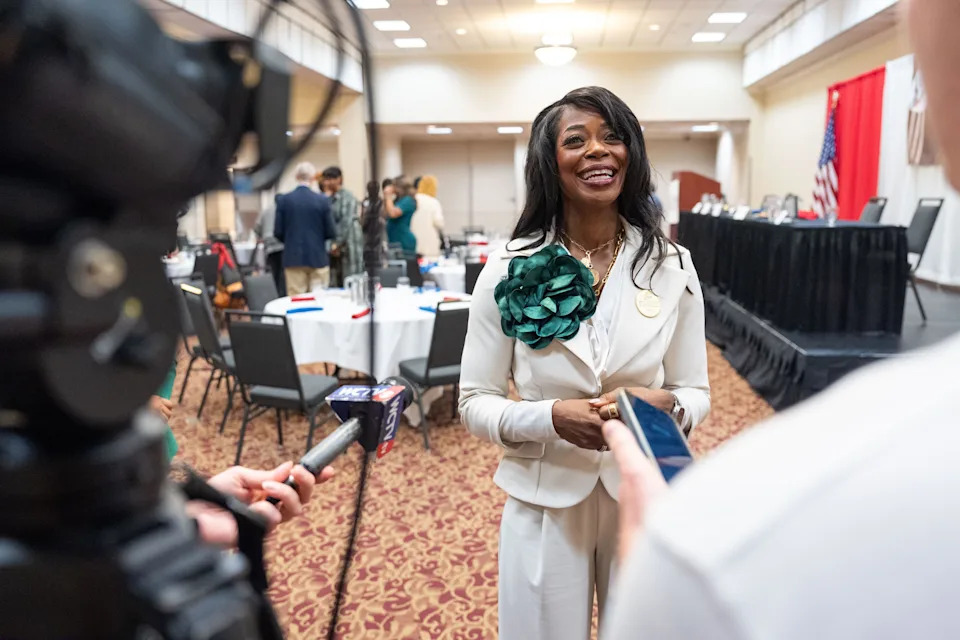
Florida A&M University President Marva Johnson answers questions from the press after speaking at a Capital Tiger Bay Club luncheon on Friday, April 3, 2026.
Talethia Edwards − a FAMU alumna and current candidate for City Commission Seat 3 who has championed southside communities for years as an activist − introduced Johnson at the event, and Johnson publicly thanked Edwards for her “constructive” and “useful” feedback when she began the presidential journey.
Among those who accompanied Johnson during the Friday forum were Special Assistant to the President and Advisor for Intercollegiate Athletics Angela Suggs, Vice President of Government Relations Michelle Robinson, Chief of Staff Carmen Cummings-Martin, Chief of Police Audrey Alexander, Vice President of Chief Marketing & Communications Officer Alonda Thomas and Executive Assistant Nicole Schloss.
Besides FAMU’s main heralded accomplishments such as being ranked the No. 1 public HBCU in the nation for seven consecutive years by U.S. News & World Report, Johnson says “not one of them tells the complete story” of FAMU.
“I want to adjust a few views − maybe of some of you in the audience… to give you a little bit more firepower,” she added, “so that when you’re out being an advocate for FAMU, you can help make sure that everybody truly understands.”
Here are three main topics Johnson covered during the forum:
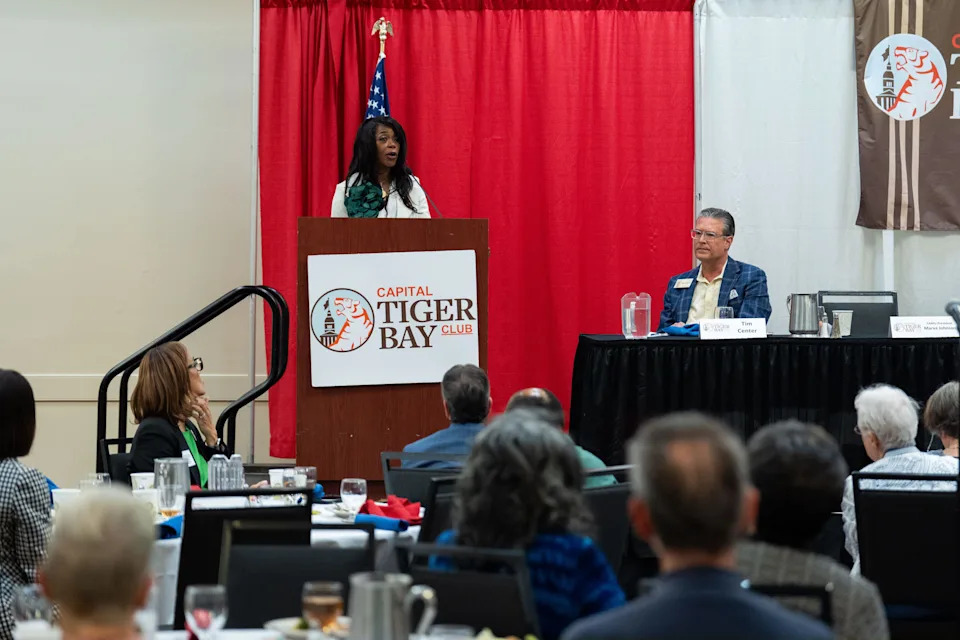
Florida A&M University President Marva Johnson speaks during a Capitol Tiger Bay Club luncheon on Friday, April 3, 2026.
FAMU graduates helping to close workforce gaps
Johnson says FAMU is one of the most direct and cost-effective solutions to what she described as the state’s “significant, measurable and growing workforce gaps in healthcare, engineering, computer science, public administration and law.”
She highlighted the passage rates of FAMU graduates across different fields, such as the 93% passage rate of nursing graduates when it comes to the National Council Licensure Examination (NCLEX) and an 89.8% passage rate achieved by the university’s doctor of pharmacy students on their licensure exam.
“FAMU’s graduates are not simply our achievement,” Johnson said. “They are Florida’s nurses, they are Florida’s pharmacists and they are Florida’s public health infrastructure.”
Regarding student recruitment to bring more scholars to FAMU, Capital Tiger Bay Club member Barney Bishop – who once sat on FAMU’s Board of Trustees – asked Johnson about if she’s had the chance to recruit first-time-in-college students to attend the university, as former presidents have done in the past.
“I have had an opportunity to do it, and it is one of the most satisfying, rewarding and inspirational things you get to do as a university president,” Johnson said. She also noted that the university usually gets an average of 20,000 applications annually, but this year, about 30,000 applications have rolled in.
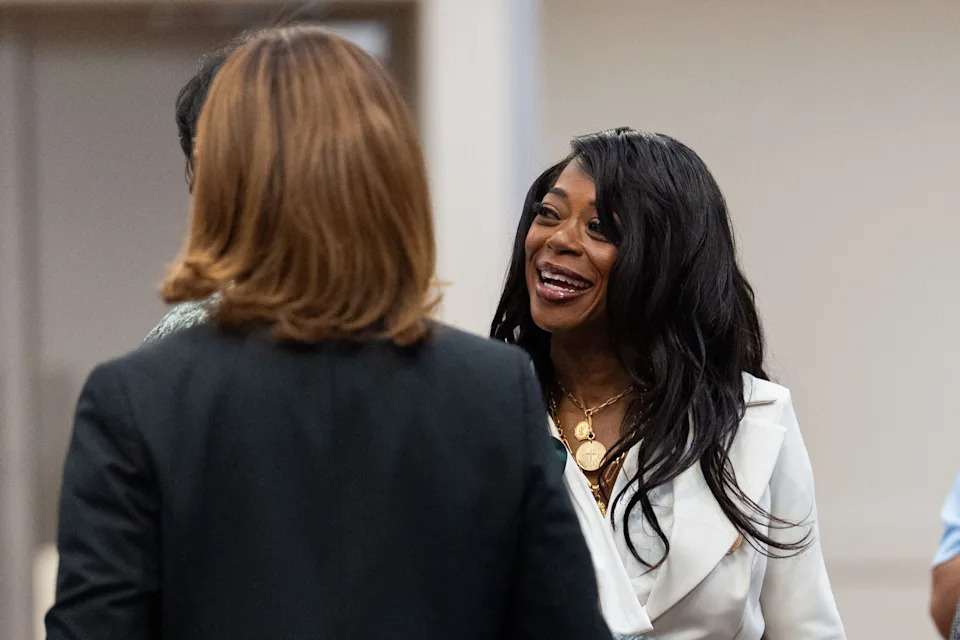
Florida A&M University President Marva Johnson, left, speaks with attendees during a Capitol Tiger Bay Club luncheon on Friday, April 3, 2026.
FAMU as an economic driver
While laying out several figures for the club members to give them a better understanding of FAMU’s role in the economy, she highlighted that FAMU’s total economic impact is estimated to be $631 million annually with 5,156 direct and indirect jobs supported by the university, according to the United Negro College Fund’s 2024 HBCU economic impact report. She also said FAMU’s research and developments expenditures exceed $70 million per year.
In addition, Johnson noted the $10 million public investment from the Blueprint Intergovernmental Agency in FAMU’s Bragg Memorial Stadium years ago that created an estimated 132 jobs and generated about $38 million in economic impact for Leon County, and how FAMU contributes to the over $30 million in annual economic impact for the state during the Florida Classic in Orlando and the Orange Blossom Classic in Miami Gardens.
Scaling resources to move faster
Following Johnson’s remarks, a Capital Tiger Bay Club member said the president is a “wonderful cheerleader” for FAMU before asking her what she would identify as critical issues and challenges that she’s dealing with at the university.
“My biggest challenge is how to scale our resources and how to push our team and optimize the resources to allow us to run faster,” Johnson said. “My secondary challenge – in order to meet that first one – is resources.”
While Florida has the lowest tuition rate for students among other states in the nation, Johnson said FAMU’s issue is that it’s not “swimming with excess revenue.” One of her goals is to diversify the university’s investment opportunities to generate more money rather than having to depend on state funding as the main source.
“We’re raising the bar on that level of accountability,” Johnson said.
Tarah Jean is the higher education reporter for the Tallahassee Democrat, a member of the USA TODAY Network – Florida. She can be reached at tjean@tallahassee.com. Follow her on X: @tarahjean_.
This article originally appeared on Tallahassee Democrat: FAMU president Marva Johnson talks university’s future